
Comparative evaluation of abortion indicators in history of patients at the Department of Pregnancy Pathology
Taits A.N., Kharbedia Sh.D., Moiseeva K.E., Zastupova A.A.
Objective: To identify the characteristics of abortion indicators in patients at the Department of Pregnancy Pathology of the Perinatal Center, who became pregnant through IVF compared with patients who became pregnant spontaneously.
Materials and methods: Patient medical data were copied from patient registration forms N003/n003 at the Department of Pregnancy Pathology of the Perinatal Center. The main group consisted of 336 patients, who conceived through IVF. The control group comprised 394 patients, who had spontaneous pregnancy. Student's t-test was used to compare the indicators between the groups. Pearson's chi-square test was used to test the hypotheses. The results were considered statistically significant at significance level of p<0.05.
Results: The incidence of abortions in first time pregnant women was statistically significantly higher in patients in the main group compared with the control group (p=0.004). Spontaneous abortions in history occurred most often in the main group, while abortions at the request of the women predominated in the control group. Statistically significant differences were found in the distribution of patients in the main and control groups by the total number of abortions in history (χ2=11.4296; p=0.044), the number of spontaneous abortions (χ2=17.12; p=0.002), abortions due to ectopic pregnancy (χ2=39.74; p=0.000), missed miscarriage (χ2=9.93; p=0.042) and legal medical abortions (χ2=39.21; p=0.000).
Conclusion: There are significant differences in the structure and prevalence of different types of abortions in patients, who became pregnant after IVF and those, who had spontaneous pregnancy. The results of the study show the need for a differentiated approach to abortion prevention, which should be determined by the characteristics of the patient's obstetric and gynecological history.
Authors' contributions: Moiseeva K.E. – the study concept and design; Taits A.N., Zastupova A.A. – data collection and analysis; Kharbedia Sh.D., Zastupova A.A. – statistical analysis; Moiseeva K.E., Kharbedia Sh.D., Taits A.N. – manuscript writing; Moiseeva K.E., Kharbedia Sh.D. – manuscript editing.
Conflicts of interest: The authors confirm that they have no conflicts of interest to declare.
Funding: The study was conducted without any sponsorship.
Ethical Approval: This type of study does not require the expertise of the local Ethics Committee.
Patient Consent for Publication: The patients have signed informed consent for participation in the study and publication of their data.
Authors' Data Sharing Statement: The data supporting the findings of this study are available on request from the corresponding author after approval from the principal investigator..
For citation: Taits A.N., Kharbedia Sh.D., Moiseeva K.E., Zastupova A.A. Comparative evaluation of
abortion indicators in history of patients at the Department of Pregnancy Pathology.
Akusherstvo i Ginekologiya/Obstetrics and Gynecology. 2026; (1): 62-69 (in Russian)
https://dx.doi.org/10.18565/aig.2025.247
Keywords
pregnant women
abortions
Perinatal Center
the Department of Pregnancy Pathology
in vitro fertilization (IVF)
spontaneous pregnancy
In the modern world reproductive health care of the nation is a key goal of the state, especially due to population decline. One of the most important challenges of the comprehensive approach to addressing this issue is implementation of effective family planning strategies [1]. Family planning includes a complex of state, medical, social and organizational measures directed to achieve desired pregnancy at the time period during which the probability of normal pregnancy resulting in the birth of a healthy child is high [2]. The leading trend in demand for family planning is abortion prevention aimed at reducing the rates of maternal, perinatal and infant morbidity and mortality [3]. It can be claimed that the development of family planning services contributes to a gradual decline in the number of abortions in Russia [4]. Despite significant advances in abortion prevention and reduction in the number of pregnancy terminations, abortion remains one of the main methods of birth control in modern healthcare practice in Russia [5]. Of particular concern is the fact that abortions among first time pregnant women account for a significant percentage – 11% of the total number of abortions in the country. In 2024, approximately 40,000 cases of abortions among first time pregnant women were registered in Russia [6], posing a serious threat to the reproductive potential in the country.
Abortions are risk factors for adverse obstetric and perinatal outcomes. The women with a medical history of abortion have increased risk to develop infertility. Currently, the prevalence of female infertility remains one of the most pressing social and medical issues [7] not only in Russia, but also in many foreign countries. According to health and social care research, approximately every fifth married couple in our country is affected by infertility. According to the estimates of some international experts, this indicator is even higher – up to a quarter of all married couples experience infertility [8]. Facing depopulation challenges, the most effective way to solve the problem of fertility includes the use of assisted reproductive technology (ART) [9], since it is believed that it can help improve reproduction of the population. IVF is the most commonly used ART technique. IVF procedures are financed by Federal Mandatory Medical Insurance Fund, and their number is increasing every year. Also, the access to ART services and healthcare quality continues to improve [10]. Thus, given a social significance of abortions affecting fertility, it seems relevant to explore the statistics of abortions among women who became pregnant by using ART compared with women who became pregnant spontaneously.
The objective of the study was to identify the characteristics of abortion indicators in patients at the Department of Pregnancy Pathology of the Perinatal Center who became pregnant through IVF compared with patients who became pregnant spontaneously.
Materials and methods
The study was carried out at the Department of Pregnancy Pathology, Perinatal Center of St. Petersburg State Pediatric Medical University, where pregnant women underwent treatment from 2018–2024. Medical data of patients were copied from patient registration forms No.003/u “Medical records of the patient receiving hospital care, day-patient care”. Confidentiality of patient information was ensured by anonymizing the created database.
Stages of the study. The first stage included selection of patients for 2 groups. The main group consisted of women who became pregnant through ART (IVF/intracytoplasmic sperm injection (ICSI), 820 observations). The control group included women who got pregnant spontaneously. The women in both groups were of similar age, marital status, and the region of residence. In the second stage, the patients in both groups were divided into the subgroups based on the type of abortion in history. The main group comprised 336 women, and the control group comprised 394 women.
The inclusion criteria were the following: reproductive age of women 15–49 years, ≥ 22 weeks of gestation, hospital stay at the Department of Pregnancy Pathology of the Perinatal Center of St. Petersburg State Pediatric Medical University, permanent residence in Saint Petersburg, availability and accessibility of medical documentation.
Additional inclusion criteria in the main group were pregnancy resulting from ART (IVF/ICSI) and abortion in history.
Additional inclusion criteria in the control group included spontaneous pregnancy, abortion in history.
Non-inclusion criteria were pregnant women at ≤22 weeks of gestation, and patients who were admitted to hospital from other regions of Russia.
Evaluation of abortions was performed using the following ICD-10 classification codes: O00-O08 pregnancy with abortive outcome, and classification codes for abortions O02-O07 containing information on termination of pregnancy (before completion of 22 weeks of gestation): О02-O03 spontaneous abortion; O04 medical abortion (legal); (therapeutic); O05 other abortion (criminal); O06 unspecified abortion (outpatient); abortion due to social reasons. In addition to evaluation of these types of abortion, the frequency of missed abortion O02.1 and ectopic pregnancy O00 (ICD-10: O02 other abnormal products of conception) was evaluated.
Statistical analysis
STATISTICA 10.0 software (StatSoft Inc., USA) was used for statistical data processing. The following quantitative data were assessed: the mean age, the mean number of pregnancies and deliveries. Assessment of qualitative data included distribution of patients by marital status, by the number of abortions in the groups; the abortion rate among first time pregnant women in the groups; the types of abortion in the groups; the frequency of each type of abortion in the groups; distribution of patients in the subgroups by the number of abortions in history depending on the type of abortion. The quantitative data are presented as median and standard deviation (М±SD). The qualitative parameters are presented as absolute values (n) and percentage (%). The Shapiro–Wilk test was used to test distribution of the numerical data. Analysis showed normal or near-normal distribution of the studied characteristics. Since the indicators in our study fit the range of distributions, further calculations were made using the parametric methods. Student's t-test was used to compare the indicators between the groups and subgroups. Pearson's chi-square test was used to analyze contingency tables. The differences were considered statistically significant at p<0.05.
Results
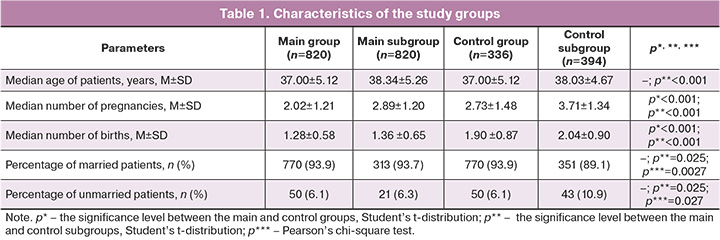
Analysis of characteristics of the groups (Table 1) showed that the median age was similar in the main and in the control groups. However, the median age of patients in the main subgroup was significantly higher versus the control group (р<0.001). In the main group as well as in the main subgroup, the median number of pregnancies and births was significantly low (р<0.001). At the same time, it was found that the percentage of married and unmarried patients was similar in the groups. However, statistically significant differences were found between the main and control subgroups in patient distribution by marital status (χ2=4.825; p=0.027).
The study showed that most women both in the main and control groups one previous abortion in history. However, their number was significantly low (р=0.008) among the patients who became pregnant after IVF (Table 2). In addition, among the patients in the main group, fewer women (р=0.015) had four or more abortions in history. Analysis confirmed statistically significant differences between the main and control groups in distribution by the number of abortions (χ2=11.429; p=0.044).
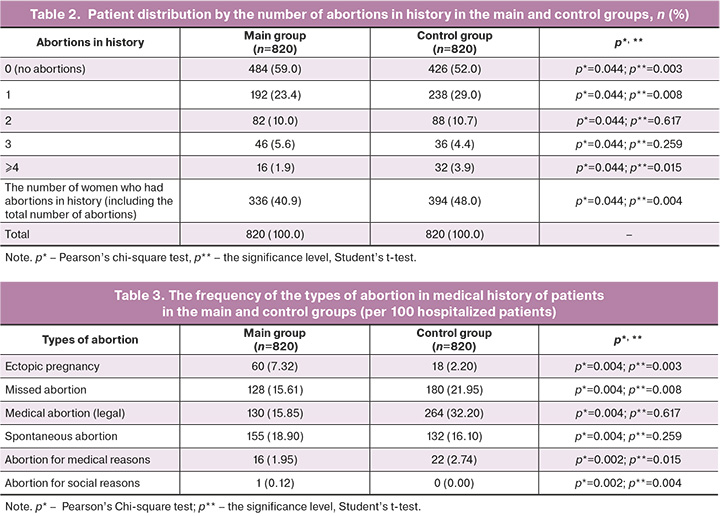
The table shows the difference between the indicators of one abortion in patients in the main and control groups. The abortion rate among first time pregnant women in the main group was significantly higher – 132/336 (39.3%) versus 120/394 (30.5%) (t=2.89; р=0.004).
Evaluation of the types of abortion in history (Fig. 1) found that the highest percentage of spontaneous abortions was among patients in the main group and accounted for almost one third of all abortions, and was significantly higher compared with the control group (p<0.001). The highest percentage of abortions classified as "O04 Medical abortion" was observed in the control group, and included both termination of pregnancy at the woman's request and due to medical reasons. The rate of medical abortions in the group of women who became pregnant through ART (IVF/ICSI) ranked second, and was 1.6 times lower compared with the control group (p<0.001). Termination of pregnancy classified as “Other abnormal products of conception (O02)” ranked third in the main group, and the percentage was significantly higher compared with the control group (p<0.001). At the same time, abortions for the same reason (O02O ranked second among women who conceived spontaneously The abortion rate classified as "O00 Ectopic Pregnancy (O00)" was 9.3 times higher in the main group versus the control group (p<0.001).
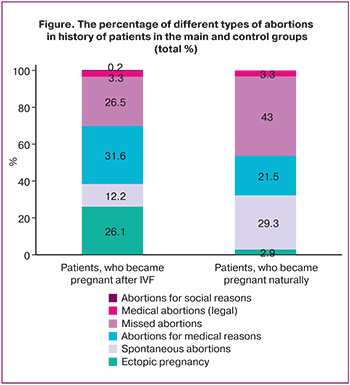
As is shown in the figure, the percentage of abortions for to medical reasons in history was similar in both groups. The reasons for abortions were fetal abnormalities. The difference between the main and the control groups in the frequency of abortions for medical reasons was not statistically significant (р=0.015) (Table 3).
Also, there was no statistically significant difference between the main and the control groups in the number of spontaneous abortions (р=0.259) and the number of abortions at the woman’s request (р=0.617). At the same time, the number of missed abortions (р=0.008) was significantly lower, and the number of ectopic pregnancies was higher (р=0,003) in the group of patients who became pregnant through ART.
Our study found (Table 4) statistically significant differences between the main and control groups in patient distribution by the number of different types of abortion in history – spontaneous abortion (χ2=17.12; p=0.002), ectopic pregnancy (χ2=39.74; p<0.001), missed abortion (χ2=9.93; p=0.042), and medical abortion (legal) (χ2=39.21; p<0.001).
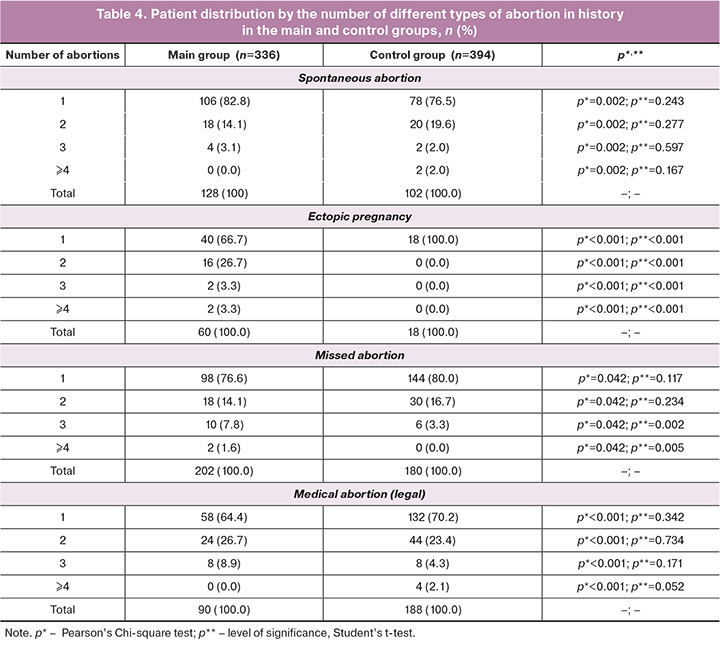
The vast majority of patients in both groups experienced one spontaneous abortion, and no statistically significant difference was found between the groups. (р=0.243). In addition, no statistically significant difference was found between the groups in the abortion rates for patients who had two (р=0.277), three (р=0.597), four or more (р=0.167) spontaneous abortions in history.
Analysis showed that there was significant difference between the main and control groups in patient distribution by the number of abortions due to ectopic pregnancy in history. The percentage of women with one abortion was significantly lower in the main group versus the control group (p<0.001). There were no cases with two, three, four or more abortions due to ectopic pregnancy among the patients in the control subgroup compared with the main group.
Evaluation of patient distribution by the number of missed abortions in history showed the following: less cases with one and two missed abortions were in the main subgroup, but the difference between these indicators was not statistically significant (р=0.117 and р=0.234, respectively). At the same time, the number of patients in the main subgroup who had three (р=0.002), four and more (р=0.005) missed abortions was significantly higher.
Evaluation of patient distribution by the number of medical abortions (legal) showed that the significant number of women both in the main subgroup and in the control subgroup previously had one abortion at the woman’s request. However, no statistically significant differences were found between the groups (р=0,342). Also, no statistically significant differences were found in the percentage of women who had two (р=0.734), three (р=0.171), four and more (р=0.052) abortions in history.
Discussion
The findings in our study provide information on the types and causes of abortions in patients who conceived spontaneously of achieved pregnancy by using ART (IVF and ICSI). The obtained results showed significant differences between the two groups in the types and frequency of abortions, that helped to gain a better understanding of abortion risks and side effects in different categories of patients. The frequency of abortions (including one, two, as well as four and more abortions) was significantly low among the patients who became pregnant after IVF compared with patients who conceived spontaneously. This could be largely due having difficulty conceiving in the main group. Moreover, the number of abortions of the total number of abortions was significantly higher among first time pregnant women in the main group.
Women who conceived spontaneously had medical abortions (legal) in history more often, that was not only due to peculiarities of their reproductive system functioning, but also due to social and psychological factors influencing the decision to continue or terminate pregnancy [11, 12].
The main reason for abortion due to medical indications in history of patients hospitalized at the Pregnancy Pathology Department of the Perinatal Center, were fetal abnormalities, that necessitated routing of pregnant women at the tertiary maternity care facility. Despite the similar percentage of abortions for medical reasons in both groups (3.3%), the absolute frequency of abortions in the main group was almost twice as high as in comparison group – 1.95 cases per 100 patients, compared with 2.95 cases in the control group. This trend was likely due to performance of preimplantation genetic testing prior to embryo transfer [8].
Miscarriages remain a relevant issue even in the context of modern medical advances and positive trend for reduction of the rates of spontaneous abortions [5]. Miscarriages are one of the main causes of reproductive losses, and their prevention is one of the ways to increase birth rates. Given the similar rates of spontaneous abortions in patients who became pregnant after IVF, and those who conceived spontaneously, further development of diagnostic methods and treatment protocols is needed to minimize the risk of miscarriages. The issue of developing personalized approaches to treatment and women's health rehabilitation is essential, that will contribute to the effective management of spontaneous abortion [7, 11].
It was found that ectopic pregnancy was most often in patients who became pregnant through ART, that is serious complication and often becomes a risk factor for subsequent infertility. Therefore, the use of ART will be justified in these cases, since women most often seek infertility treatment using ART after failed attempts to conceive naturally [10]. It should be noted that ectopic pregnancy in history indicates the importance of detailed physical exam of patients prior to using ART aimed at reducing the risk of recurrent adverse pregnancy outcomes. Moreover, given a high prevalence of complications, identification of early signs of ectopic pregnancy should be a priority in patients who conceived spontaneously.
Thus, despite similar frequency of spontaneous abortions (p>0.05), in patients who became pregnant after IVF, the rates of missed abortions and abortions at woman’s request were significantly low (p<0.05), and the rates of abortions due to ectopic pregnancy were significantly high (p<0.05). Statistically significant differences were found between the main and control groups in patient distribution by the number of abortions at women’s request, spontaneous abortions, abortions due to ectopic pregnancy, and missed abortions.
The results of the study show that management of pregnancies in women who became pregnant through ART and those who got pregnant naturally requires special attention and a differentiated approach. This can be useful for the doctors specializing in management of pregnancy and prevention of women's reproductive health problems [11]. High prevalence of abortion-related infertility necessitates to strengthen preventive measures in antenatal clinics. This includes improvement of contraceptive service quality, prevention of unintended pregnancies, extended preconception health programs coverage for women, and regular medical check-up [3, 4].
Conclusion
Among patients at the Department of Pregnancy Pathology of the Perinatal Center who became pregnant after IVF, the number of patients with abortions in history was significantly low. The abortion rate was significantly higher among first time pregnant women compared with patients who conceived spontaneously.
Significant differences were found in the prevalence of different types of abortion and their number among the patients who underwent IVF, and the patients in the control group. High prevalence of spontaneous abortions was among women who achieved pregnancy by using ART. Medical abortions at women’s request were most common among patients who became pregnant spontaneously. In patients who underwent IVF, the frequency of ectopic pregnancy was significantly high, and the frequency of missed abortion was low. Abortions for medical reasons in both groups were due to fetal abnormalities, and there was no difference in the frequency of this type of abortion between the groups. The obtained results indicated the need for the individualized approach to management of pregnancy and preventive measures for each category of patients.
References
- Орел В.И., Криволесова Т.А. Оценка качества помощи и организационные проблемы лечения бесплодия методом ВРТ. Медицина и организация здравоохранения. 2022; 7(4): 32-9. [Orel V.I., Krivolesova T.A. Assessment of the quality of care and organizational problems of infertility treatment using ART. Medicine and healthcare organization. 2022; 7(4): 32-9 (in Russian)]. https://dx.doi.org/10.56871/MHCO.2022.55.47.004
- Федеральный закон от 21.11.2011 № 323-ФЗ «Об основах охраны здоровья граждан в Российской Федерации». Доступно по: https://base.garant.ru/12191967/e88847e78ccd9fdb54482c7fa15982bf/?ysclid=m2nl1gymi3859876 [Federal Law of November 21, 2011 No. 323-FZ "On the fundamentals of protecting the health of citizens in the Russian Federation". Available at: https://base.garant.ru/12191967/e88847e78ccd9fdb54482c7fa15982bf/?ysclid=m2nl1gymi3859876 (in Russian)].
- Косых А.В., Стороженко Т.Н. Медицинские аборты и их профилактика. Научные горизонты. 2023; 11(75): 117-20. [Kosykh A.V., Storozhenko T.N. Medical abortions and their prevention. Scientific horizons. 2023; 11(75):117-20 (in Russian)]
- Вартанова М.Л. Аборты среди несовершеннолетних как медико-социальная проблема. Проблемы социальной гигиены, здравоохранения и истории медицины. 2022; 30 (4): 580-6. [Vartanova M.L. Abortions among minors as a medical and social problem. Problems of social hygiene, health care and history of medicine. 2022; 30(4): 580-6 (in Russian)]. https://dx.doi.org/10.32687/0869-866X-2022-30-4-580-586
- Гурылева М.Э., Карданова Л.Д. Аборты в Российской Федерации: исторический опыт, организация помощи и пути совершенствования отечественного законодательства. Менеджер здравоохранения. 2025; 2: 72-8. [Guryleva M.E., Kardanova L.D. Abortions in the Russian Federation: historical experience, organization of assistance and ways to improve domestic legislation. Healthcare manager. 2025; 2: 72-8 (in Russian)]. https://dx.doi.org/10.21045/1811-0185-2025-2-72-78
- Деев И.А., Кобякова О.С., Стародубов В.И., Александрова Г.А., Голубев Н.А., Кучерявая Д.А. и др. Основные показатели здоровья матери и ребенка, деятельность службы охраны детства и родовспоможения в Российской Федерации. Статистический сборник. М.: ЦНИИОИЗ; 2025. [Deev I.A., Kobyakova O.S., Starodubov V.I., Alexandrova G.A., Golubev N.A., Kucheryavaya D.A. et al. Key indicators of maternal and child health, activities of child welfare and maternity services in the Russian Federation. Statistical digest. Moscow: TsNIIOIZ; 2025 (in Russian)].
- Моисеева К.Е., Юрьев В.К., Харбедия Ш.Д., Шевцова К.Г., Алексеева А.В., Кирюшина М.Ю. Возрастные особенности акушерско-гинекологического профиля женщин, преодолевших бесплодие при помощи вспомогательных репродуктивных технологий. Социальные аспекты здоровья населения. 2024; 70(1): 9. [Moiseeva K.E., Yuryev V.K., Kharbediya Sh.D., Shevtsova K.G., Alekseeva A.V., Kiryushina M.Yu. Age-related features of the obstetric and gynecological profile of women who overcame infertility with the help of assisted reproductive technologies. Social aspects of population health. 2024; 70(1): 9 (in Russian)]. https://dx.doi.org/10.21045/2071-5021-2024-70-1-9
- Абрамова В.Н., Тайц А.Н., Пугачева М.А., Матухин В.И., Куц Е.Е. Комплексный метод подготовки к экстракорпоральному оплодотворению пациенток с внутриматочными синехиями. Педиатр. 2023; 14(5): 15-24. [Abramova V.N., Taits A.N., Pugacheva M.A., Matukhin V.I., Kuts E.E. Complex method of preparation for in vitro fertilization of patients with intrauterine synechia. Pediatrician (St. Petersburg). 2023; 14(5): 15-24 (in Russian)]. https://dx.doi.org/10.17816/PED625939
- Иванов Д.О., Моисеева К.Е., Харбедия Ш.Д., Шевцова К.Г., Суслова Г.А., Микиртичан Г.Л., Заславский Д.В. Возраст как социально-биологический компонент перинатального риска у пациенток отделения патологии беременности, преодолевших бесплодие с помощью ВРТ. Медицина и организация здравоохранения. 2024; 9(3): 6-16. [Ivanov D.O., Moiseeva K.E., Kharbediya S.D., Shevtsova K.G., Suslova G.A., Mikirtichan G.L., Zaslavsky D.V. Age as a socio-biological component of perinatal risk in patients of the pregnancy pathology department who overcame infertility with the help of ART. Medicine and healthcare organization. 2024; 9(3): 6-16 (in Russian)]. https://doi.org/10.56871/MHCO.2024.40.92.001
- Иванов Д.О., Орел В.И., Криволесова Т.А., Бородкина О.И. Оценка пациентками доступности медицинской помощи при подготовке к экстракорпоральному оплодотворению. Вопросы гинекологии, акушерства и перинатологии. 2023: 22(4): 66-71. [Ivanov D.O., Orel V.I., Krivolesova T.A., Borodkina O.I. Patients’ perspectives about access to health care in preparation for in vitro fertilization. Gynecology, Obstetrics and Perinatology. 2023; 22(4): 66-71 (in Russian)]. https://dx.doi.org10.20953/1726-1678-2023-4-66-71
- Долгушина Н.В., Ермакова Д.М., Шешко Е.Л. Влияние абортов на здоровье женщины. Акушерство и гинекология. 2025; 7: 5-11. [Dolgushina N.V., Ermakova D.M., Sheshko E.L. The impact of abortions on women’s health. Obstetrics and Gynecology. 2025; (7): 5-11 (in Russian)]. https://dx.doi.org/10.18565/aig.2025.129
- Гладкова К.А., Сакало В.А. Прерывание беременности после внутриутробной коррекции фето-фетального трансфузионного синдрома. Акушерство и гинекология. 2024; 12: 26-32. [Gladkova K.A., Sakalo V.А. Pregnancy loss after intrauterine surgical treatment of twin-to-twin transfusion syndrome.. Obstetrics and Gynecology. 2024; (12): 26-32 (in Russian)]. https://dx.doi.org/10.18565/aig.2024.245
Received 18.09.2025
Accepted 30.12.2025
About the Authors
Anna N. Taits, PhD, Associate Professor at the Department of Obstetrics and Gynecology, Saint Petersburg State Pediatric Medical University, Ministry of Health of the Russian Federation, 194100, Russia, St. Petersburg, Litovskaya str., 2, annataits1@rambler.ru, https://orcid.org/0000-0003-1084-260XShalva D. Kharbedia, PhD, Associate Professor at the Department of Public Health and Healthcare, Saint Petersburg State Pediatric Medical University, Ministry of Health of the Russian Federation, 194100, Russia, St. Petersburg, Litovskaya str., 2, ozz.gpma444@mail.ru, https://orcid.org/0000-0001-8285-2917
Karina E. Moiseeva, Dr. Med. Sci., Associate Professor, Professor at the Department of Public Health and Healthcare, Saint Petersburg State Pediatric Medical University, Ministry of Health of the Russian Federation, 194100, Russia, St. Petersburg, Litovskaya str., 2, karina-moiseeva@yandex.ru, https://orcid.org/0000-0002-3476-5971
Anna A. Zastupova, Teaching Assistant at the Department of Public Health and Healthcare, Saint Petersburg State Pediatric Medical University, Ministry of Health of the Russian Federation, 194100, Russia, St. Petersburg, Litovskaya str., 2, prozorova-anya@mail.ru, https://orcid.org/0000-0002-0232-0388
Corresponding author: Karina E. Moiseeva, karina-moiseeva@yandex.ru
Similar Articles