
Current trends in the prevalence of gestational diabetes mellitus and fetal macrosomia based on the data obtained at level 3 Perinatal Center
Tysyachny O.V., Baev O.R.
Against the backdrop of the global obesity epidemic and the related metabolic disorders, the prevalence of gestational diabetes mellitus (GDM) has increased with a steadily rising trend over recent years. Glucose is transported across the placenta and transferred to the fetal circulation, that increases the risk of fetal macrosomia. Fetal macrosomia is associated with high incidence of obstetric and neonatal complications. Therefore, it is of interest to explore the frequency of fetal macrosomia in women with GDM.
Objective. To explore the frequency of GDM and large fetuses in primiparous women.
Materials and methods. This cross-sectional study included analysis of 1.165 birth records. A total of 1,004 women and their newborn babies, who met the inclusion criteria, were included in the study and divided into two groups. The comparison group consisted of women without GDM (n=787). The main group consisted of women diagnosed with GDM (n=217).
Results. The women who refused to undergo oral glucose tolerance test (6.43%) were excluded from the study. The incidence of GDM in the examined cohort was 21.19% (diet therapy was used in 80.5% of cases and insulin therapy in 19.6%). In the GDM group, pre-pregnancy weight and BMI were higher, and the prevalence of obesity was more common. However, significantly less weight gain during pregnancy was in the GDM group – 9 kg versus 12 kg (p<0.0001). This was probably due to adherence to the recommended diet and treatment. Newborn’s body weight in the GDM group was on average 104 g less than in the comparison group –3340 g versus 3444 g (p=0.01). Furthermore, body weight of 2500–3499 g was more common (p<0.05) in the GDM group versus 3500–4999 g in the comparison group. There was no difference between the groups in the prevalence of large-for-gestational-age fetuses and fetal macrosomia (у автора: large fetuses) – 15.88% versus 15.20%, and 8.89% versus 6.45%, respectively (p<0.05). At the same time, birth weight of ≥4500 g was registered 5.5 times more often (1.38% versus 0.25%) in patients with GDM (p=0.06).
Conclusion. These findings confirm our assumption about the increasing incidence of carbohydrate metabolism disorders in pregnant women. The obtained results also showed high incidence of fetal macrosomia in the group of women without traditional risk factors, that indicates the need to search new clinical and laboratory predictors of its development. To obtain the data on the prevalence of GDM in the general population of women in Russia, further research is necessary using larger and more diverse sample, encompassing medical facilities in different regions, with the lowest refusal rate.
Authors' contributions. Baev O.R. – the study concept and design, manuscript editing; Tysyachny O.V. – material collection and processing, statistical data analysis and visualization, manuscript writing.
Conflicts of interest. The authors confirm that they have no conflict of interest to declare.
Funding. The study was carried out without any sponsorship.
Ethical Approval. The study was approved by the local Ethics Committee of V.I. Kulakov National Medical Research Center for Obstetrics, Gynecology and Perinatology, Ministry of Health of Russia.
Generative Artificial Intelligence. No generative AI was used in preparing this article.
Patient Consent for Publication. The patients have signed informed consent for publication of their data.
Authors' Data Sharing Statement. The data supporting the findings of this study are available on request from the corresponding author after approval from the principal investigator.
For citation: Tysyachny O.V., Baev O.R. Current trends in the prevalence of gestational diabetes mellitus
and fetal macrosomia based on the data obtained at level 3 Perinatal Center.
Akusherstvo i Ginekologiya/Obstetrics and Gynecology. 2026; (7): 58-65 (in Russian)
https://dx.doi.org/10.18565/aig.2026.116
Keywords
large for gestational age fetus
fetal macrosomia
large fetus
gestational diabetes mellitus
It is known that the metabolic load on a woman's body increases during normal pregnancy, and is accompanied by decreased insulin sensitivity. In pregnancy complicated by gestational diabetes mellitus (GDM), severe insulin resistance is accompanied by hyperglycemia and excess weight gain [1]. Against the backdrop of the global epidemic of obesity and associated metabolic disorders, GDM is the most common complication during pregnancy. According to the International Diabetes Federation, more than 14% of pregnant women have carbohydrate metabolism disorders, with approximately 80% of these cases being GDM. That is, approximately one in six women develops GDM during pregnancy [2, 3].
In recent decades, socioeconomic changes in the developed countries have led to postponed childbearing in women to later age. At the same time, the prevalence of hyperglycemia increases with advancing maternal age. The risk of developing GDM at 35–39 years is significantly higher compared with younger pregnant women (OR 95% CI: 10.85 (7.72–15.25) versus 2.59 (1.84–3.67)) [4].
The linear correlation has been found between high blood glucose in pregnant women and perinatal complications in early and late pregnancy [5], [5], as well as cardiometabolic risk for a mother and her child in the distant future [6]. The studies have shown that women with GDM have increased risk for cesarean section (OR=1.16, 95% CI 1.03–132), low Apgar scores in newborns at 1 minute (OR=1.43, 95% CI 1.01–2.03), macrosomia (OR=1.70, 95% CI 1.23–2.36) and large for gestational age fetuses (OR=1.57, 95% CI 1.25–1.97) [7].
Prenatal exposure to maternal hyperglycemia is of special significance. Glucose passes freely through the placenta to the fetal circulation and stimulates insulin release from the fetal pancreatic β-cells, causing hyperinsulinemia, that in turn increases the risk of fetal macrosomia [8]. The incidence of macrosomia in the general population is up to 10%, while with GDM it reaches 50% [9].
The relevance of the study of fetal macrosomia is due to a high incidence of obstetric and neonatal complications. For example, fetal weight of 4000 g is associated with a two-fold greater risk of cesarean section (OR=1.98, 95% CI 1.80–2.18). When fetal weight is equal or greater than 4500 g, the risk increases threefold (OR=2.55, 95% CI 2.33–2.78). The risk of shoulder dystocia is when fetal weight is 4000 g (OR=9.54 (95% CI 6.76–13.46), and is equal or greater than 4500 g (OR=15.64, 95% CI 11.31–21.64) [10]. Given the above, it is relevant to study the incidence of fetal macrosomia in GDM to search the ways for reducing obstetric and neonatal complications.
The objective of the study was to explore the frequency of GDM and fetal macrosomia in primiparous women.
Materials and methods
This cross-sectional study was conducted from February 01 to February 28, 2026. It analyzed 1.165 birth records from the electronic data base in 2025 at V.I. Kulakov National Medical Research Center for Obstetrics, Gynecology and Perinatology, Ministry of Health of Russia.
Inclusion criteria in the study were primiparous women aged from 18 to 41 years, spontaneous singleton pregnancy, cephalic fetal presentation, ≥36 weeks of pregnancy, undergoing oral glucose tolerance test (OGTT).
Non-inclusion criteria were severe somatic pathology, pregnancy complications (preeclampsia, anemia, gestational arterial hypertension), fetal anomalies.
Exclusion criteria were the patients who refused to undergo OGTT.
The diagnosis of GDM was made based on the clinical recommendations “Gestational diabetes mellitus” [11].
The clinical data about the course of pregnancy and the status of child health were obtained from archival sources of delivery and birth records.
The clinical and anamnestic data, the features of the course of pregnancy and delivery in women included in the study and the status of the newborns at birth were analyzed.
The incidence of GDM in primiparous women was investigated as the primary pregnancy outcome, and the incidence of fetal macrosomia associated with GDM as the secondary outcome.
The study was approved by the local Ethics Committee of V.I. Kulakov National Medical Research Center for Obstetrics, Gynecology and Perinatology, Ministry of Health of Russia (Kulakov Center).
The sample size was calculated using the online calculator (https://medstatistic.ru/calculators/calcsize.html). The population (N) consisted of 5,595 primiparous women who gave birth at Kulakov Center in 2025. Simple random sampling was used to ensure that the sample was representative and the obtained results were accurately extrapolated to the target population. Simple random sampling is a widely used and statistically feasible approach to minimize selection bias. This method assumes an equal and independent probability for each patient in the general population of being included in the study, and the selection was made randomly using the random number generator. This fundamental selection strategy ensures representativeness of the sample that allows accurate extrapolation of the obtained results to the target population. Based on the study by Andreeva E.N. et al. [12], the expected prevalence of GDM was considered to be equal to 13% (p=0.13). The final sample size would need to be about 5,583 women to achieve accuracy assessment of ±3% at a 95% confidence level (Z=1.96). Given the potential participant attrition, the initial number of respondents was planned to be larger. The study involved 1,165 primiparous women. Of them, 161 women (13.8%) were excluded from further analysis due to refusal to undergo OGTT (n=75) and/or those who had severe somatic pathology or fetal congenital anomaly (n=86). Thus, the final sample size included 1,004 women and their newborn babies. The accuracy in estimating the prevalence of GDM was ±1.89% at a 95% confidence level, given the final sample size of 1,004 women and final population of 5,595 women. This accuracy rate was sufficient to draw valid research conclusions. After selection according to the inclusion criteria all examined women were divided into two groups. The main group (n=217) included the women with GDM. The comparison group included healthy women (n=787).
Statistical analysis
Statistical processing of the results was carried out using IBM SPSS Statistics 27 software program for Windows. The hypothesis of normal distribution was tested using the Kolmogorov–Smirnov test.
The quantitative data with non-normal distribution were represented as the median (Me) and the upper and lower quartiles (Q1; Q3). In the absence of normal distribution, the quantitative data were compared between the groups using the Mann–Whitney U test. The categorical data were described as the absolute values and percentage. The qualitative data were represented as the absolute values and percentage. The intergroup comparisons were made using Pearson’s chi-squared test. Fisher’s exact test was used for analysis of rare events. Relative risk (RR) was used as a measure of effect size. The critical level of statistical significance was set at 0.05.
The results are represented in accordance with STROBE recommendations.
Results
The study analyzed medical records of 1165 primiparous women and their newborn babies. The first stage of the study was investigation of the incidence of GDM in the Russian population of primiparous women. The results showed that out of 1165 women, 75/1165 (6.43%) refused to undergo oral glucose tolerance test. Among the remaining 1090 women, 231/1090 (21.19%) were diagnosed with GDM. For correction of glucose level, nutrition therapy was used in 186/231 (80.5%) women, and insulin therapy was used in 45/231 (19.6%) women.
The characteristics of women, somatic and gynecological anamnesis, and the course of pregnancy are shown in Table 1.
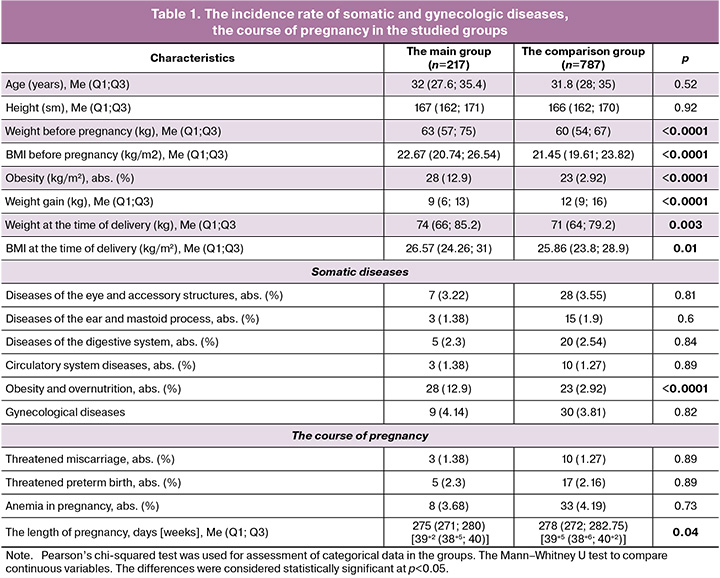
There was no difference in the age of women included in the study – 32 years (27.6; 35.4) versus 31.8 (28; 35). Assessment of the weight and height of pregnant women showed no difference in the height – 167 (162; 171) cm versus 166 (162; 170) sm. However, higher weight before pregnancy, body mass index (BMI), and prevalence of obesity were observed significantly more often in the group of women with GDM – 63 versus 60 kg (р<0.0001), 22.67 kg/m2 versus 21.45 kg/m2 (р<0.0001), and 12.9% versus 2.92% (р<0.0001), respectively.
At the same time, less weight gain during pregnancy was in the group with GDM – 9 kg versus 12 kg (р<0.0001). Despite this, body weight and BMI at the time of delivery were significantly higher in women with GDM – 74 kg versus 71 kg (р=0.003) and 26.57 kg/m2 versus 25.86 kg/m2 (р=0.01).
Analysis of somatic and gynecologic anamnesis, as well as the course of pregnancy found no differences between the studied groups.
The next stage of the study was assessment of newborn health. The characteristics of newborns in the groups depending on the length of pregnancy are represented in Table 2. All cases were live births. No differences were found between the groups in Apgar scores at 1 and 5 minutes.
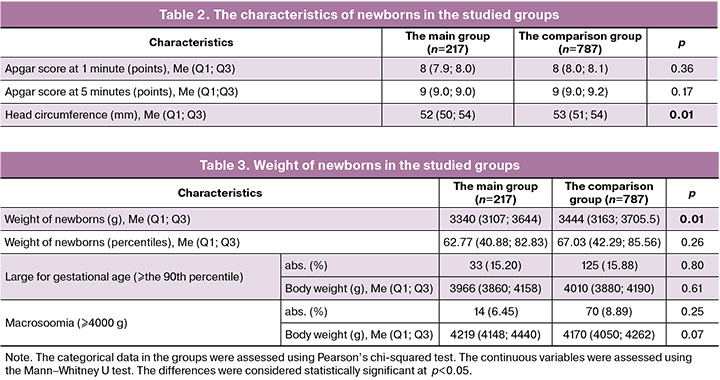
Assessment of anthropometric data of newborns unexpectedly showed larger weight and head circumference in the comparison group – 3444 g versus 3340 g (р=0.01) and 53 mm versus 52 mm (р=0.01), respectively (Table 3).
Weight distribution in newborns is represented in Figure.
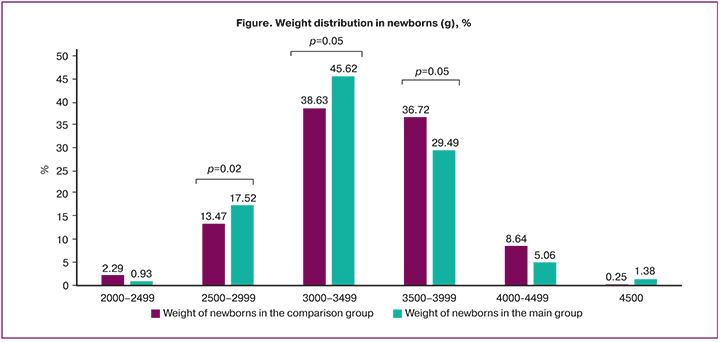
Newborn weight of 2500–2999 g and 3000–3499 g was significantly more common in the main group – 17.52% versus 13.47% (р=0.02) and 45.62% versus 38.63% (р=0.05), respectively. At the same time, fetal weight of 3500–3999 g was more common in the comparison group – 36.72% versus 29.49% (р=0.05). The trend toward newborn birth weight of 4500 g was observed more often in the main group – 1.38% versus 0.25% (р=0.068).
Discussion
Our study analyzed the incidence of GDM and fetal macrosomia in the current population of primiparous women. The diagnosis of GDM was made based on the results of oral glucose tolerance test. Our study showed that 6.43% of pregnant women refused to undergo OGTT, and this percentage was less than in published literature. Lachmann E.H. et al. reported that 32.2% of pregnant women refused to undergo OGTT [13]. The study by Hocaoglu M. showed that the reasons for refusal to undergo OGTT are the following: the opinion that the procedure is harmful (50% of cases), missed test deadlines (25.7%), withholding information about the need to take OGTT by the attending physician (16.3%), the opinion that OGTT is an unpleasant and unnecessary procedure (8.1%) [14].
The results obtained by us showed that according to oral glucose tolerance test, the prevalence of GDM in the current population of primiparous women was 21.19%. In 80.5% of cases glucose levels were corrected using nutrition therapy, and in 19.6% of cases using insulin therapy.
According to literature data, the regional prevalence of GDM varies from 7.1% in North America to 28.4% in Middle East, and the global prevalence of GDM is on average 14.0% (95% CI 13.97–14.04%) [2]. According to the retrospective analysis of medical records of 5,000 pregnant women who were followed-up at antenatal clinics in the South-Eastern Administrative Region in Moscow in 2019, the diagnosis of GDM was established in 510 women (10.2%) [15]. However, our data analysis of the female population in Moscow showed that the prevalence of GDM was two times higher.
High prevalence of GDM in our study can be due to a number of factors. First, our study was conducted 6 years later, and the incidence of GDM and risk factors has been steadily increasing in recent years. The growing number of cases of eating disorders, metabolic disorders and diseases of the endocrine system occurred in the period from 2019 to 2024, that complicated 38.1% of pregnancies in the Russian Federation, and 44.4% in the Central Federal District. At the same time, the prevalence of GDM reached 89.2% in the RF, and 70.1% in the Central Federal District [16].
Second, the results obtained by us reflect the prevalence of GDM according to the data on seeking care at Kulakov Center, and for this reason cannot fully match the population data. Third, the patients with preeclampsia, anemia, gestational arterial hypertension, or fetal anomalies were not included in the study. Nevertheless, the obtained results show high prevalence of GDM in the current metropolitan population.
Analysis of body weight and height in women showed that pre-pregnancy weight, BMI, and the prevalence of obesity were significantly higher in the group of women with GDM. At the same time, regardless of the fact that significantly low weight gain during pregnancy was in women with GDM – 9 kg versus 12 kg, body weight and BMI at the time of delivery were still higher – 74 kg versus 71 kg and 26.57 kg/m² versus 25.86 kg/m².
It is known that newborn's body weight, including the risk of fetal macrosomia correlates with weight gain in woman during pregnancy [17, 18]. Maayan‐Metzger A. et al. reported that high birth weight was in babies born to mothers who had weight gain exceeding the recommended ranges [17]. On the contrary, the study by Viecceli C. et al. showed that gaining less weight than recommended had a protective effect on large for gestational age babies – ОR 0.71 (95% CI 0.56–0.90), fetal macrosomia – OR 0.57 (95% CI 0.40–0.83) and did not increase the risk of having small for gestational age babies – OR 1.40 (95% CI 0.86–2.27) [19]. A systematic review based on nearly 740,000 women’s data found that weight gain between 5 kg and 9 kg in women with Class 1 obesity, between 1 kg and less than 5 kg in women with Class 2 obesity, and absence of weight gain in women with Class 3 obesity minimizes the overall risk of having large for gestational age babies [20].
In our study, the women with GDM had significantly low gestational weight gain, that was probably due to following the recommended diet. It has been proven that in women with obesity and GDM, dietary restriction to 30–33% reduces high blood sugar levels and high triglyceride levels [21]. Kurtzhals L.L. et al. reported that limiting gestational weight gain against the backdrop of dietary therapy in women with GDM helps reduce both glycated hemoglobin levels and the risk of excessive fetal growth [22].
A meta-analysis of 18 randomized controlled trials for women with GDM found that diet modification promoted weight loss – 170.62 g (95% CI -333.64–-7.60) and reduction in the incidence of fetal macrosomia – OR 0.49 (95% CI 0.27–0.88) [23].
A retrospective analysis of data by Yang G.R. еt al. showed that the rate of macrosomia among babies born to women with GDM was 16.4% versus 11.2% in the control group [24]. The results of our analysis showed that birth weight of newborns in the GDM group was on average 104 g lower than in the comparison group – 3340 g versus 3444 g (р=0.01). At the same time, birth weight of 2500–3499 g was more common in the GDM group, and the weight of 3500–4999 g was more common in the comparison group. No difference was found between the groups in the prevalence of large for gestational age babies (greater than or equal to the 90th percentile) and fetal macrosomia (≥4000 g). Nevertheless, newborn’s weight of ≥4500 g was registered by 5.5 time more often in patients with GDM, though only a trend toward statistical significance was observed, that was possibly due to the small sample size of newborns weighing ≥4500 g.
Thus, despite the expected higher birth weight in newborns and higher incidence of fetal macrosomia in pregnant women with GDM, our study revealed the opposite pattern. This result may be due to the fact that close continuous monitoring of patients with GDM was provided by endocrinologist and obstetrician-gynecologist. The patients regularly monitored their glucose levels, followed lifestyle modification recommendations (diet, physical activity) and, when necessary, maintained normoglycemia with insulin therapy.
In the comparison group, where according to the results of glucose tolerance test at 24–28 weeks GDM was not detected, neither healthcare workers no patients paid such attention to GDM management. Despite the fact that all pregnant women received information about the importance of a balanced diet and physical activity, these recommendations were not strictly defined and allowed deviations. Glycemic control was not monitored in this group. For this reason, the episodes of hyperglycemia, and possibly a persistent elevation of blood glucose could not be excluded. Gestational weight gain was higher in this group, along with higher birth weight of newborns.
In addition, it should be noted that a negative glucose tolerance test at 24–28 weeks does not prevent women from developing carbohydrate metabolism disorders in the later period. In recent years, several studies have been published on late GDM that was diagnosed in the first trimester after 28 weeks of gestation. In a Dutch cohort study, the authors reported GDM diagnoses in 23.5% of parturients who initially tested negative at 24–28 weeks of gestation [25]. Similarly, according to other studies, late GDM was diagnosed in about 25% of women who underwent OGTT in late pregnancy due to suspected fetal macrosomia or polyhydramnios. Higher prevalence of GDM was among obese women [26–28].
The strength of our study is that this is one of few studies in Russia that showed the prevalence of fetal macrosomia in women with impaired carbohydrate metabolism, as well as the number of pregnant women who refused to undergo the glucose tolerance test.
Limitations of the study. However, we acknowledge that there are several limitations in our study. First, the sample size was small. Second, despite the fact that simple random sampling was used, the initial formation of the study population based on the data obtained at a single medical facility, and a high percentage of refusal to participate in the study (6.43%) make the sample less representative with regard to the general population of primiparous women.
The observed high rate of GDM (21.19%) cannot be extrapolated to the general population of primiparous women. The results likely reflect the characteristics of patient cohort at Kulakov Center.
Conclusion
The obtained data confirm our assumption about the increasing incidence of carbohydrate metabolism disorders in pregnant women. This necessitates development of the advanced approaches to their diagnosis and a broader range of patients, who need measures to prevent complications associated with these disorders. The obtained results also showed high incidence of fetal macrosomia in the group of women without traditional risk factors, that indicates the need to search new clinical and laboratory predictors of its development.
To obtain the data on the prevalence of GDM in the general population of women in Russia, further research is necessary using larger and more diverse sample, encompassing medical facilities in different regions, with the lowest refusal rate.
References
- Hivert M.F., White F., Allard C., James K., Majid S., Aguet F. et al. Placental IGFBP1 levels during early pregnancy and the risk of insulin resistance and gestational diabetes. Nat. Med. 2024; 30(6): 1689-95. https://dx.doi.org/10.1038/s41591-024-02936-5
- Wang H., Li N., Chivese T., Werfalli M., Sun H., Yuen L. et al. IDF Diabetes Atlas: Estimation of Global and Regional Gestational Diabetes Mellitus Prevalence for 2021 by International Association of Diabetes in Pregnancy Study Group’s Criteria. Diabetes Res. Clin. Pract. 2022; 183: 109050. https://dx.doi.org/10.1016/j.diabres.2021.109050
- Sweeting A., Hannah W., Backman H., Catalano P., Feghali M., Herman W.H. et al. Epidemiology and management of gestational diabetes. Lancet. 2024; 404(10448): 175-92. https://dx.doi.org/10.1016/S0140-6736(24)00825-0
- Lao T.T., Ho L.F., Chan B.C.P., Leung W.C. Maternal age and prevalence of gestational diabetes mellitus. Diabetes Care. 2006; 29(4): 948-9. https://dx.doi.org/10.2337/diacare.29.04.06.dc05-2568
- Simmons D., Immanuel J., Hague W.M., Teede H., Nolan C.J., Peek M.J. et al. Treatment of gestational diabetes mellitus diagnosed early in pregnancy. N. Engl. J. Med. 2023; 388(23): 2132-44. https://dx.doi.org/10.1056/NEJMoa2214956
- Lowe L.P., Perak A.M., Kuang A., Lloyd-Jones D.M., Sacks D.A., Deerochanawong C. et al. Associations of glycemia and lipid levels in pregnancy with dyslipidemia 10–14 years later: the HAPO follow-up study. Diabetes Res. Clin. Pract. 2022; 185: 109790. https://dx.doi.org/10.1016/j.diabres.2022.109790
- Ye W., Luo C., Huang J., Li C., Liu Z., Liu F. Gestational diabetes mellitus and adverse pregnancy outcomes: systematic review and meta-analysis. BMJ. 2022; 377: e067946. https://dx.doi.org/10.1136/bmj-2021-067946
- O’Tierney-Ginn P., Presley L., Myers S., Catalano P. Placental growth response to maternal insulin in early pregnancy. J. Clin. Endocrinol. Metab. 2015; 100(1): 159-65. https://dx.doi.org/10.1210/jc.2014-3281
- Kamana K.C., Shakya S., Zhang H. Gestational diabetes mellitus and macrosomia: A literature review. Ann. Nutr. Metab. 2015; 66(Suppl. 2): 14-20. https://dx.doi.org/10.1159/000371628
- Beta J., Khan N., Khalil A., Fiolna M., Ramadan G., Akolekar R. Maternal and neonatal complications of fetal macrosomia: systematic review and meta‐analysis. Ultrasound Obstet. Gynecol. 2019; 54(3): 308-18. https://dx.doi.org/10.1002/uog.20279
- Министерство здравоохранения Российской Федерации. Клинические рекомендации. Гестационный сахарный диабет. 2014. [Ministry of Health of the Russian Federation. Clinical guidelines. Gestational diabetes mellitus. 2014. (in Russian)].
- Андреева Е.Н., Арбатская Н.Ю., Аржанова О.Н., Башмакова Н.В., Боровик Н.В., Бурумкулова Ф.Ф., Галстян Г.Р., Григорян О.Р., Гринева Е.Н., Дерябина Е.Г., Дедов И.И., Демидова И.Ю., Древаль А.В., Есаян Р.М., Зазерская И.Е., Ибрагимова Л.И., Капустин Р.В., Лукановская О.Б., Мальгина Г.Б., Мельниченко Г.А., Петрухин В.А., Путилова Н.В., Рагозин А.К., Радзинский В.Е., Серов В.Н., Старцева Н.М., Тиселько А.В., Фадеев В.В., Ходжаева З.С., Шестакова М.В., Шмаков Р.Г., Ярыгина Т.А. Клинические рекомендации «Гестационный сахарный диабет» Минздрава России. Версия 2024 года. Вестник репродуктивного здоровья. 2025; 4(1): 12-24. https://dx.doi.org/10.14341/brh12758 [Andreeva E.N., Arbatskaya N.Yu., Arzhanova O.N., Bashmakova N.V., Borovik N.V., Burumkulova F.F., Galstyan G.R., Grigoryan O.R., Grineva E.N., Deryabina E.G., Dedov I.I., Demidova I.Yu., Dreval A.V., Esayan R.M., Zazerskaya I.E., Ibragimova L.I., Kapustin R.V., Lukanovskaya O.B., Malgina G.B., Melnichenko G.A., Petrukhin V.A., Putilova N.V., Ragozin A.K., Radzinskiy V.E., Serov V.N., Startseva N.M., Tiselko A.V., Fadeyev V.V., Khodzhaeva Z.S., Shestakova M.V., Shmakov R.G., Yarygina T.A. Clinical recommendations «gestational diabetes mellitus» of the russian ministry of health. Version of the year 2024. Bulletin of Reproductive Health. 2025; 4(1): 12-24 (in Russian). https://dx.doi.org/10.14341/brh12758].
- Lachmann E.H., Fox R.A., Dennison R.A., Usher‐Smith J.A., Meek C.L., Aiken C.E. Barriers to completing oral glucose tolerance testing in women at risk of gestational diabetes. Diabet Med. 2020; 37(9): 1482-9. https://dx.doi.org/10.1111/dme.14292
- Hocaoğlu M. Why some pregnant women refuse glucose challenge test? Turkish pregnant women’ s perspectives for gestational diabetes mellitus screening. North Clin. Istanbul. 2018; https://dx.doi.org/10.14744/nci.2018.37167.
- Ушанова Ф.О., Лобанова К.Г., Переходов С.Н. Гестационный сахарный диабет: особенности течения и исходы беременности в реальной клинической практике. Медицинский Совет. 2021; (7): 184-91. https://dx.doi.org/10.21518/2079-701X-2021-7-184-191 [Ushanova F.O., Lobanova K.G., Perekhodov S.N. Gestational diabetes mellitus: peculiarities of course and pregnancy outcomes in real clinical practice.. Medical Council. 2021; (7): 184-91 (in Russian). https://dx.doi.org/10.21518/2079-701X-2021-7-184-191].
- Атаев О.Г., Миргородская О.В., Маношкина Е.М. Основные тенденции заболеваемости беременных женщин в субъектах Центрального федерального округа. Социальные аспекты здоровья населения. 2025; 71(3S): 19. https://dx.doi.org/10.21045/2071-5021-2025-71-3S-19 [Ataev O.G., Mirgorodskaya O.V., Manoshkina E.M. The main trends in the incidence of pregnant women in the subjects of the Central Federal District. Social'nye aspekty zdorov'a naselenia. 2025; 71(3S): 19 (in Russian). https://dx.doi.org/10.21045/2071-5021-2025-71-3S-19].
- Maayan‐Metzger A., Schushan‐Eisen I., Strauss T., Globus O., Leibovitch L. Gestational weight gain and body mass indexes have an impact on the outcomes of diabetic mothers and infants. Acta Paediatr. 2015; 104(11): 1150-5. https://dx.doi.org/10.1111/apa.13166
- Wang N., Ding Y., Wu J. Effects of pre-pregnancy body mass index and gestational weight gain on neonatal birth weight in women with gestational diabetes mellitus. Early Hum. Dev. 2018; 124: 17-21. https://dx.doi.org/10.1016/j.earlhumdev.2018.07.008
- Viecceli C., Remonti L.R., Hirakata V.N., Mastella L.S., Gnielka V., Oppermann M.L.R. et al. Weight gain adequacy and pregnancy outcomes in gestational diabetes: a meta‐analysis. Obes. Rev. 2017; 18(5): 567-80. https://dx.doi.org/10.1111/obr.12521
- Faucher M.A., Barger M.K. Gestational weight gain in obese women by class of obesity and select maternal/newborn outcomes: a systematic review. Women and Birth. 2015; 28(3): e70-9. https://dx.doi.org/10.1016/j.wombi.2015.03.006
- Franz M.J. Lifestyle modifications for diabetes management. Endocrinol. Metab. Clin. North Am. 1997; 26(3): 499-510. https://dx.doi.org/10.1016/S0889-8529(05)70263-2
- Kurtzhals L.L., Nørgaard S.K., Secher A.L., Nichum V.L., Ronneby H., Tabor A. et al. The impact of restricted gestational weight gain by dietary intervention on fetal growth in women with gestational diabetes mellitus. Diabetologia. 2018; 61(12): 2528-38. https://dx.doi.org/10.1007/s00125-018-4736-6
- Yamamoto J.M., Kellett J.E., Balsells M., García-Patterson A., Hadar E., Solà I. et al. Gestational diabetes mellitus and diet: a systematic review and meta-analysis of randomized controlled trials examining the impact of modified dietary interventions on maternal glucose control and neonatal birth weight. Diabetes Care. 2018; 41(7): 1346-61. https://dx.doi.org/10.2337/dc18-0102
- Yang G.R., Dye T.D., Li D. Effects of pre-gestational diabetes mellitus and gestational diabetes mellitus on macrosomia and birth defects in Upstate New York. Diabetes Res. Clin. Pract. 2019; 155: 107811. https://dx.doi.org/10.1016/j.diabres.2019.107811
- de Wit L., Bos D.M., van Rossum A.P., van Rijn B.B., Boers K.E. Repeated oral glucose tolerance tests in women at risk for gestational diabetes mellitus. Eur. J. Obstet. Gynecol. Reprod. Biol. 2019; 242: 79-85. https://dx.doi.org/10.1016/j.ejogrb.2019.09.022
- Mohr Sasson A., Shats M., Goichberg Z., Mazaki-Tovi S., Morag I., Hendler I. Oral glucose tolerance test for suspected late onset gestational diabetes. J. Matern. Neonatal. Med. 2021; 34(23): 3928-32. https://dx.doi.org/10.1080/14767058.2019.1702945
- Abu Shqara R., Or S., Wiener Y., Lowenstein L., Frank Wolf M. Clinical implications of the 100-g oral glucose tolerance test in the third trimester. Arch. Gynecol. Obstet. 2022; 307(2): 421-9. https://dx.doi.org/10.1007/s00404-022-06520-5
- Abu Shqara R., Or S., Nakhleh Francis Y., Wiener Y., Lowenstein L., Wolf M.F. Third trimester re‐screening for gestational diabetes in morbidly obese women despite earlier negative test can reveal risks for obstetrical complications. J. Obstet. Gynaecol. Res. 2023; 49(3): 852-62. https://dx.doi.org/10.1111/jog.15515
Received 08.04.2026
Accepted 25.06.2026
About the Authors
Oleg V. Tysyachny, PhD, Researcher at the 1st Maternity Department, Academician V.I. Kulakov National Medical Research Center for Obstetrics, Gynecology and Perinatology, Ministry of Health of Russia, 117997, Russia, Moscow, Oparina str., 4, o_tysyachny@oparina4.ru, https://orcid.org/ 0000-0001-9282-9817Oleg R. Baev, Dr. Med. Sci., Head of the 1st Maternity Department, Academician V.I. Kulakov National Medical Research Center for Obstetrics, Gynecology and Perinatology, Ministry of Health of Russia, 117997, Russia, Moscow, Oparina str., 4; Professor at the Department of Obstetrics, Gynecology, Perinatology, and Reproductology,
I.M. Sechenov First Moscow State Medical University, Ministry of Health of Russia (Sechenov University), metod_obsgyn@hotmail.com, https://orcid.org/0000-0001-8572-1971
Similar Articles