
Risk prediction of spontaneous preterm birth in twin pregnancy: a monogram
Gladkova K.A., Kiryanova A.O., Sakalo V.A., Vtorushina V.V.
Preterm birth remains a leading cause of perinatal morbidity and mortality in twin pregnancy.
Objective. To improve perinatal outcomes in twin pregnancies by creating a nomogram to predict the risks of spontaneous preterm births.
Materials and methods. The study included 839 patients with twin pregnancies. Based on pregnancy outcomes, the patients were divided into two groups. Group 1 consisted of women (n=175) whose pregnancies ended in term births. Group 2 included women (n=664) whose pregnancies ended in preterm births. A nomogram for the risk of preterm birth was constructed based on significant predictors, and its predictive performance was evaluated using ROC analysis.
Results. Multivariate analysis identified that independent predictors of preterm birth were twin growth discordance (OR=1.044; 95% CI 1.024–1.064; p<0.001) and twin chorionicity (monochorionic diamniotic twins: OR=2.993; 95% CI 1.677–5.340; p<0.001). The nomogram model included these predictors, and was developed to estimate the individual preterm birth risk. ROC curve analysis confirmed satisfactory predictive performance of the model (AUC=0.766).
Conclusion. The risk of spontaneous preterm birth in twin pregnancy is primarily associated with twin chorionicity and twin growth discordance, that is important for personalized high-risk patient management.
Authors' contributions. Gladkova K.A. – the study concept and design, statistical analysis, manuscript writing. structuring and finalization; Gladkova K.A., Sakalo V.A., Kiryanova A.O., Vtorushina V.V. — material collection, statistical data analysis and processing, manuscript writing and editing.
Conflicts of interest. The authors confirm that they have no conflict of interest to declare.
Funding. The authors received no funding for this study.
Ethical Approval. The study was approved by the local Ethics Committee of V.I. Kulakov National Medical Research Center for Obstetrics, Gynecology and Perinatology, Ministry of Health of Russia.
Generative Artificial Intelligence. No generative AI tools were used in preparing this article.
Patient Consent for Publication. The patients have signed informed consent for publication of their data.
Authors' Data Sharing Statement. The data supporting the findings of this study are available on request from the corresponding author after approval from the principal investigator.
For citation: Gladkova K.A., Kiryanova A.O., Sakalo V.A., Vtorushina V.V.
Risk prediction of spontaneous preterm birth in twin pregnancy: a monogram.
Akusherstvo i Ginekologiya/Obstetrics and Gynecology. 2026; (6): 82-91 (in Russian)
https://dx.doi.org/10.18565/aig.2026.21
Keywords
preterm birth
multiple pregnancy
risk factors
nomogram
Preterm birth (PB) is one of the leading causes of perinatal morbidity and mortality [1, 2]. Approximately 15 million babies [3] are born prematurely annually worldwide. Preterm birth rate in the general population is 10% [4].
Multiple pregnancies deserve special attention. According to some estimates, they account for up to 2–4% of all births. However, in PB the leading position belongs to multiple pregnancies [5]. The incidence rate of PB in women pregnant with twins reaches 31–63% and is 5–7 times higher than in singleton pregnancies [6]. According to the domestic and foreign studies, association between preterm birth and complications of multiple pregnancy can be due to the pathogenetic mechanism – the imbalance of angiogenic and anti-angiogenic factors, leading to the activation of proinflammatory, procoagulant and vasoconstriction cascades underlying endothelial dysfunction [7, 8].
It is assumed that chorionicity plays an important role in predicting the risks of PB in multiple pregnancies: monochorionic twins have a high risk of perinatal and neonatal complications [9, 10]. The main causes of PB in multiple pregnancies include the following conditions: premature structural changes in the cervix, preeclampsia (PE), gestational diabetes mellitus (GDM), twin-to-twin transfusion syndrome (TTTS), selective fetal growth restriction (sFGR), twin reversed arterial perfusion (TRAP), and twin anemia polycythemia sequence (TAPS) [11, 12]. Additional predictors are maternal ethnicity and age, body mass index (BMI), smoking, a history of infertility, a history of preterm birth [13]. Each of these factors has limited prognostic value. In our view, a very promising direction is to create a comprehensive model, such as a nomogram, which allows integration of clinical and anamnestic, laboratory and ultrasound data for individual risk assessment of PB. This was a rationale for conducting the study.
The objective of the study was to create and introduce into clinical practice a nomogram for risk assessment of preterm birth in women pregnant with twins.
Materials and methods
From January 2018 to January 2024 a retrospective cohort observational study was carried out at V.I. Kulakov National Medical Research Center for Obstetrics, Gynecology and Perinatology of the Ministry of Health of Russia (Kulakov Center). The study design was developed according to the STROBE recommendations [14]. The course of twin pregnancies in 839 women was analyzed based on the available medical documentation. The clinical and anamnestic data, laboratory and instrumental test results were assessed to identify risk factors for preterm birth. Risk factor criteria corresponded to the current domestic clinical recommendations [15].
Step 1 was assessment of the course of twin pregnancies and outcomes in 839 patients. Based on pregnancy outcomes (preterm or term births), the patients were divided into two groups. Group 1 consisted of women whose pregnancies ended in term births (n=175). Group 2 included women (n=664) whose pregnancies ended in preterm births (n=664). Consecutive sampling included the patients who met the inclusion criteria during the follow-up period.
Inclusion criteria were twin pregnancy; patient follow-up and giving birth at Kulakov Center of the Ministry of Health of Russia.
Non-inclusion criteria were higher-order multiple pregnancy (triplets, quadruplets); refusal of treatment; a history of severe concomitant diseases, oncological and autoimmune diseases; the patients who underwent organ transplantation.
The solid-phase enzyme-linked immunosorbent assay was used to detect the biomarkers of angiogenesis and vasculogenesis in patients at 22–24 and 30–32 weeks of pregnancy using the following test kits: angiopoietin 2 (ANGPT2) ELISA Kit (RayBiotech), vascular endothelial growth factor-C (VEGF-C) (Invitrogen), hypoxia-inducible factor 1-alpha (HIF-1-alpha) ELISA Reagent Kit (RayBiotech), transforming growth factor β1 (TGF-β1) (Invitrogen), soluble vascular endothelial growth factor receptor-1 (sVEGFR-1) ELISA Kit (Invitrogen). The Infinite F50 absorbance microplate reader (Tecan) was used to quantify the results of ELISA.
Step 2 was statistical analysis of 58 categorical and quantitative variables to identify significant predictors of spontaneous PB. The analysis included key indicators of patients' health status, anamnestic data, and the most common pregnancy complications.
Statistical analysis
Descriptive and analytical statistics were used for data analysis. The quantitative variables are represented as the mean values and standard deviation (M±SD), as well as the median and interquartile range (Me [Q1; Q3]). The categorical variables were represented as absolute and relative frequencies (n, %). Statistical tests were chosen taking into account data distribution. The non-parametric Mann–Whitney U test, Student's t-test, Pearson’s chi-squared test, and Fisher’s exact test were used for intergroup comparisons. Associations between risk factors for PB were assessed using univariate logistic regression and calculation of the odds ratio (OR) and 95% confidence interval (CI). The differences were considered statistically significant at p<0.05. Based on statistically significant factors, multivariate binary logistic regression analysis was performed to determine independent predictors of PB, and to obtain the OR with 95% CI. Statistical significance was determined at p<0.05. A nomogram for personalized assessment of preterm birth risk was constructed using independent predictors of a multivariate model. The discriminatory ability of the model was evaluated using ROC analysis and the area under the curve (AUC). All statistical calculations were performed using IBM SPSS Statistics 26.0-27.0 software packages.
Limitations of our study was the cumulative number of high-risk patients and extremely complicated course of twin pregnancies in level 3B hospital, that resulted in sample selection bias towards PB.
Results
Statistical analysis of clinical and anamnestic factors (Table 1) showed that the risk of spontaneous PB in twin pregnancies was associated with chorionicity (p<0.001). The rate of monochorionic diamniotic twins was higher in the group with PB (86.9% versus 73.1%; p<0.001). Spontaneous term births in monochorionic monoamniotic twin pregnancies occurred in 5 cases with intrauterine correction of twin reversed arterial perfusion (TRAP) and continuation of pregnancy with one fetus.
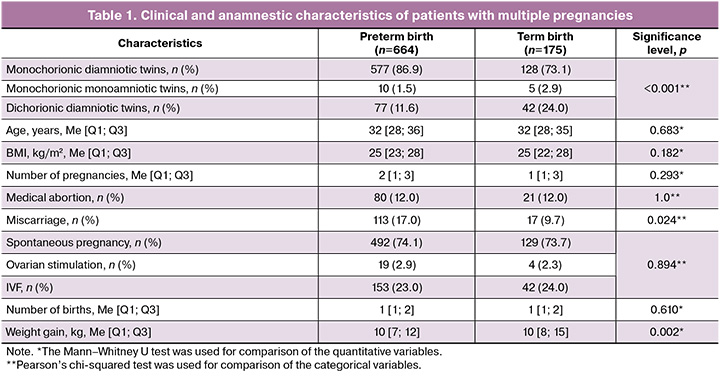
Preterm birth was also common in pregnant women who gained less weight during pregnancy and had a history of miscarriage.
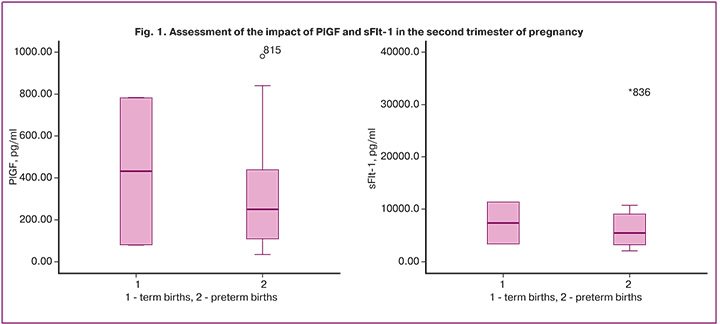
In the second trimester of pregnancy, plasma PlGF levels were statistically insignificant in the groups, and plasma concentration of sFlt-1 were significantly higher in PB (p<0.001) (Fig. 1).
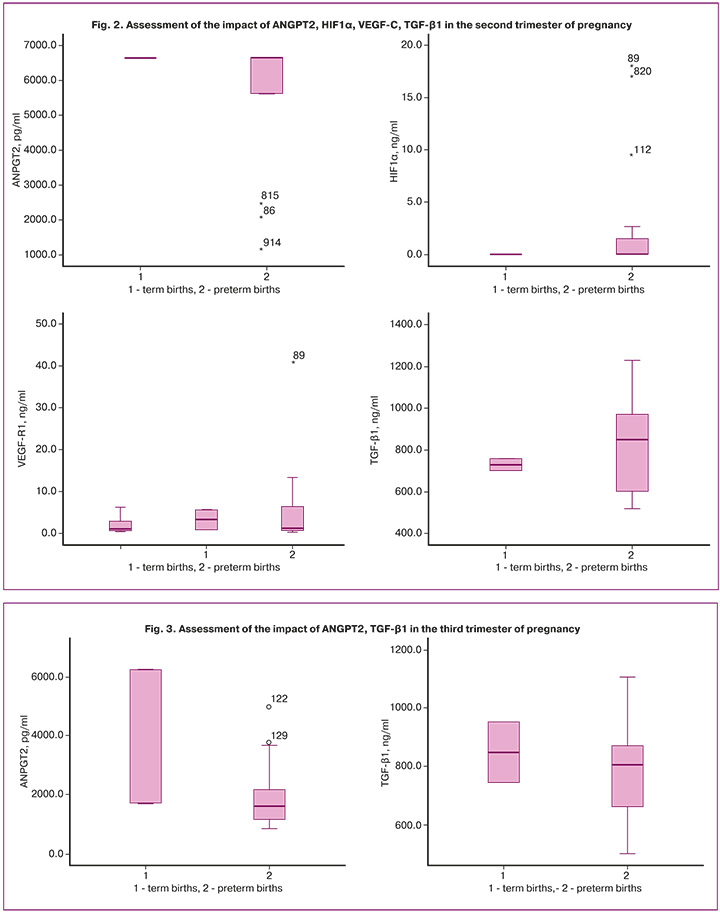
In the second trimester of pregnancy ANGPT2, HIF1α, VEGF-С, TGF-β1 plasma concentrations were statistically insignificant in the groups. However, a decrease in the median level of angiogenesis factors was observed in PB (Fig. 2).
In the third trimester ANPGT2, TGF-β1 plasma concentrations were significantly higher in the group with PB (Fig. 3).
PlGF, sFlt-1, sFlt-1/PlGF, HIF1α, VEGF-С, VEGF-R1 levels showed no statistically significant differences between the groups.
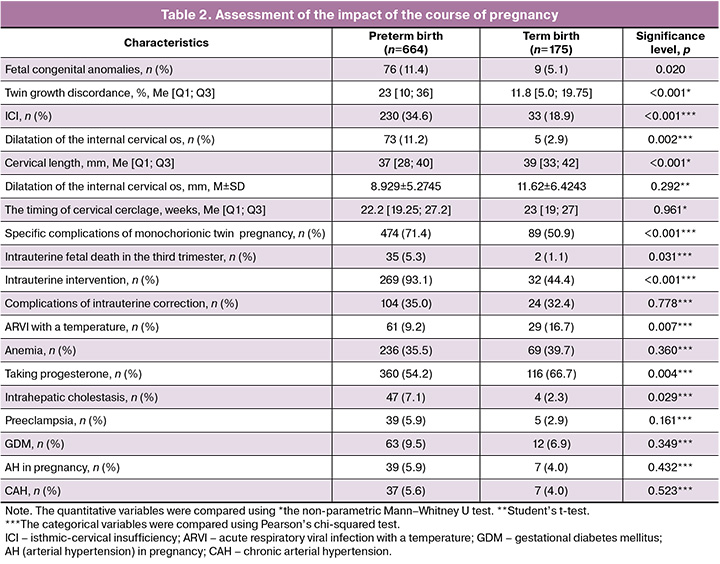
Among obstetric and clinical factors (Table 2), cervical shortening, dilation of the internal cervical os, and twin growth discordance were most often diagnosed in the group with PB. Specific complications of monochorionic twin pregnancy (TTTS, sFGR, TAPS, TRAP) were most common in the group with PB and required intrauterine correction in 93.1% of cases. Also, antenatal fetal death occurred in the third trimester statistically more often in the group with PB (p=0.031). The group of patients with term births was characterized by the absence of pregnancy complications. Fetal congenital anomalies in the group with PB were diagnosed significantly more often. Intrahepatic cholestasis in pregnant women was also associated with the risk of preterm birth. ARVI with a high temperature were less often in the group with PB (9.2% versus 16.7%) (p=0.007).
Univariate logistic regression analysis identified a number of factors, which were significantly associated with the risk of preterm birth. Significantly higher probability of PB was associated with complications typical for monochorionic pregnancy. So, the risk of PB increased more than 3 times with sFGR and TTTS (OR=3.20; 95% CI 2.073–4.934; OR=3.24; 95% CI 2.150–4.870, respectively), and more than 6 times with TAPS (OR=6.44; 95% CI 1.547–26.790).
Antenatal fetal death in the third trimester was a significant risk factor associated with five-fold increase in probability of PB (OR=4.81; 95% CI 1.146–20.211).
Isthmic-cervical insufficiency increased the risk of early preterm birth by more than 2 times (OR=2.28; 95% CI 1.512–3.440); dilatation of the internal cervical os by more than 4 times (OR=4.18; 95% CI 1.660–10.502); intrahepatic cholestasis by more than 3 times (OR=3.26; 95% CI 1.157–9.165), a history of miscarriage almost by 2 times (OR=1.906; 95% CI 1.111–3.270). By contrast to this, past ARVI with a high temperature and taking progesterone were associated with reduced risk of PB (OR=0.51; 95% CI 0.314–0.816; OR=0.59; 95% CI 0.417–0.840, respectively).
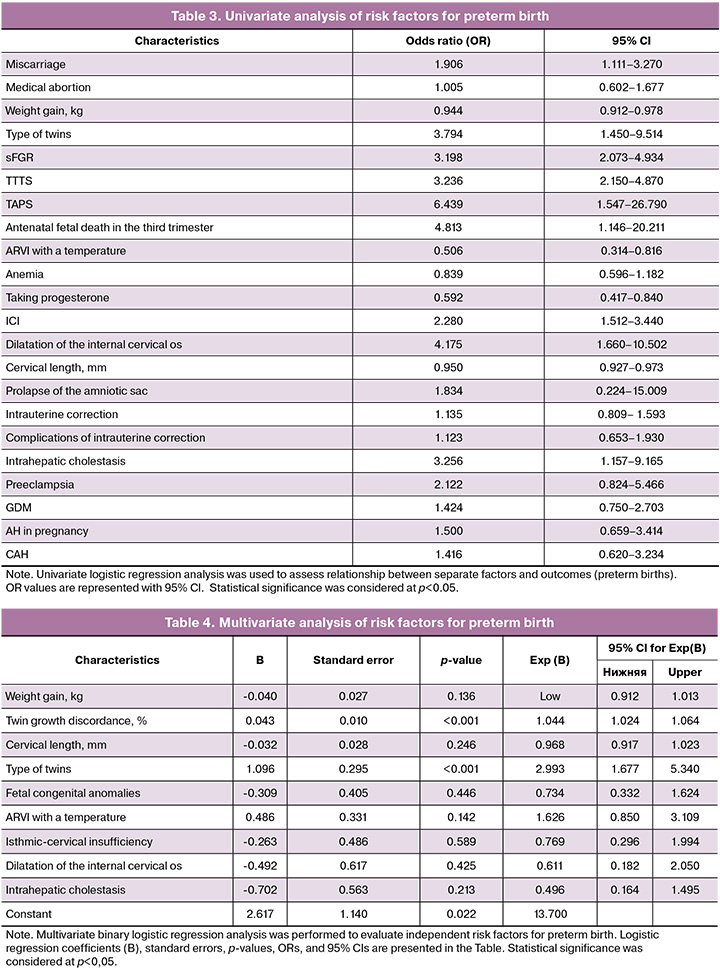
Multivariate binary logistic regression analysis was performed for independent associations with PB (Table 4). Binary birth outcome was considered as the dependent variable. The model included the predictors that demonstrated the strongest association with the outcome in univariate analysis (p<0.05). Due to missing values in dataset, reduced sample size, and simultaneous inclusion of all variables in regression, the final model was formed of the variables, which were selected to construct the nomogram. This made it possible to include 505 observations in analysis. Angiogenesis and vasculogenesis factors were excluded from analysis due to unavailability of routine testing.
Multivariate analysis showed that twin growth discordance and type of twins were statistically significant independent predictors of PB. High twin growth discordance was associated with increased probability of PB (B=0.043; p<0.001); (OR=1.044; 95% CI 1.024–1.064). Monochorionic placentation in comparison with dichorionic placentation was also associated with PB (B=1.096; p<0.001; OR=2.993; 95% CI 1.677–5.340).
Other variables in the model including weight gain, cervical length, fetal congenital anomalies ARVI, isthmic-cervical insufficiency, dilatation of the internal cervical os, and intrahepatic cholestasis in pregnant women did not show statistically significant independent association with the studied outcome (p>0.05).
Note. ROC analysis was used to evaluate the predictive ability of the model for preterm birth. The area under the curve (AUC) indicates the ability of the model to discriminate between high-risk and low-risk patients. AUC=0.766.
To assess the discriminatory ability of the final model, ROC analysis was performed using statistically significant predictors, which were identified using logistic regression (Fig. 4). The area under the ROC curve (AUC) was 0.766, that indicated satisfactory predictive value of the model in relation to the risk of PB.
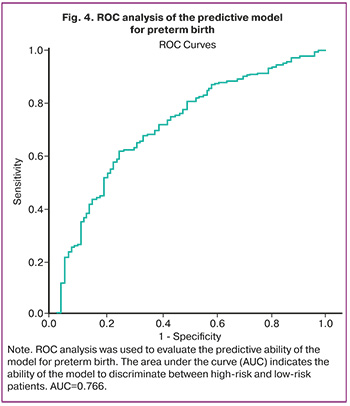
The optimal cut-off value for high risk of PB determined by the Youden index was 0.75. The model sensitivity was 0.82, and the specificity was 0.53.
Based on the created model the nomogram was constructed for individual preterm birth risk evaluation.
Given the results of multivariate analysis based on the selected predictors, the nomogram was constructed as a tool to predict the probability of preterm birth risk individually (Fig. 5). The nomogram is a graphical model that allows to evaluate the risk of a binary outcome based on clinical and instrumental parameters that are included in logistic regression. The nomogram is interpreted in the following way. It consists of a set of scales. Each variable is listed separately, with a corresponding number of points assigned to a given magnitude of the variable on a certain scale. Then, the cumulative point score for all variables included in the model is matched to the lower scale of the individual probability of the outcome.
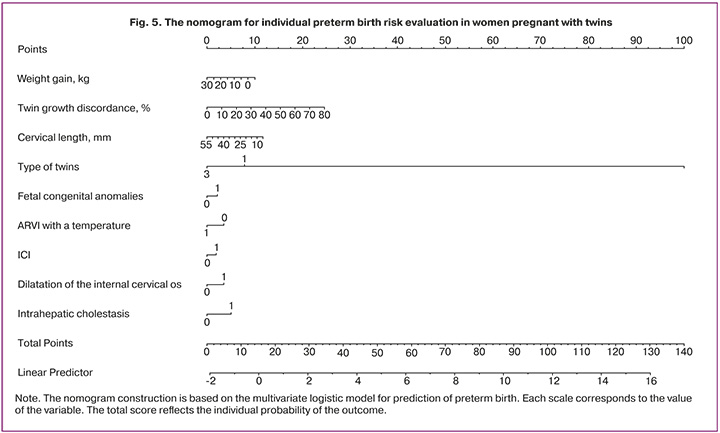
Thus, this nomogram is a graphic representation of contribution of each predictor to the overall probability of PB. It can be used for quantitative individual risk assessment in clinical practice and for research purposes.
Discussion
Our study found that the vast majority of patients with multiple pregnancies had preterm births, that indicated the initially existing high level of obstetric risk in this cohort of patients [5, 6]. Comparative analysis of clinical and anamnestic parameters, the course of multiple pregnancies, and changes in vasculogenesis and angiogenesis markers showed that preterm delivery is associated with a set of characteristics reflecting fetoplacental insufficiency, angiogenic imbalance, and complications of pregnancy, particularly monochorionic pregnancy. Our findings are consistent with foreign published data on the key role of endothelial dysfunction and impaired angiogenesis and vasculogenesis in the pathogenesis of preterm birth and complications of multiple pregnancy [7, 8].
Spontaneous preterm births occurred most frequently in patients with monochorionic diamniotic twins. Also, the group of women with preterm births had poor weight gain, a history of miscarriage, isthmic-cervical insufficiency in the current pregnancy, dilatation of the internal cervical os, intrahepatic cholestasis, twin growth discordance. In addition, they were not taking progesterone. The identified changes in angiogenic markers – increased sFlt-1 concentrations and the sFlt-1/PlGF ratio in the second trimester, as well as the differences in the levels of ANGPT2 and TGF-β1 in the third trimester confirm the key role of angiogenic imbalance in the pathogenesis of PB in multiple pregnancy. These data are consistent with a higher frequency of specific complications in preterm birth placental insufficiency, including antenatal death, TTTS, sFGR, TAPS,
The results of univariate logistic analysis complement the descriptive data and demonstrate that specific complications of monochorionic pregnancy (sFGR, TTTS, TAPS, and complications of their intrauterine correction), antenatal fetal death in the third trimester, isthmic-cervical insufficiency, dilatation of the internal cervical os, and cholestasis of pregnancy contribute greatly to the risk of preterm birth. Not taking progesterone in the group with PB, and its protective association in univariate analysis confirm the important role of progesterone supplementation in prevention of PB in patients with multiple pregnancies. Multivariate binary logistic regression showed that only twin growth discordance and twin chorionicity are independent predictors of PB. The nomogram is based on these predictors. It allows to quantitatively assess the individual probability of PB and shows the contribution of each factor to the risk. ROC analysis demonstrated satisfactory discriminatory ability of the model (AUC=0.766), that confirms its potential for practical use in clinical risk assessment of preterm births in patients with multiple monochorionic pregnancies.
Conclusion
The results of this study indicate the multifactorial etiopathogenesis of preterm birth in multiple pregnancy. The developed prognostic nomogram based on the most informative indicators opens up prospects for individual prediction of preterm birth, that has practical significance for optimization of high-risk pregnancy management and improvement of maternal and perinatal outcomes.
References
- World Health Organization. Preterm birth. Available at: https://www.who.int/news-room/fact-sheets/detail/preterm-birth.
- Menzies R., Li A.L.K., Melamed N., Shah P.S., Horn D., Barrett J. et al. Risk of singleton preterm birth after prior twin preterm birth: a systematic review and meta-analysis. Am. J. Obstet. Gynecol. 2020; 223(2): 204.e1-e8. https://dx.doi.org/10.1016/j.ajog.2020.02.003
- Zierden H.C., Shapiro R.L., DeLong K., Carter D.M., Ensign L.M. Next generation strategies for preventing preterm birth. Adv. Drug. Deliv. Rev. 2021; 174: 190-209. https://dx.doi.org/10.1016/j.addr.2021.04.021
- Emms A., Pilarski N., Hodgetts Morton V. Preterm labour and birth: prevention strategies and preparation for delivery. Obstet. Gynaecol. Reprod. Med. 2025; 35: 193-8. https://dx.doi.org/10.1016/j.ogrm.2025.04.003
- Deng C., Dai L., Yi L., Li X., Deng K., Mu Y. et al. Temporal trends in the birth rates and perinatal mortality of twins: a population-based study in China. PLoS One. 2019; 14(1): e0209962. https://dx.doi.org/10.1371/journal.pone.0209962
- Li S., Gao J., Liu J., Hu J., Chen X., He J. et al. Perinatal outcomes and risk factors for preterm birth in twin pregnancies in a Chinese population: a multi-center retrospective study. Front. Med. (Lausanne). 2021; 8: 657862. https://dx.doi.org/10.3389/fmed.2021.657862
- Amelio G.S., Provitera L., Raffaeli G., Tripodi M., Amodeo I., Gulden S. et al. Endothelial dysfunction in preterm infants: the hidden legacy of uteroplacental pathologies. Front. Pediatr. 2022; 10: 1041919. https://dx.doi.org/10.3389/fped.2022.1041919
- Гладкова К.А., Ходжаева З.С., Сакало В.А., Фролова Е.Р., Шакая М.Н., Киртбая А.Р. Роль факторов васкуло- и ангиогенеза в перинатальных исходах, неонатальной заболеваемости и смертности при осложненной монохориальной многоплодной беременности. Акушерство и гинекология. 2023; 12: 95-103. https://dx.doi.org/10.18565/aig.2023.243 [Gladkova K.A., Khodzhaeva Z.S., Sakalo V.A., Frolova E.R., Shakaya M.N., Kirtbaya A.R. The role of vasculogenic and angiogenic factors in perinatal outcomes, neonatal morbidity, and mortality in complicated monochorionic multiple pregnancies. Obstetrics and Gynecology. 2023; (12): 95-103 (in Russian). https://dx.doi.org/10.18565/aig.2023.243].
- Oger A.S., Robillard P.Y., Barau G., Randrianaivo H., Bonsante F., Iacobelli S. et al. Perinatal outcome of monochorionic and dichorionic twin gestations: a study of 775 pregnancies at Reunion Island. J. Gynecol. Obstet. Biol. Reprod. (Paris). 2013; 42(7): 655-61. French. https://dx.doi.org/10.1016/j.jgyn.2013.02.010
- Нефтерева А.А., Сакало В.А, Гладкова К.А., Костюков К.В., Ходжаева З.С. Возможные молекулярно-биологические механизмы формирования синдрома селективной задержки роста плода при монохориальной беременности. Акушерство и гинекология. 2021; 10: 5-12. https://dx.doi.org/10.18565/aig.2021.10.5-12 [Neftereva A.A., Sakalo V.A., Gladkova K.A., Kоstyukov K.V., Khodzhaeva Z.S. Possible molecular and biological mechanisms for the development of selective fetal growth restriction in monochorionic twin pregnancy. Obstetrics and Gynecology. 2021; (10): 5-12 (in Russian). https://dx.doi.org/10.18565/aig.2021.10.5-12].
- Гладкова К.А., Сакало В.А., Фролова Е.Р., Костюков К.В., Ходжаева З.С. Осложнения фетоскопической лазерной коагуляции сосудистых анастомозов плаценты при фето-фетальном трансфузионном синдроме. Проблемы репродукции. 2024; 30(5): 55-63. https://dx.doi.org/10.17116/repro20243005155 [Gladkova K.A., Sakalo V.A., Frolova E.R., Kostyukov K.V., Khodzhaeva Z.S. Complications of fetoscopic laser coagulation of placental anastomosis in twin-to-twin transfusion syndrome. Russian Journal of Human Reproduction. 2024; 30(5): 55‑63. (in Russian). https://doi.org/10.17116/repro20243005155].
- Seetho S., Kongwattanakul K., Saksiriwuttho P., Thepsuthammarat K. Epidemiology and factors associated with preterm births in multiple pregnancy: a retrospective cohort study. BMC Pregnancy Childbirth. 2023; 23(1): 872. https://dx.doi.org/10.1186/s12884-023-06186-0
- Yang X., Zhong Q., Li L., Chen Y., Tang C., Liu T. et al. Development and validation of a prediction model on spontaneous preterm birth in twin pregnancy: a retrospective cohort study. Reprod. Health. 2023; 20(1): 187. https://dx.doi.org/10.1186/s12978-023-01728-3
- Vandenbroucke J.P., von Elm E., Altman D.G., Gotzsche P.C., Mulrow C.D., Pocock S.J. et al. Повышение качества отчетов о наблюдательных исследованиях в эпидемиологии (STROBE): разъяснения и уточнения. Вопросы современной педиатрии. 2022; 21(3): 173-208. https://dx.doi.org/10.15690/vsp.v21i3.2426 [Vandenbroucke J.P., von Elm E., Altman D.G., Gotzsche P.C., Mulrow C.D., Pocock S.J. et al. Strengthening the Reporting of Observational Studies in Epidemiology (STROBE): Explanation and Elaboration. Current Pediatrics. 2022; 21(3): 173-208. (in Russian). https://doi.org/10.15690/vsp.v21i3.2426].
- Министерство здравоохранения Российской Федерации. Клинические рекомендации. Преждевременные роды. М.; 2024. 28 с. [Ministry of Health of the Russian Federation. Clinical guidelines. Premature birth. Moscow; 2024. 28 p. (in Russian)].
Received 26.01.2026
Accepted 09.06.2026
About the Authors
Kristina A. Gladkova, PhD, Senior Researcher at the Department of Fetal Medicine, Institute of Obstetrics, Head of the 1st Obstetric Department of Pregnancy Pathology, V.I. Kulakov National Medical Research Center for Obstetrics, Gynecology and Perinatology, Ministry of Health of Russia, 4 Ak. Oparina str., Moscow 117997, Russia, +7(495)438-07-88, +7(916)321-10-07, k_gladkova@oparina4.ru, https://orcid.org/0000-0001-8131-4682Anastasia O. Kiryanova, 6th year student at N.V. Sklifosovsky Institute of Clinical Medicine, I.M. Sechenov First Moscow State Medical University, Ministry of Health of Russia (Sechenov University), 8-2 Trubetskaya str., Moscow, 119048, Russia, +7(963)380-89-16, anastasia.kiryanova2002@gmail.com
Victoria A. Sakalo, PhD, Researcher at the Department of Obstetrics and Extragenital Pathology, Institute of Obstetrics, obstetrician-gynecologist at the 1st Obstetric Department of Pregnancy Pathology, V.I. Kulakov National Medical Research Center for Obstetrics, Gynecology and Perinatology, Ministry of Health of Russia, 4 Ak. Oparina str., Moscow, 117997, Russia, +7(495)438-07-88, +7(929)588-72-08, v_sakalo@oparina4.ru, https://orcid.org/0000-0002-5870-4655
Valentina V. Vtorushina, PhD, Doctor of Clinical Laboratory Diagnostics at the Laboratory of Clinical Immunology, V.I. Kulakov National Medical Research Center for Obstetrics, Gynecology and Perinatology, Ministry of Health of Russia, 4 Ak. Oparina str., Moscow, 117997, Russia, +7(495)438-11-83, v_vtorushina@oparina4.ru
Corresponding author: Kristina A. Gladkova, k_gladkova@oparina4.ru
Similar Articles