
Clinical and anamnestic characteristics of patients requiring cervical ripening prior to delivery
Khaikin A.A., Semenov Yu.A., Melkozerova O.A.
Background. Contemporary obstetric practice is characterized by a high rate of labor induction, the success of which depends directly on the biological readiness of the cervix. When the cervix is not mature at the time of delivery, the risk of complications, including dysfunctional labor, fetal hypoxia, and emergency cesarean delivery, increases substantially. Investigating clinical and anamnestic characteristics, such as body mass index (BMI), comorbidities, and parity, is essential for developing a personalized approach to the management of pregnant women.
Objective. To identify clinical and anamnestic factors indicating the need for cervical ripening before labor induction.
Materials and methods. A retrospective analysis of 150 medical records of women who delivered at the Ural Research Institute of Maternity and Child Care between January and December 2025 was conducted. Cervical readiness was assessed using the Bishop score, which was also used for group allocation. Group I (n=120) included women requiring labor preinduction with a Bishop score of <8, whereas group II (n=30) included women who had achieved spontaneous cervical maturity with a Bishop score of ≥8. Somatic and gynecological histories and menstrual and reproductive characteristics were analyzed.
Results. Women who underwent labor pre-induction had a significantly higher prevalence of metabolic disorders, including a higher BMI (p=0.0001) and a greater frequency of obesity (p=0.012). Women requiring cervical ripening were also significantly more likely to require insulin therapy for managing impaired carbohydrate metabolism (p=0.0069). In addition, the need for labor preinduction was associated with a history of cervical ectopy and varicose veins in the lower extremities.
Conclusion. Women requiring cervical ripening before labor are significantly more likely to be obese, have diabetes mellitus, and have a history of cervical pathology. Considering these factors may facilitate the timely prediction of the need for medical interventions and the selection of the optimal method of cervical ripening, thereby reducing maternal and perinatal complications.
Authors’ contributions. Khaikin A.A., Semenov Yu.A., Melkozerova O.A. – conception and design of the study; A.A. Khaikin – data collection and processing, drafting of the manuscript; Semenov Yu.A., Melkozerova O.A. – editing of the manuscript.
Conflicts of interest. The authors have no conflicts of interest to declare. The study was conducted as part of a dissertation research project and has no commercial or other interest of individuals or legal entities.
Funding. There was no funding for this study.
Generative Artificial Intelligence. No artificial intelligence tools were used in the preparation of this manuscript.
Patient Consent for Publication. All patients provided informed consent for the publication of their data (and associated images)
Authors' Data Sharing Statement. The data supporting the findings of this study are available upon request from the corresponding author after approval from the principal investigator.
For citation: Khaikin A.A., Semenov Yu.A., Melkozerova O.A. Clinical and anamnestic
characteristics of patients requiring cervical ripening prior to delivery.
Akusherstvo i Ginekologiya/Obstetrics and Gynecology. 2026; (7): 80-85 (in Russian)
https://dx.doi.org/10.18565/aig.2026.55
Keywords
cervical ripening
labor pre-induction
labor induction
Bishop score
The primary goal of modern obstetrics is to ensure safe delivery, protect fetal well-being, reduce maternal and perinatal morbidity and mortality, and minimize birth-related trauma to both the mother and newborn [1, 2].
Pregnancy complications, such as preeclampsia, hypertensive disorders, disorders of glucose metabolism, placental insufficiency, post-term pregnancy, and multiple pregnancies, are indications for cervical ripening and subsequent labor induction [3, 4].
Cervical ripening (labor pre-induction) refers to interventions aimed at promoting cervical maturation when the cervix is absent or insufficiently prepared for labor.
Labor induction refers to the initiation of uterine contractions after cervical maturation has been achieved, with the aim of accomplishing vaginal delivery [5].
An accurate assessment of the birth canal before cervical ripening enables the selection of an appropriate pre-induction strategy and may reduce the incidence of adverse outcomes associated with labor induction [6, 7].
According to the Clinical Practice Guidelines for Cervical Ripening and Labor Induction, cervical readiness should be assessed using the Bishop score [5]. Cervical maturity is a key determinant of successful labor induction. In women with an immature or insufficiently mature cervix, labor pre-induction improves the effectiveness of subsequent labor induction [8].
An immature cervix is defined as the absence of clinical signs of readiness for labor ("cervical maturity"), corresponding to a Bishop score of ≤5. An insufficiently mature cervix is characterized by clinical signs of incomplete readiness for labor, corresponding to a Bishop score of 6–7 [5].
In the absence of biological readiness for labor, planned labor induction may be ineffective, leading to an increased incidence of abnormal uterine contractility, fetal hypoxia, birth trauma affecting both the mother and newborn, and operative delivery [9, 10].
This study aimed to identify clinical and anamnestic factors indicating the need for cervical ripening before labor induction.
Materials and methods
A retrospective analysis of 150 delivery records was conducted at the Ural Research Institute of Maternity and Child Care, Ministry of Health of the Russian Federation, between January and December of 2025.
Participants were selected using a convenience sampling method. Group I (n=120) comprised women requiring labor pre-induction with a Bishop score of <8, whereas group II (n=30) comprised women who had achieved spontaneous cervical maturity with a Bishop score of ≥8.
The biological readiness of the birth canal was assessed using the Bishop score, which also served as the basis for group allocation. Women with a Bishop score of <8 were assigned to group I and underwent cervical ripening before the onset of labor. Women with a total Bishop score of ≥8 were considered to have a mature cervix and were assigned to group II.
The inclusion criteria were as follows: term singleton pregnancy, indications for planned delivery, and indications for labor pre-induction and induction.
The exclusion criteria were as follows: age <18 years; uterine scar; severe decompensated somatic disease; intolerance to medications used for labor preinduction; a history of six or more term pregnancies; and congenital malformations of the internal female genital organs or urinary tract.
Somatic and gynecological history, as well as menstrual and reproductive characteristics, were analyzed.
Statistical analysis
Statistical analysis was performed using Microsoft Excel, Statistica 12.0, and SPSS (version 25). Descriptive statistics for categorical variables were presented as counts and percentages. Statistical analyses included two-sided Student's t-test for continuous variables and Fisher's exact test for categorical variables. Between-group comparisons of continuous variables were performed using the Mann–Whitney U test. A two-tailed p-value <0.05 was considered statistically significant.
Results
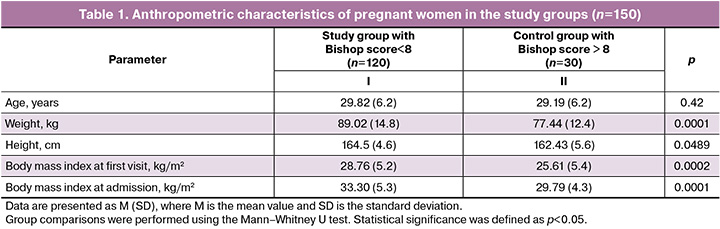
Clinical and anamnestic characteristics of the patients in the study groups were analyzed. The mean age of the patients was comparable between the study groups: 29.82 (6.2) years in group I and 29.19 (6.2) years in group II. Analysis of anthropometric characteristics revealed that the body mass index (BMI) of patients requiring cervical ripening before labor was significantly higher than that of the control group (33.3 [5.3] vs. 29.79 [4.3] kg/m², p=0.0001) (Table 1).
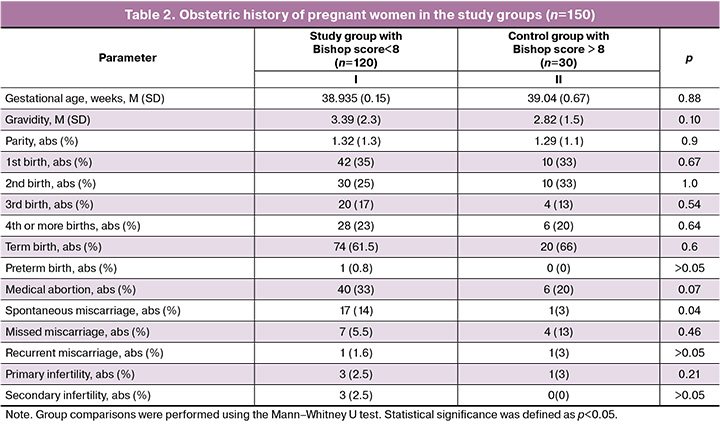
No statistically significant differences were observed between the groups in the number of pregnancies, number of previous deliveries, or gestational age. The mean gravidity was 3.39 (2.3) in group I and 2.82 (1.5) in group II. The mean number of previous deliveries was 1.32 (1.3) and 1.29 (1.1), respectively. Similarly, the proportions of nulliparous and multiparous women did not differ significantly between the groups (Table 2).
The mean age at sexual debut was 17.33 (1.3) years in the study group and 17.57 (2.0) years in the control group, with no statistically significant difference. Similarly, the mean age at menarche was nearly identical between the groups: 12.95 (0.9) years in the study group and 12.89 (1.3) years in the control group. The mean menstrual cycle length was approximately 29 days in both groups. The small between-group difference in cycle duration (approximately half a day) was not statistically significant. Women in the control group had a slightly longer duration of menstruation than those in the study group (5.1 [0.9] vs. 4.74 [0.75] days), although this difference was also not statistically significant.
The prevalence of menstrual disorders was low and comparable between the groups, occurring in 6/120 (5.0%) patients in the study group and 1/30 (3.3%) in the control group. A similarly small proportion of women in both groups had used hormonal contraception.
Patients with an adverse obstetric history were evenly distributed between the groups. The most common obstetric event in both groups was a history of induced abortion, reported in 40/120 (33%) patients in the study group and 6/30 (20%) in the control group. Infertility was observed in both groups; however, the observed differences either indicated no significant effect or approached the threshold for statistical significance, warranting further investigation in larger study populations.
Analysis of cervical pathology and previous cervical interventions demonstrated a history of cervical ectopy in 7/120 (5.8%) patients who underwent labor preinduction. First- and second-degree cervical lacerations during previous deliveries were more common in the study group, occurring in 6/120 (5.0%) patients.
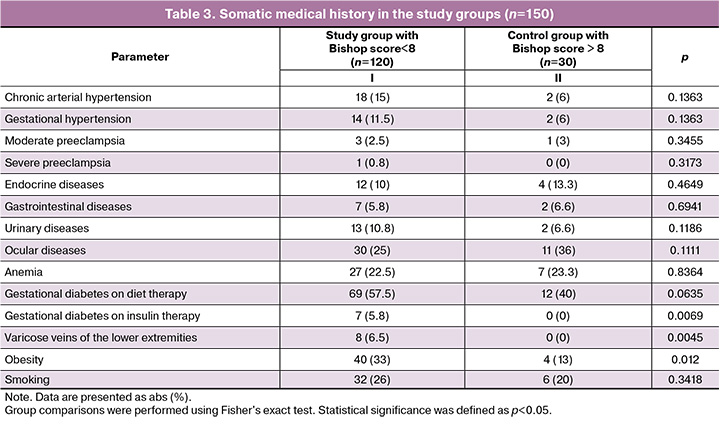
Analysis of concomitant somatic diseases showed that patients requiring labor preinduction were significantly more likely to have chronic medical conditions (p<0.05). Obesity, defined as a BMI >30.0 kg/m² regardless of severity, was significantly more common in group I than in the control group (33/120 [33%] vs. 4/30 [13%], p=0.012). In addition, insulin therapy for the management of carbohydrate metabolism disorders was required more frequently in the study group than in the control group (7/120 [5.8%] vs. 0/30 [0%], p=0.0069). Another distinguishing characteristic was varicose veins of the lower extremities, which were more prevalent in the study group (8/120 [6.5%] vs. 0/30 [0%]). The diagnosis of lower-extremity varicose veins was based on validated ultrasonographic criteria, including incompetence of the saphenofemoral junction and/or the great saphenous vein, with chronic venous insufficiency classified as stages 1, 2, or 3 (Table 3).
Discussion
Analysis of the clinical and anamnestic data of patients requiring cervical ripening before labor induction identified several key clinical and anamnestic factors associated with this need.
Our study demonstrated that patients requiring cervical ripening had a significantly higher body mass index and a higher prevalence of obesity compared with women who achieved spontaneous biological readiness for labor. Patients in the study group also required insulin therapy for glycemic control during pregnancy significantly more often.
The principal mechanism linking obesity to cervical immaturity involves hormonal imbalance and inflammatory changes associated with excess adiposity. The American College of Obstetricians and Gynecologists has described how metabolic syndrome impedes the natural process of cervical ripening: metabolic dysregulation leads to hyperinsulinemia and increased cellular insulin resistance [11]. This, in turn, raises androgen levels while reducing estrogen levels. Estrogens are essential for preparing the cervix for labor by promoting softening and dilation of the cervical canal. Production of inflammatory cytokines is also increased: the chronic inflammatory state characteristic of obesity upregulates biologically active molecules such as interleukin-6 and tumor necrosis factor-alpha, which induce local inflammation in reproductive tract tissue, impair cervical elasticity, and delay cervical readiness for labor [12]. These changes disrupt cervical ripening and increase the risk of complications during pregnancy and labor, including delayed spontaneous labor onset, the need for labor induction, and an elevated risk of cesarean delivery [11–13].
Among patients requiring cervical ripening, a notable finding was the presence of first- and second-degree obstetric cervical lacerations from previous deliveries, as well as a history of cervical ectopia.
Studies examining pregnancy and labor outcomes in women with cervical pathology have linked prior cervical ectopia to potential alterations in cervical mucosal structure [14–16]. Chronic inflammatory diseases of the reproductive organs are a common comorbid factor in ectopia and may impair connective tissue integrity and reduce the elasticity of the birth canal. Altered sensitivity of cervical nerve receptors resulting from these pathological changes may disrupt the reflexes required for normal cervical dilation and fetal descent during labor [16, 17].
The demographic and reproductive characteristics of the study population, including age, age at menarche, and total number of pregnancies and deliveries, did not differ significantly according to the need for cervical ripening.
Conclusion
Patients requiring cervical ripening before labor induction were characterized by a significantly higher body mass index and a higher prevalence of obesity, confirming the adverse effect of excess weight on the physiological mechanisms of cervical maturation.
The need for cervical ripening was more common among patients with a history of cervical ectopia, underscoring the importance of considering this factor in pregnancy management.
Chronic conditions, particularly obesity and diabetes mellitus, were significantly more likely to impair timely cervical maturation, increasing the frequency of labor preinduction.
Anthropometric and reproductive characteristics (age, age at first intercourse, age at menarche, and number of pregnancies and deliveries) did not differ significantly between study groups.
Patients with a history of cervical laceration more often required birth canal preparation. Cervical ripening was also more frequently required among patients with chronic vascular pathology, including varicose veins.
Overall, these findings highlight the importance of a comprehensive approach to the prevention and management of cervical pathology, as well as ongoing monitoring of maternal health, to support successful pregnancy outcomes and reduce the risk of adverse delivery outcomes.
References
- Пестрикова Т.Ю., Барботько Д.К., Лещева Д.К. Преиндукции родов: анализ эффективности использования мифепристона у первородящих и повторнородящих женщин. Фарматека. 2025; 3: 117-22. https://dx.doi.org/10.18565/pharmateca.2025.3.117-122 [Pestrikova T.Yu., Barbotko D.K., Leshcheva D.K. Pre-induction of labor: an analysis of the effectiveness of mifepristone use in primiparous and repeat-bearing women. Pharmateca. 2025; 3: 117-22 (in Russian). https://dx.doi.org/10.18565/pharmateca.2025.3.117-122]
- Ayala N.K., Rouse D.J. Failed induction of labor. Am. J. Obstet. Gynecol. 2024; 230(3S): S769-74. https://dx.doi.org/10.1016/j.ajog.2021.06.103
- Papalia N., D'Souza R.D., Hobson S.R. Optimal timing of labour induction in contemporary clinical practice. Best Pract. Res. Clin. Obstet. Gynaecol. 2022; 79: 18-26. https://dx.doi.org/10.1016/j.bpobgyn.2021.12.002
- Coates D., Makris A., Catling C., Henry A., Scarf V., Watts N. et al. A systematic scoping review of clinical indications for induction of labour. PloS One. 2020; 15(1): e0228196. https://dx.doi.org/10.1371/journal.pone.0228196
- Министерство здравоохранения Российской Федерации. Клинические рекомендации. Подготовка шейки матки к родам и родовозбуждение. 2024. [Ministry of Health of the Russian Federation. Clinical guidelines. Preparation of the cervix for childbirth and labor induction. 2024. (in Russian)].
- Lopez J., Garcia S., Pailos R., Rodrigo A., Pascual P., Moreno C. et al. Prediction of an effective cervical ripenning in the induction of labour using vaginal dinoprostone. Sci. Rep. 2023; 13(1): 6855. https://dx.doi.org/10.1038/s41598-023-33974-7
- Carlson N., Ellis J., Page K., Dunn Amore A., Phillippi J. Review of evidence-based methods for successful labor induction. J. Midwifery Women's Health. 2021; 66(4): 459-69. https://dx.doi.org/10.1111/jmwh.13238
- Saucedo A.M., Cahill A.G. Evidence-based approaches to labor induction. Obstet. Gynecol. Surv. 2023; 78(3): 171-83. https://dx.doi.org/10.1097/OGX.0000000000001110
- Ghi T., Dall'Asta A., Fieni S. Elective induction of labour in low risk nulliparous women at term: caution is needed. Eur. J. Obstet. Gynecol. Reprod. Biol. 2019; 239: 64-6. https://dx.doi.org/10.1016/j.ejogrb.2019.05.037
- Robinson D., Campbell K., Hobson S.R., MacDonald W.K., Sawchuck D., Wagner B. Guideline No. 432c: Induction of labour – general information. JOGC. 2023; 45(1): 35-44.e1. https://dx.doi.org/10.1016/j.jogc.2022.11.009
- Ashrafi R., Maxwell C., D'Souza R. Induction of labour in pregnant individuals with obesity. Best Pract. Res. Clin. Obstet. Gynaecol. 2022; 79: 70-80. https://dx.doi.org/10.1016/j.bpobgyn.2021.12.004
- Abdi F., Alizadeh S., Roozbeh N., Montazeri F., Banaei M., Mehrnoush V. et al. Prepregnancy overweight and obesity and the risk of adverse pregnancy outcomes. Scientific reports. 2025; 15(1): 16846. https://dx.doi.org/10.1038/s41598-025-02113-9
- Мартина М.Н., Ильин М.В., Чилова Р.А., Савельева М.И., Валиев Т.Т.,Ковалев М.И., Жолобова М.Н., Позняк М.В., Гадаева И.В., Севастьянов Г.Е. Влияние метаболического синдрома на фертильность женщин репродуктивного возраста. Врач. 2025; 36(5): 75-80. https://dx.doi.org/10.29296/25877305-2025-05-15 [Martina M.N., Ilyin M.V., Chilova R.A., Savelyeva M.I., Valiev T.T., Kovalev M.I., Zholobova M.N., Poznyak M.V., Gadaeva I.V., Sevastyanov G.E. The effect of metabolic syndrome on the fertility of women of reproductive age. Vrach. 2025; 36(5): 75-80 (in Russian). https://dx.doi.org/10.29296/25877305-2025-05-15]
- Kim W.J., Kim Y.W. Association between cervical conization and pregnancy outcomes: a nationwide population-based cohort study. PLoS One. 2026; 21(2): e0341660. https://dx.doi.org/10.1371/journal.pone.0341660
- Madhukaran S., Fomina Y.Y., Mahendroo M. Cervical function in pregnancy and disease: new insights from single-cell analysis. Am. J. Obstet. Gynecol. 2025; 232(4S): S81-94. https://dx.doi.org/10.1016/j.ajog.2024.07.039
- Sanchez-Ramos L., Levine L.D., Sciscione A.C., Mozurkewich E.L., Ramsey P.S., Adair C.D. et al. Methods for the induction of labor: efficacy and safety. Am. J. Obstet. Gynecol. 2024; 230(3S): 669-95. https://dx.doi.org/10.1016/j.ajog.2023.02.009
- Carlson N., Ellis J., Page K., Dunn Amore A., Phillippi J. Review of evidence-based methods for successful labor induction. J. Midwifery Womens Health. 2021; 66(4): 459-69. https://dx.doi.org/10.1111/jmwh.13238
Received 11.02.2026
Accepted 07.07.2026
About the Authors
Artem A. Khaikin, obstetrician-gynecologist, Maternity Unit, Ural Research Institute of Maternity and Child Care, Ministry of Health of Russia, 620028, Russia, Yekaterinburg, Repin str., 1, +7(982)703-99-30, Doter-lod@mail.ru, https://orcid.org/0009-0004-7518-7620Yuri A. Semenov, Dr. Med. Sci., Associate Professor, Honored Doctor of the Russian Federation, Rector, Ural State Medical University, Ministry of Health of Russia, 620028, Russia, Yekaterinburg, Repin str., 3, +7(343)371-87-68, u-sirius@mail.ru, https://orcid.org/0000-0002-3268-7981
Oxana A. Melkozerova, Dr. Med. Sci., Professor, Vice-Rector for Research and Innovation Activities, Ural State Medical University, Ministry of Health of Russia, 620028, Russia, Yekaterinburg, Repin str., 3; Deputy Director for Scientific Work Ural Research Institute of Maternity and Child Care, Ministry of Health of Russia, 620028, Russia, Yekaterinburg, Repin str., 1, +7(343)371-24-27, +7(922)219-45-06, abolmed1@mail.ru, https://orcid.org/0000-0002-4090-0578
Corresponding author: Artem A. Khaikin, doter-lod@mail.ru
Similar Articles