
Age, menstrual cycle regularity, and metabolic status as determinants of ultrasound reference values for uterine and ovarian parameters in adolescent girls
Razdrogina K.A., Istomina N.G., Baranov A.N., Trescheva N.D.
Background. Reproductive healthcare for adolescent girls is a priority in modern medicine, as puberty marks the completion of the morphofunctional maturation of the reproductive system. Diagnosis of gynecological pathology in this age group is challenging due to the lack of standardized ultrasound reference values for the uterus and ovaries that account for the dynamic nature of pubertal development. Morphometric parameters of reproductive organs are determined by several simultaneously changing factors: chronological and gynecological age, body mass index (BMI), and menstrual cycle characteristics. A strategy that integrates these factors is needed to establish an individual "normative track" and enable personalized patient management.
Objective. To assess the impact of chronological and gynecological age, body mass index, and menstrual cycle characteristics on clinical and ultrasound parameters of the reproductive system in adolescents, aiming to identify key determinants of age-specific norms during puberty.
Materials and methods. A prospective, non-randomized study with a diagnostic intervention (ultrasound monitoring) was conducted at Arkhangelsk City Clinical Outpatient Clinic No. 1. The study included 340 adolescent girls (aged 15–17 years) recruited from various educational institutions. The inclusion criteria were as follows: age 15–17 years, signed informed consent, absence of acute or exacerbated chronic diseases, and a history of menarche. All participants underwent serial pelvic ultrasound examinations (twice per menstrual cycle; total, n=2031 examinations). Statistical analysis was performed using the Kruskal–Wallis test, chi-square test (with Bonferroni correction), one-way analysis of covariance (ANCOVA), and univariate logistic regression.
Results. Chronological and gynecological ages were not independent determinants of clinical or ultrasound parameters (p>0.05), except for an expected increase in the proportion of regular cycles with advancing gynecological age (up to 90% at 6–8 years post-menarche, p=0.037). Menstrual cycle regularity was significantly associated with corpus luteum detection in the luteal phase (p<0.001), with irregular cycles associated with a markedly reduced probability of corpus luteum visualization (OR=0.209; 95% CI: 0.104–0.420). The newly defined "conditionally regular" cycle group represented a transitional phenotype: despite age similarity to the regular cycle group, ovarian ultrasound parameters (ovarian-uterine index [OUI], p<0.001; ovarian-uterine coefficient [OUC], p=0.016) were statistically closer to those of the irregular cycle group. BMI independently influenced ovarian volume (F=8.024; p=0.005) and ovarian-uterine indices (OUI: p=0.017), whereas uterine dimensions were not associated with BMI. OUI demonstrated greater sensitivity to intergroup differences than OUC.
Conclusion. Ovarian ultrasound is a sensitive tool for assessing the morphofunctional maturity of the reproductive system in adolescents and requires a multifactorial approach for result interpretation. Menstrual cycle regularity and BMI are key determinants of ovarian ultrasound morphology. Adolescents with conditionally regular and irregular menstrual cycles are at risk for ovulatory dysfunction, and ovarian-uterine ratios serve as sensitive markers for their identification. The findings will form the basis for a multilevel model of clinically applicable ultrasound reference values for the uterus and ovaries, incorporating age-related, functional, and metabolic characteristics of the animals.
Authors' contributions. Razdrogina K.A. – data collection, literature review, conception of the study, and drafting of the manuscript; Istomina N.G. – conception of the study, literature analysis, statistical analysis, and drafting of the manuscript; Baranov A.N. – design of the study and final editing. All authors confirm that they meet the international ICMJE authorship criteria. Each author has contributed substantially to the study's conception, data collection, or analysis; participated in drafting or revising the manuscript; and reviewed and approved the final version prior to submission.
Conflicts of interest. The authors have no conflicts of interest to declare.
Funding. There was no funding for this study.
Ethical Approval. The study was reviewed and approved by the Research Ethics Committee of the Northern State Medical University.
Generative Artificial Intelligence. No artificial intelligence tools were used in the preparation of this manuscript.
Patient Consent for Publication. All patients provided informed consent for the publication of their data.
Authors' Data Sharing Statement. The data supporting the findings of this study are available upon request from the corresponding author after approval from the principal investigator.
For citation: Razdrogina K.A., Istomina N.G., Baranov A.N., Trescheva N.D. Age, menstrual cycle regularity, and metabolic status as determinants of ultrasound reference values for uterine and ovarian parameters in adolescent girls.
Akusherstvo i Ginekologiya/Obstetrics and Gynecology. 2026; (9): 126-137 (in Russian)
https://dx.doi.org/10.18565/aig.2026.64
Keywords
adolescent girls
ovarian ultrasound
menstrual cycle
ovarian-uterine ratios
BMI
Reproductive healthcare for adolescent girls is a priority in modern medicine, as the pubertal period marks the completion of the morphofunctional maturation of the reproductive system. Ultrasonography (US) is one of the most accessible and informative methods for monitoring this process. However, clinicians currently lack standardized reference values for uterine and ovarian sonographic parameters that account for the dynamic nature of adolescent maturation, limiting the timely diagnosis of abnormalities [1, 2].
Simultaneously, the morphometric parameters of the reproductive organs during adolescence are determined by several dynamically changing factors, including chronological age, gynecologic age (time since menarche), and somatic status, particularly body mass index (BMI) [3]. Furthermore, characterizing normal development requires careful assessment of gynecologic history, including various patterns of menstrual cycle disturbances [4].
Thus, establishing sonographic reference values for the uterus and ovaries in adolescents requires more than simply accumulating research data; it necessitates an assessment strategy that integrates all the key factors. Such a system may make it possible to establish an individualized developmental "reference trajectory" for adolescent girls and distinguish physiological variations in maturation from the early stages of pathological processes, thereby enabling a personalized approach to managing patients.
This study aimed to assess the effects of chronological and gynecological age, BMI, and menstrual cycle characteristics on the clinical and ultrasonographic parameters of the reproductive system in adolescents, with the goal of clarifying the factors underlying the development of age-specific reference values during puberty.
Materials and methods
A prospective, nonrandomized study involving a diagnostic intervention (ultrasonographic monitoring) was conducted at the outpatient service of Arkhangelsk City Clinical Outpatient Clinic No. 1. Participants were recruited by disseminating information about the study through randomly selected educational institutions (schools, colleges, and technical schools) and advertisements on social media. The study included 340 adolescent girls aged 15–17 years: 80/340 (23.5%) were aged 15 years, 123/340 (36.2%) were aged 16 years, and 137/340 (40.3%) were aged 17 years.
The inclusion criteria were age 15–17 years, informed consent to participate in the study, absence of acute or chronic somatic diseases in exacerbation, and a history of menarche.
The exclusion criteria were severe somatic disease, gynecologic diseases diagnosed before the study, refusal to participate, use of hormonal contraceptives, presence of an intrauterine contraceptive device, and absence of the uterus and uterine adnexa on US.
Study end points. The primary endpoints were as follows: (1) ultrasonographic parameters of the uterus and ovaries (linear dimensions, volumes, and M-echo in the first and second phases of the menstrual cycle) as morphological markers of reproductive system maturity; (2) the ovarian–uterine index (OUI) and ovarian–uterine coefficient (OUC) as integrated functional measures; and (3) the presence of a corpus luteum in the second phase of the cycle as a direct ultrasonographic marker of ovulation. The secondary endpoints were the clinical and medical history characteristics of menstrual function, including cycle regularity, severity of dysmenorrhea, and heavy menstrual bleeding.
In the first stage, all participants completed a questionnaire that included a detailed history of menstrual function and information on other aspects of gynecologic history. The BMI was also calculated for each participant. The questionnaire comprised the following sections.
- General information: Participants reported their chronological age (completed years), height, and weight. BMI was calculated using the following formula: BMI = weight (kg)/height (m)². BMI was interpreted in accordance with the recommendations of the Russian Association of Endocrinologists, "Assessment of Physical Development in Children and Adolescents" [5].
- Menstrual cycle: Age at menarche, cycle duration and regularity, age at establishment of regular cycles, and duration of menstruation were assessed. Gynecologic age was calculated as the difference between chronological age and age at the time of menarche.
- Cycle regularity was assessed using menstrual calendars for the preceding 6–12 months. The criteria for an irregular cycle were based on the 2024 European Society of Human Reproduction and Embryology (ESHRE) recommendations [1]: during the first year after menarche, any cycle lasting more than 90 days was considered irregular; more than 1 year but less than 3 years after menarche, cycles lasting less than 21 days or more than 45 days were considered irregular; more than 3 years after menarche, cycles lasting less than 21 days or more than 35 days, or fewer than 8 cycles per year, were considered irregular. All cycles with abnormal durations but with at least 11 cycles per year were considered regular; all other cycles that did not meet the criteria for irregularity but did not exceed 90 days were classified as conditionally regular.
- Presence and severity of menstrual pain were assessed using a visual analog scale (VAS) ranging from 0 (no pain) to 5 (unbearable pain), as well as a pain tolerance scale ranging from "1 – pain can be ignored" to "5 – bed rest is required." A comprehensive assessment of the clinical presentation of dysmenorrhea was performed using a questionnaire addressing the following parameters: quality of life (physical, social, and academic activity), autonomic symptoms accompanying menstruation (nausea and vomiting), sites and intensity of pain, severity of depressive symptoms, and symptoms suggestive of endometriosis (pain during urination and/or defecation during menstruation). The analysis was based on the total score for each scale, the and participants were divided into groups using percentile analysis. The 75th percentile was selected as the threshold for most of the parameters. The selection of the upper quartile allowed for the definition of a risk group comprising participants with a substantial but not maximal symptom burden. Symptoms of painful urination and/or defecation during menstruation were treated as exceptions. Given their high diagnostic specificity for endometriosis, the criterion was based not on the total score, but on the presence of the symptom itself. We also considered participants' reports of using pharmacologic analgesic therapy with minimal effect. Given the high prevalence of self-reported symptoms, dysmenorrhea was defined as the presence of more than two of the above-mentioned features.
- Heavy menstrual bleeding was assessed according to a menstrual cycle duration of less than 24 days, menstrual bleeding lasting more than 8 days, frequency of changing sanitary products when fully saturated on the heaviest days (more than one sanitary pad every 2 hours), presence of menstrual clots larger than 2 cm, and self-reported heavy menstrual bleeding. We also assessed whether the participants had sought medical care because of heavy menstrual bleeding, received hormonal hemostatic therapy, or had a history of hospitalization for heavy menstrual bleeding. As with dysmenorrhea, the high prevalence of self-reported symptoms led us to define heavy menstrual bleeding as the presence of more than two of the above-mentioned features.
In the second stage, all participants underwent pelvic ultrasonography twice per menstrual cycle using a VOLUSON S8 ultrasound system. Examinations were performed transabdominally with a full bladder (1,494 total ultrasound examinations) and transvaginally among sexually active participants who provided consent (129 adolescents; 537 transvaginal ultrasound examinations). Ultrasound assessment included uterine and ovarian sizes and morphology. During the second phase of the menstrual cycle, the disappearance of the dominant follicle and the presence of the corpus luteum were assessed. The corpus luteum was defined as an anechoic or hypoechoic lesion of regular or irregular shape, with a distinct, smooth external contour and a hypervascular peripheral rim along the outer contour (according to Ozerskaya I.A. et al.) [6].
Several ratios were calculated. The uterine body-to-cervix length ratio was calculated as follows: uterine body length/cervical length. The OUI was calculated using the formula proposed by Demidov V.N. (1990): OUI = 0.5 (0.5×right ovarian volume + 0.5×left ovarian volume)/uterine thickness [7].The ovarian–uterine coefficient (OUC) was calculated as follows: OUC = mean ovarian volume/mean uterine volume [4]. In the analyses of ovarian volumetric parameters (ovarian volume and OUC), cases with identified ovarian cysts (n=47) were excluded because cysts result in non-physiological enlargement of the ovarian volume and distortion of normative values. The final analysis of the volumetric parameters was conducted in a subsample of 293 participants.
Statistical analysis
Statistical analyses were performed using IBM SPSS Statistics (version 23.0; IBM Corp., Armonk, NY, USA). The normality of the distribution of continuous variables was assessed using the Shapiro–Wilk test. Normally distributed variables are presented as mean and standard deviation, M (SD), whereas non-normally distributed variables are presented as median and quartiles, Me (Q1; Q3). The absolute and relative frequencies of categorical variables are presented as n (%).
The Mann–Whitney U test was used to compare continuous variables between two independent groups, and the Kruskal–Wallis test was used for comparisons among three or more groups. When statistically significant differences were identified using the Kruskal–Wallis test, pairwise comparisons were performed using the Mann–Whitney U test with Bonferroni correction. Pearson's χ² test was used to analyze categorical variables, and Fisher's exact test was applied when expected cell frequencies were less than 5. When statistically significant differences were identified in contingency tables with multiple categories, pairwise comparisons with Bonferroni correction were conducted. For multiple comparisons, the adjusted threshold for statistical significance was calculated using the Bonferroni correction and was set at p<0.017 (0.05/3) or p<0.008 (0.05/6), depending on the number of groups compared. A one-way analysis of covariance (ANCOVA) was used to assess the independent effects of body mass index (BMI) and menstrual cycle regularity on continuous ultrasonographic parameters. Menstrual cycle type was included in the model as a fixed categorical factor with three levels: regular cycle (reference group), conditionally regular cycle, and irregular cycle. BMI was included as a continuous covariate. The interaction between the factors and covariates was also assessed. Results are presented as F-statistics and corresponding p-values.
Logistic regression analysis was used to examine the factors associated with binary outcomes, namely, the presence of a corpus luteum and ovarian cysts. The potential predictors included BMI as a continuous variable and menstrual cycle type as a categorical variable, with regular cycles as the reference group. Predictor selection was based on clinical relevance and the evidence in the literature. At this stage, univariable logistic regression analyses were performed to assess the isolated contributions of each factor. The independent variables were assessed for multicollinearity (variance inflation factor <2.0). Results are presented as odds ratios (ORs) with 95% confidence intervals (CIs) and p-values. Differences were considered statistically significant at p<0.05.
Results
The results were analyzed in stages to establish a reference group of adolescents with physiological pubertal development and to identify clinical, anamnestic, and ultrasonographic factors that potentially influence the morphofunctional parameters of the reproductive system.
In the first stage, we determined the baseline descriptive characteristics of the study group by stratifying the participants according to chronological age. The age distribution included three groups: 15 years – 23.5% (80/340), 16 years – 36.2% (123/340), and 17 years – 40.3% (137/340). The mean age at menarche across the entire cohort was 12.54±1.19 years (range, 9–16).
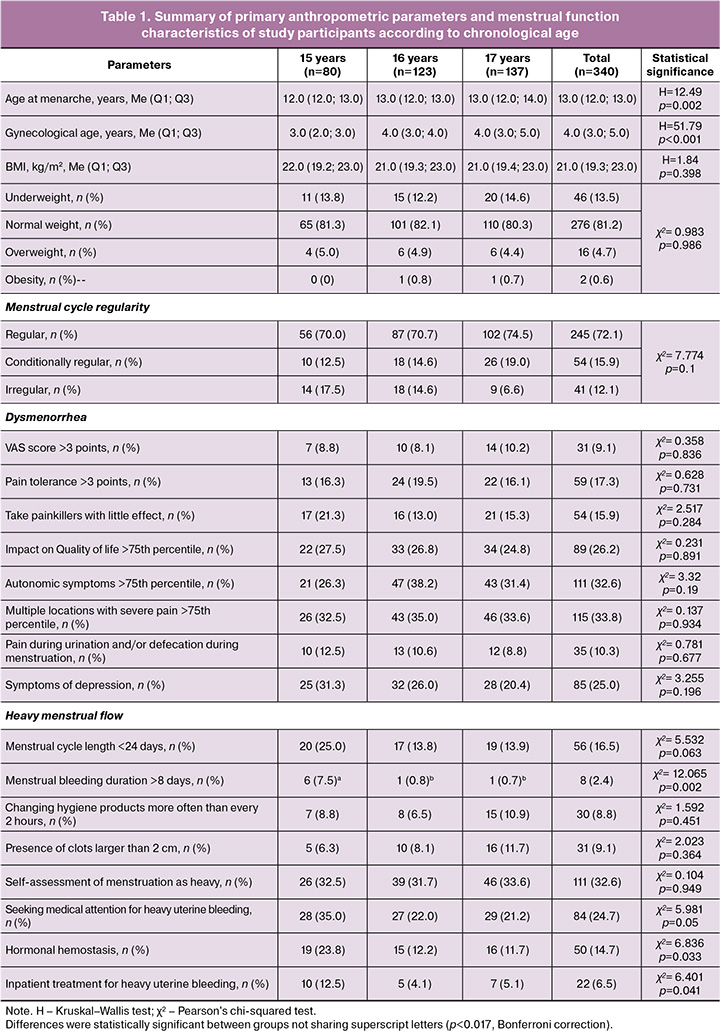
Analysis of all clinical and anamnestic questionnaire parameters revealed no statistically significant differences based on chronological age. The majority of participants (81.2%) had a normal body mass index (BMI) of 21.0 (19.3–23.0) kg/m², with no statistically significant intergroup differences in BMI. A regular menstrual cycle was reported by 72.1% of respondents and was independent of chronological age (p=0.1). Statistically significant differences between age groups were observed in the duration of menstrual bleeding exceeding 8 days (p=0.002).
Pairwise comparisons with Bonferroni correction demonstrated that prolonged bleeding occurred more frequently in 15-year-old adolescents than in 16- and 17-year-olds (p<0.017), whereas the differences between the latter two groups did not reach statistical significance. The summary data are presented in Table 1.
Given that the establishment of menstrual function and morphofunctional parameters of reproductive organs during adolescence are largely determined by the duration of hormonal exposure, the next analytical stage was performed according to gynecological age (Table 2).

At this stage, the groups remained largely homogeneous with a few notable exceptions. First, as expected, the proportion of regular menstrual cycles increased with advancing gynecological age, reaching 90% at 6–8 years post-menarche (p=0.037). Furthermore, given the narrow age range of 15–17 years, specific patterns were observed in the distribution of mean age at menarche: later menarche onset was noted in the group with a gynecological age of less than 1 year, whereas age at menarche was significantly lower in the group with 6–8 years post-menarche (p<0.011). These two polar groups were distinct from the remainder of the cohort. They exhibited a higher incidence of uterine bleeding and related hospitalizations (p=0.001), with peak values observed in the groups with the shortest and longest gynecological ages, potentially reflecting features of early menarche or early maturation period of menstrual function.
Another notable finding was that, despite the absence of a statistically significant increase in pain severity on the Visual Analog Scale (VAS), the frequency of specific complaints of pain during urination and/or defecation during menses increased significantly with longer gynecological age (p=0.001). Pairwise comparisons indicated significant differences predominantly between the extreme gynecological age groups. This dynamic may serve as a clinical marker for the potential progression of organic pathologies, including endometriosis, the symptoms of which tend to manifest as the duration of exposure to the menstrual factor lengthens.
Thus, these data demonstrate that neither chronological nor gynecological age independently accounted for the pronounced differences in most clinical parameters across the overall cohort. This allowed us to consider the study population relatively homogeneous and proceed with the evaluation of the ultrasonographic features of the uterus and ovaries. Given that previous studies have demonstrated that morphofunctional ultrasound characteristics depend on cycle regularity and metabolic status, the next stage of analysis involved stratifying participants by menstrual cycle pattern.
In accordance with our predefined criteria for menstrual regularity, all participants were divided into three subgroups: regular, conditionally regular, and irregular menstrual cycles. At this point, the question arose as to whether patients with regular and conditionally regular cycle patterns could be merged into a single group. To evaluate this, a comparative analysis of the primary clinical, anthropometric, and ultrasonographic parameters was performed.
To evaluate group comparability, chronological age, gynecological age, BMI, mean linear dimensions, uterine and ovarian volumes, uterine body-to-cervix maturity ratios, ovarian-to-uterine volume metrics (OUC and OUI), endometrial thickness (M-echo), presence of a corpus luteum in the luteal phase, and several clinical parameters (heavy menstrual bleeding, dysmenorrhea, and intermenstrual bleeding) were analyzed. Because the measurements were performed across two cycle phases, all linear dimensions and volumes were calculated using the arithmetic means. The primary characteristics of the study groups are shown in Table 3.

Prior to statistical analysis, a "conditionally regular" menstrual cycle was considered a physiological variant of normal menstrual maturation, rather than a pathological state. However, during the initial data evaluation, we hypothesized that this cycle pattern might represent a transitional or subclinical variant of ovulatory dysfunction.
No statistically significant differences were observed between the groups of varying cycle regularity in terms of chronological age, age at menarche, gynecological age, BMI, or uterine body-to-cervix ratio (p>0.05 for all comparisons).
In contrast, the analysis of pelvic ultrasound parameters revealed statistically significant intergroup differences across several indices reflecting the morphofunctional state of the ovaries (Table 3).
Because the presence of ovarian cysts could confound the evaluated parameters, analyses of ovarian volume, follicle count, OUI, and OUC were performed after excluding patients with ovarian cysts. Kruskal–Wallis testing demonstrated statistically significant differences between groups for OUI and OUC (p<0.05). Bonferroni-adjusted pairwise comparisons revealed that values for these parameters were statistically significantly higher in the conditionally regular group than in the regular group (p<0.017), whereas the irregular group occupied an intermediate position and did not differ significantly from the other groups.
For several other ultrasound parameters (including ovarian volume and follicle count), the observed intergroup differences did not maintain statistical significance after adjustment for multiple comparisons (p>0.017).
Corpus luteum detection rates were highest in adolescents with regular cycles and lowest in those with irregular cycles (p<0.001). Pairwise comparisons demonstrated statistically significant differences when comparing the regular and conditionally regular groups with the irregular group (p=0.002 and p<0.001, respectively), whereas the differences between the regular and conditionally regular groups did not reach statistical significance.
Thus, these findings indicate differences in ovarian morphological characteristics based on the menstrual cycle pattern; however, a portion of the identified associations appears borderline and warrants further verification considering potential confounding factors.
The hypothesis regarding potential age-related immaturity and subjective errors in cycle reporting among girls with irregular menstruation (specifically, due to intermenstrual bleeding) was not statistically confirmed.
The identified differences suggest that a conditionally regular menstrual cycle may represent a transitional or subclinical phenotype distinct from both completely regular and markedly irregular cycles.
Given the observed intergroup differences and the potential influence of metabolic factors, multivariate analysis was performed to evaluate the independent contributions of BMI and menstrual cycle pattern to pelvic ultrasound characteristics. Analysis of covariance (ANCOVA) established that BMI was significantly associated with several ultrasound indices, including ovarian volume and OUI values (p<0.05).
Importantly, menstrual cycle patterns maintained a statistically significant association with OUI and OUC after adjusting for BMI, demonstrating their independent contribution. The interaction between BMI and menstrual cycle pattern was not statistically significant (p>0.05). Specifically, BMI was significantly associated with ovarian volume (F=8.024, p=0.005) and OUI (F=5.728, p=0.017), whereas a trend toward an association was observed for OUC (F=3.265, p=0.059). Uterine dimensions were not significantly associated with BMI.
Despite the demonstrated effect of BMI on morphometric parameters (ovarian volume and OUI), its role in qualitative cycle characteristics (presence of a corpus luteum and cysts) was less pronounced.
To evaluate the factors associated with the presence of a corpus luteum and ovarian cysts, a univariable logistic regression analysis was performed (Table 4). BMI and menstrual cycle patterns were evaluated as potential predictors, selected based on previously identified correlations and clinical relevance.

According to the analysis, the menstrual cycle pattern was the only statistically significant predictor of the presence of a corpus luteum (p<0.001). An irregular cycle was associated with a nearly five-fold reduction in the odds of corpus luteum detection (OR 0.213; 95% CI 0.106–0.426; p<0.001) compared to the control group. For conditionally regular cycles, no statistically significant difference was observed (p=0.5). Regarding ovarian cysts, no statistically significant association with the menstrual cycle pattern was identified in this cohort (p=0.605). These results align with the understanding that ovulatory function is tied to menstrual cycle regularity, whereas ovarian cyst formation is likely governed by distinct mechanisms.
Discussion
This study aimed to conduct a stepwise evaluation of the clinical, anamnestic, and sonographic characteristics of reproductive system maturation in adolescent females. The ultimate goal was to establish reference values for the menstrual cycle and sonographic features of the uterus and ovaries. Unlike most previous studies, we accounted for the contributions of multiple anthropometric and clinical-anamnestic parameters and their mutual effects on sonographic findings.
In the first stage, we demonstrated that neither chronological age nor gynecological age independently determined the variability in clinical and sonographic parameters. These results align with the current understanding of the high inter-individual variability in the maturation rate of the hypothalamic-pituitary-ovarian (HPO) axis [3], underscoring the limitations of relying solely on age-based criteria to define normal puberty.
Nevertheless, analyzing parameters according to gynecological age yielded greater specificity. The observed increase in the proportion of regular cycles with advancing gynecological age is consistent with the findings of at least 14 studies reviewed by Carlson L.J. et al. (2019) [9]. These studies reported that the frequency of ovulatory cycles rises from 20–30% in the first year postmenarche to approximately 50% after 3–4 years [9, 10]. This allows our data to be interpreted as reflecting the general patterns of ovulatory function development and confirms the representativeness of our study sample.
A critical stage of the study was the analysis of the data stratified by menstrual cycle regularity. We identified significant differences in sonographic parameters reflecting uterine and ovarian proportions and ovarian functional activity, which is consistent with similar studies [4, 11]. Notably, we utilized two ovarian-uterine ratio coefficients previously described in the literature: OUI and OUC. In our study, both indices were sensitive markers of cycle regularity and metabolic status, with the OUI demonstrating a greater statistical significance.
The frequency of corpus luteum visualization in the present study decreased consistently and significantly from the regular to the irregular cycle group. This aligns with the current physiological understanding of ovulation and is regarded in clinical guidelines as the most practical indicator of ovulatory function [1].
The results obtained in the group of adolescents with a conditionally regular cycle are of particular importance. We introduced the concept of a conditionally regular cycle in this study to encompass all cases that did not meet the criteria for regular or irregular cycles. When other measured characteristics were comparable, the sonographic parameters were closer to those typical of an irregular cycle. This discrepancy between the clinical regularity and functional signs indicates that a conditionally regular cycle should not be considered an unambiguous variant of the normal cycle. Pairwise comparisons support this assumption: differences between regular and conditionally regular cycles were predominantly observed in sonographic parameters, whereas differences between conditionally regular and irregular cycles were primarily related to age. This highlights the limitations of clinically evaluating menstrual regularity without considering morphofunctional data, a point also emphasized in the current clinical guidelines for managing adolescents with menstrual irregularities [12, 13].
A separate analytical stage focused on the impact of metabolic status. BMI was shown to independently affected ovarian volume and OUI without influencing uterine dimensions. Similar data have been reported in population-based ultrasound studies, which demonstrated that BMI is associated with increased ovarian volume and antral follicle count, whereas uterine size remains relatively stable [8, 14]. This confirms the high sensitivity of ovarian tissue to metabolic factors and the necessity of considering BMI when interpreting sonographic findings.
However, in the multivariate models, menstrual cycle regularity did not affect the quantitative sonographic parameters, remaining a key factor associated exclusively with the presence of a corpus luteum.
These findings have important methodological implications for establishing reference values for sonography. Given the asynchrony between chronological and gynecological age, as well as the functional heterogeneity of the menstrual regularity, normative ranges cannot be established based on a single parameter. A combined stratification approach incorporating age, gynecological age, and menstrual cycle type, with BMI as a modifying factor, appears to be a promising strategy.
Consequently, the next stage of our research will focus on developing a multilevel model of age-specific normative sonographic values for the uterus and ovaries based on the integration of age, functional, and metabolic characteristics. This approach will enable the establishment of clinically applicable reference values that reflect the physiological heterogeneity during puberty.
Conclusions
- Chronological and gynecological ages are not independent, universal criteria for the degree of morphofunctional maturity of the reproductive system in adolescents, underscoring the need to integrate age characteristics with functional and morphological indicators of reproductive system maturity.
- Menstrual cycle regularity is associated with ovarian functional activity and is primarily reflected in the frequency of corpus luteum detection, confirming the menstrual cycle as an indicator of the functional state of the reproductive system.
- Adolescents with conditionally regular and irregular menstrual cycles exhibit a discrepancy between age characteristics and sonographic findings. These phenotypes should be considered at-risk groups for the development of ovulatory dysfunction.
- BMI exerts an independent effect on ovarian sonographic parameters, including volume and proportional indices, and must be considered when establishing normative sonographic values.
- Ovarian sonographic data represent a highly sensitive tool for assessing morphofunctional maturity; its application should be broader and more systematic, albeit requiring careful and responsible investigations. Furthermore, the OUI and OUC are not identical indices; at this stage, the OUI better corroborated the clinical differences between groups and can be considered a sensitive marker of functional maturity.
- An accurate description of the ranges of sonographic parameters reflecting physiological variability of the uterus and ovaries during adolescence requires a multifactorial approach that integrates chronological and gynecological age, menstrual regularity characteristics, and metabolic status of the adolescent.
References
- Teede H.J., Tay C.T., Laven J.J.E., Dokras A., Moran L.J., Piltonen T.T. et al. Recommendations from the 2023 International Evidence-based Guideline for the Assessment and Management of Polycystic Ovary Syndrome. J. Clin. Endocrinol. Metab. 2023; 108(10): 2447-69. https://dx.doi.org/10.1210/clinem/dgad463
- Волк Ю.В., Солнцева А.В. Диагностика и лечение синдрома поликистозных яичников у подростков. Репродуктивное здоровье Восточная Европа. 2021; 11(1): 41-9. https://dx.doi.org/10.34883/PI.2021.11.1.014 [Volk Yu.V., Solntseva A.V. Diagnosis and treatment of polycystic ovary syndrome in adolescents. Reproductive Health Eastern Europe. 2021; 11(1): 41-9. (in Russian). https://dx.doi.org/10.34883/PI.2021.11.1.014].
- Истомина Н.Г., Раздрогина К.А., Баранов А.Н. Ультразвуковые особенности функциональной анатомии внутренних половых органов в период раннего постменархе. Гинекология. 2025; 27(3): 209-14. https://dx.doi.org/10.26442/20795696.2025.3.203382 [Istomina N.G., Razdrogina K.A., Baranov A.N. Ultrasound features of the internal genitalia functional anatomy in the early postmenarcheal period. A review. Gynecology. 2025; 27(3): 209-14 (in Russian). https://dx.doi.org/10.26442/20795696.2025.3.203382].
- Radivojevic U.D., Lazovic G.B., Kravic-Stevovic T.K., Puzigaca Z.D., Canovic F.M., Nikolic R.R. et al. Differences in anthropometric and ultrasonographic parameters between adolescent girls with regular and irregular menstrual cycles: a case-study of 835 cases. J. Pediatr. Adolesc. Gynecol. 2014; 27(4): 227-31. https://dx.doi.org/10.1016/j.jpag.2013.11.007
- Российская ассоциация эндокринологов. Оценка физического развития детей и подростков. Методические рекомендации. М.; 2017. 98 c. [Russian Association of Endocrinologists. Assessing the physical development of children and adolescents. Guidelines. Moscow; 2017. 98 p. (in Russian)].
- Озерская И.А., Семилетова А.А., Казарян Г.Г. Ультразвуковая диагностика эндометрита (В-режим). Ультразвуковая и функциональная диагностика. 2017; (6): 36-52. https://dx.doi.org/10.24835/1607-0771-2017-6-36-52 [Ozerskaya I.A., Semiletova A.A., Kazaryan G.G. Ultrasound in diagnosis of endometritis (B-mode). Ultrasound & Functional Diagnostics. 2017; (6): 36-52 (in Russian). https://dx.doi.org/10.24835/1607-0771-2017-6-36-52].
- Хащенко Е.П., Уварова Е.В., Иванец Т.Ю., Мамедова Ф.Ш., Высоких М.Ю., Боровиков П.И., Балашов И.С. Ключевые критерии диагностики синдрома поликистозных яичников у подростков с учетом уточненных возрастных нормативов гормонального и метаболического статуса. Акушерство и гинекология. 2019; 9: 102-10. https://dx.doi.org/10.18565/aig.2019.9.102-110 [Khashchenko E.P., Uvarova E.V., Ivanets T.Yu., Mamedova F.Sh.,Vysokikh M.Yu., Borovikov P.I., Balashov I.S. Key diagnostic criteria for adolescent polycystic ovary syndrome adjusted for age-specific hormonal and metabolic status standards. Obstetrics and gynecology. 2019; (9): 102-110 (in Russian). https://dx.doi.org/10.18565/aig.2019.9.102-110].
- Камилова Н.Н., Султанова И.А., Халилова Г.М., Ахмедзаде В.А. Комплексная ультразвуковая диагностика органов малого таза у девушек-подростков при ожирении. Пермский медицинский журнал. 2019; 36(3): 43-50. https://dx.doi.org/10.17816/pmj36343-50 [Kamilova N.M., Sultanova I.A., Khalilova G.M., Akhmedzade V.A. Complex ultrasound diagnosis of pelvic organs in girls-adolescents with obesity. Perm Medical Journal. 2019; 36(3): 43-50 (in Russian). https://dx.doi.org/10.17816/pmj36343-50].
- Carlson L.J., Shaw N.D. Development of ovulatory menstrual cycles in adolescent girls. J. Pediatr. Adolesc. Gynecol. 2019; 32(3): 249-53. https://dx.doi.org/10.1016/j.jpag.2019.02.119
- De Sanctis V., Soliman A.T., Tzoulis P., Daar S., Di Maio S., Millimaggi G. et al. Hypomenorrhea in adolescents and youths: normal variant or menstrual Disorder? Revision of literature and personal experience. Acta Biomed. 2022; 93(1): e2022157. https://dx.doi.org/10.23750/abm.v93i1.12804
- Porcu E. Imaging in pediatric and adolescent gynecology. Endocr. Dev. 2004; 7: 9-22. https://dx.doi.org/10.1159/000077074
- ACOG Committee Opinion No. 651: Menstruation in girls and adolescents: Using the menstrual cycle as a vital sign. Obstet. Gynecol. 2015; 126(6): e143-e146. https://dx.doi.org/10.1097/AOG.0000000000001215
- Saei Ghare Naz M., Farahmand M., Dashti S., Ramezani Tehrani F. Factors affecting menstrual cycle developmental trajectory in adolescents: a narrative review. Int. J. Endocrinol. Metab. 2022; 20(1): e120438. https://dx.doi.org/10.5812/ijem.120438
- Dondi E., Tufano M., Vigone M.C., Lucaccioni L., Pozzobon G., Ubertini G. et al. Polycystic ovary syndrome in pediatric obesity and diabetes. Minerva Pediatr. (Torino). 2021; 73(6): 523-36. https://dx.doi.org/10.23736/S2724-5276.21.06542-3
Received 24.02.2026
Accepted 02.09.2026
About the Authors
Ksenya A. Razdrogina, PhD Student at the Department of Obstetrics and Gynecology, Northern State Medical University, Ministry of Health of Russia, 163000, Russia, Arkhangelsk, Troitsky Ave., 51, +7(8182)24-03-46, +7(999)270-29-25, ksushka08_91@mail.ru, SPIN: 9481-8909, https://orcid.org/0000-0003-3010-2983Natalia G. Istomina, PhD, Associate Professor at the Department of Obstetrics and Gynecology, Northern State Medical University, Ministry of Health of Russia, 163000, Russia, Arkhangelsk, Troitsky Ave., 51, +7(8182)24-03-46, +7(921)477-47-84, nataly.istomina@gmail.com, SPIN: 3839-9145, https://orcid.org/0000-0001-9214-8923
Alexey N. Baranov, Dr. Med. Sci., Professor, Head of the Department of Obstetrics and Gynecology, Northern State Medical University, Ministry of Health of Russia, 163000, Russia, Arkhangelsk, Troitsky Ave., 51, a.n.baranov2011@yandex.ru, SPIN: 5935-5163, https://orcid.org/0000-0003-2530-0379
Natalia D. Trescheva, PhD, Associate Professor at the Department of Obstetrics and Gynecology, Northern State Medical University, Ministry of Health of Russia, 163000, Russia, Arkhangelsk, Troitsky Ave., 51, +7(8182)24-03-46, +7(921)484-76-33, trescheva.nd@gmail.com
Similar Articles