

External validation of the Fetal Medicine Foundation algorithm for predicting preeclampsia before 37 weeks' gestation in a Russian cohort
Ivshin A.A.
Objective. To externally validate the Fetal Medicine Foundation (FMF) algorithm for predicting preeclampsia before 37 weeks' gestation (preterm preeclampsia) in a Russian cohort, comprehensively assessing its discrimination, calibration, and clinical utility.
Materials and methods. This retrospective cohort study utilized data from a multicenter pregnancy registry. The validation cohort included 7,369 women, with 119 cases (1.61%) of preterm preeclampsia. Preterm preeclampsia risk was calculated using the extended configuration of the FMF algorithm, which incorporates maternal factors and first-trimester biomarkers (MAP, UtAPI, PlGF, PAPP-A). Outcomes assessed included AUC, O:E ratio, calibration slope, screening performance at various risk thresholds, and decision curve analysis.
Results. The FMF algorithm demonstrated high discriminative ability, with an AUC of 0.893 (95% CI: 0.856–0.925). Calibration was good, indicated by an O:E ratio of 1.007 (95% CI: 0.842–1.206). At the standard 1:100 risk threshold, sensitivity was 84.0%, specificity 80.2%, screen-positive rate 20.8%, and negative predictive value 99.7%. Subgroup analysis revealed risk overestimation in women with chronic hypertension (O:E=0.41) and underestimation in women with prior preeclampsia (O:E=1.35). External validation in an additional cohort (n=7,581) confirmed these results, with an AUC of 0.907 and an O:E of 1.085. Sensitivity at the standardized 10% false-positive rate, conventionally used in international FMF validations, was 75.6% (95% CI: 66.9–83.0). Secondary analysis for early preeclampsia (delivery before 34 weeks; 131 cases in the pooled cohort) showed higher discriminative ability (AUC=0.919 and 0.956 in the two cohorts) but with systematic overestimation of risk (O:E=0.516 and 0.551).
Conclusion. The FMF algorithm demonstrates high discriminative ability and high calibration accuracy for preterm preeclampsia prediction in a Russian cohort, comparable to findings from major European validation studies. These results support the implementation of the FMF algorithm in the Russian prenatal screening system when using the standard 1:100 risk threshold.
Conflicts of interest. The author has no conflicts of interest to declare.
Funding. There was no funding for this study.
Ethical Approval. The study was reviewed and approved by the Research Ethics Committee of the Petrozavodsk State University (Ref. No: 17 of 20.03.2024).
Generative Artificial Intelligence. No artificial intelligence tools were used in the preparation of this manuscript.
Patient Consent for Publication. Given the retrospective nature of the study and the use of de-identified data, informed consent was not required under applicable law.
Author's Data Sharing Statement. Anonymized data are available from the author upon a substantiated request, in accordance with the requirements of Federal Law No. 152-FZ "On Personal Data." Supplementary materials (Appendix) are publicly available: https://doi.org/10.5281/zenodo.19286495
For citation: Ivshin A.A. External validation of the Fetal Medicine Foundation algorithm for
predicting preeclampsia before 37 weeks' gestation in a Russian cohort.
Akusherstvo i Ginekologiya/Obstetrics and Gynecology. 2026; (10): 56-67 (in Russian)
https://dx.doi.org/10.18565/aig.2026.105
Keywords
preeclampsia
first-trimester screening
FMF algorithm
external validation
calibration
prediction model
Russian cohort
Preeclampsia, a multisystem complication, affects 2–8% of pregnant women and remains a leading cause of maternal mortality [1, 2]. In the Russian Federation, hypertensive disorders occupy one of the leading positions among the causes of maternal mortality [3, 4]. Preterm preeclampsia, defined as preeclampsia requiring delivery before 37 weeks of gestation, is of particular clinical importance due to its association with the majority of severe outcomes [5, 6].
The Fetal Medicine Foundation (FMF) algorithm, based on a competing-risks model [7–9], integrates maternal factors with first-trimester biomarkers: mean arterial pressure (MAP), uterine artery pulsatility index (UtAPI), placental growth factor (PlGF), and pregnancy-associated plasma protein A (PAPP-A). The ASPRE trial (n=26,941) demonstrated that aspirin administration to women identified as high risk reduced the incidence of preterm preeclampsia by 62% [10], forming the basis for the International Federation of Gynecology and Obstetrics (FIGO) recommendations [11].
Validation studies have confirmed the algorithm's performance in European cohorts: AUC=0.89 in PRESIDE (Denmark, n=8,783) [12], sensitivity 82.4% – in SPREE (United Kingdom, n=16,747) [13]. However, in Asian cohorts results are heterogeneous: sensitivity 65% in China [14], AUC=0.96 in Japan [15], indicating the need for local validation [14–16].
The performance of the FMF algorithm in a cohort of Russian women has not been adequately investigated. While Kholin A.M. et al. demonstrated moderate performance in predicting early-onset preeclampsia (AUC 0.69–0.79) [17], a comprehensive external validation of the full FMF algorithm, including calibration assessment, has not been performed. Calibration – the agreement between predicted probabilities and observed outcome frequencies – is a critical yet frequently underappreciated aspect of prognostic model evaluation [18].
Study objective: to externally validate the FMF algorithm for predicting preterm preeclampsia in a cohort of Russian women, with a comprehensive assessment of discrimination, calibration, and clinical utility.
Study aims:
- To assess the discriminatory performance of the FMF algorithm for predicting preterm preeclampsia in a cohort of Russian women and compare the results with those of international validation studies.
- To comprehensively assess the calibration of the FMF algorithm using the observed-to-expected (O:E) ratio, calibration slope, integrated calibration index (ICI), and Brier score, and determine whether local recalibration is necessary.
- To determine the operating characteristics of screening (sensitivity, specificity, predictive values, and screen-positive rate) at different risk thresholds.
- To assess the clinical utility of the algorithm using decision curve analysis (DCA).
- To conduct subgroup analyses of the algorithm's discrimination and calibration across clinically relevant categories (parity, age, body mass index, chronic arterial hypertension, and history of preeclampsia), assessing heterogeneity and quantifying the contribution of subgroups with disproportionate outcome frequencies to the overall performance metrics.
- To conduct a secondary analysis of the algorithm's discrimination and calibration for the outcome of preeclampsia requiring delivery before 34 weeks of gestation in both study cohorts and compare these metrics with those obtained for the primary outcome.
Materials and methods
Study design and ethical approval. This was a retrospective external validation cohort study of a prognostic model, reported in accordance with TRIPOD type 4 guidelines [19]. The study protocol was approved by the local ethics committee of Petrozavodsk State University (Protocol No. 17, March 20, 2024).
Cohorts. The cohorts were formed based on the MARS (Obstetric Risk Modeling and Stratification) multicenter scientific registry of pregnant women, which integrates retrospective data from medical organizations across nine regions of the Russian Federation. The regions were randomly divided into two cohorts.
Validation cohort (n=7,369): medical organizations in five regions (Volgograd, Kirov, and Ryazan Oblasts, the Republic of Buryatia, and the Republic of Karelia) from 2011 to 2025. A total of 119 cases of preterm preeclampsia were registered (1.61%).
Additional cohort (n=7,581): medical organizations in four regions (Omsk and Chelyabinsk Oblasts, the Republic of Bashkortostan, and the Yamalo-Nenets Autonomous Okrug) from 2011 to 2024. A total of 138 cases of preterm preeclampsia were registered (1.82%).
Data from the MARS registry are used in a series of studies involving the formation of various analytical subsamples depending on the specific objectives of each study.
Inclusion and exclusion criteria. The study included pregnant women who met the following criteria: singleton pregnancy; completion of combined first-trimester screening at 11⁺0 to 13⁺6 weeks of gestation; a complete dataset for risk calculation using the Fetal Medicine Foundation (FMF) algorithm, including maternal factors and all four first-trimester biomarkers – mean arterial pressure (MAP), uterine artery pulsatility index (UtAPI), placental growth factor (PlGF), and pregnancy-associated plasma protein-A (PAPP-A); and a known pregnancy outcome with a verified diagnosis of preeclampsia or its documented absence.
Patients meeting any of the following criteria were excluded from the study: multiple pregnancy; pregnancy termination or fetal loss before 22 weeks of gestation for reasons unrelated to hypertensive disorders; severe congenital fetal anomalies requiring pregnancy termination; an incomplete biomarker set (absence of any of the four key biomarkers – MAP, UtAPI, PlGF, PAPP-A); and inability to verify the pregnancy outcome.
Only observations with a complete set of all four biomarkers were included in the final cohorts (0% missing values in both cohorts). Detailed characteristics of the cohorts and a comparison of biomarkers between the groups are presented in the Appendix (Tables S1–S2).
Outcome definitions
Primary outcome. The primary outcome of the study was preterm preeclampsia, defined as the development of preeclampsia according to the 2018 International Society for the Study of Hypertension in Pregnancy (ISSHP) criteria [1] with subsequent delivery before 37⁺0 weeks of gestation. This definition was chosen because it corresponds to the primary target outcome of the FMF algorithm, which was specifically developed and tuned for predicting preterm preeclampsia (Wright D. et al., 2015 [7]; O’Gorman N. et al., 2016 [8]; Tan M.Y. et al., 2018 [9]), and aligns with the operational definitions used in key international validation studies of the algorithm (ASPRE [10], SPREE [13], PRESIDE [12], Cuenca-Gómez D. et al., 2023 [20]).
Secondary outcome. Early-onset preeclampsia was considered as a secondary outcome, defined as the development of preeclampsia according to ISSHP criteria with delivery before 34⁺0 weeks of gestation. This outcome corresponds to the clinical and pathogenetic classification of preeclampsia in Russian clinical guidelines [4] and is characterized by the most severe clinical course and the most pronounced first-trimester biomarker signal.
Risk calculation using the FMF algorithm
The individual risk of preterm preeclampsia and early-onset preeclampsia was calculated using the expanded configuration of the FMF algorithm, which includes maternal factors and four first-trimester biomarkers. Calculations were performed using the official FMF batch calculator (https://fetalmedicine.org/research/assess/preeclampsia/first-trimester, version dated October 17, 2025), which implements the competing risks model developed by Tan M.Y. et al. (2018) [9]. The use of the official calculator ensures calculation identity with the original model and eliminates the possibility of discrepancies associated with independent software implementation. Details on biomarker measurement and quality control are provided in the Appendix (Section S3).
Outcome verification. All cases of preeclampsia were verified by obstetrician-gynecologists based on an analysis of electronic medical records (individual medical charts, labor and delivery records, discharge summaries, and the results of laboratory and instrumental examinations) using unified 2018 ISSHP criteria [1], regardless of the year of initial diagnosis.
Statistical analysis
Descriptive statistics. The normality of continuous variables was assessed using the Shapiro–Wilk test (on a subsample of n=5,000 for cohort sizes exceeding 5,000), the coefficient of variation, and the skewness coefficient. Variables with an approximately normal distribution (|skewness|<1.0 and CV<50%) are presented as mean (SD) and compared using Student's t-test with equality of variances verified by Levene's test; variables with a non-normal distribution are presented as median [Q1, Q3] and compared using the Mann–Whitney U test. Categorical variables are presented as n (%) and compared using the chi-square test, checking the condition of minimum expected frequencies.
Discrimination. The discriminatory performance of the model was evaluated using the area under the receiver operating characteristic curve (AUC). The 95% confidence interval (95% CI) for the AUC was calculated using the bootstrap method (2000 replications, bias-corrected and accelerated [BCa] method). The methodology for evaluating discrimination and calibration complies with current standards for prognostic model validation [18, 21].
Calibration. Calibration was assessed using a set of metrics: the observed-to-expected (O:E) ratio (the ratio of observed events to the sum of predicted probabilities) with a 95% CI calculated using the Poisson approximation; the calibration slope (ideal value of 1.0); the calibration intercept; the integrated calibration index (ICI); and the maximum absolute difference between observed and predicted probabilities (E-max). In addition, calibration plots with LOWESS smoothing and grouping by predicted risk deciles are presented.
Screening performance. For six fixed risk thresholds (from 1:200 to 1:50), the following performance measures were calculated: the screen-positive rate, sensitivity with 95% CI (Wilson method), specificity, positive predictive value, negative predictive value, and the number of women needed to screen to detect one case. Additionally, in accordance with the practice established in international validation studies of the FMF algorithm, sensitivity was calculated at fixed false-positive rate levels (5, 10 and 15%) to ensure comparability with key international studies of the FMF algorithm (the ASPRE and PRESIDE cohorts) [10, 12].
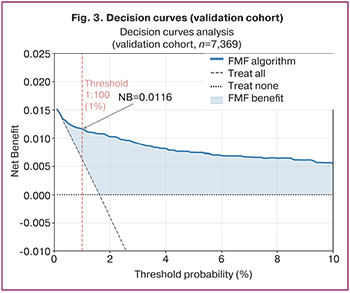
Clinical utility. Clinical utility was evaluated using decision curve analysis (DCA) [22]. Net benefit was calculated for a range of threshold probabilities from 0.5% to 10%. The model was compared with the treat-all and treat-none strategies.
Subgroup analysis. Calibration (O:E ratio) and discrimination (AUC) were evaluated in pre-specified clinically relevant subgroups according to parity, age, body mass index, history of preeclampsia, and presence of chronic arterial hypertension. Heterogeneity between subgroups was assessed using an interaction test in logistic regression.
Sensitivity analysis. To evaluate the robustness of the results, a sensitivity analysis was performed in several directions: (1) calculation of performance measures in the combined cohort (n=14,950); (2) comparison of performance measures between the validation cohort and the additional cohort; (3) comparison of performance measures in the subgroup with a history of preeclampsia against the full cohort and a subsample excluding this subgroup; (4) a full secondary analysis for the outcome of early-onset preeclampsia (delivery before 34 weeks of gestation) in both cohorts.
Sample size. Sample size adequacy was evaluated post hoc in accordance with the recommendations of Riley R.D. et al. (2020) [23]. The minimum number of events recommended for reliable estimation of calibration and discrimination (≥100) was achieved in both cohorts for the primary outcome (119 cases in the validation cohort, 138 in the additional cohort) and for the secondary analysis of early-onset preeclampsia in the combined sample (131 cases).
Software. Statistical analysis was performed using R version 4.3 (packages pROC, rms, CalibrationCurves, dcurves) and Python version 3.11 (scikit-learn, scipy, lifelines). A two-sided significance level of 0.05 was adopted. Details of the statistical procedures are provided in the Appendix (Section S4).
Results
Cohort characteristics
The cohorts were comparable in key characteristics (Appendix, Table S1). Mean age was 30.4 (5.4) years in the validation cohort and 30.1 (5.4) years in the additional cohort; body mass index (BMI) was 25.4 (4.6) and 25.4 (4.7) kg/m², respectively. The rate of preterm preeclampsia did not differ statistically significantly: 119/7,369 (1.61%) in the validation cohort and 138/7,581 (1.82%) in the additional cohort; p=0.366. The distribution of biomarker MoM values corresponded to expected values, with medians close to 1.0. Women with preterm preeclampsia had significantly higher MAP MoM and UtAPI MoM and lower PlGF MoM (all p<0.0001; Appendix, Table S2).
Discrimination and calibration of the FMF algorithm
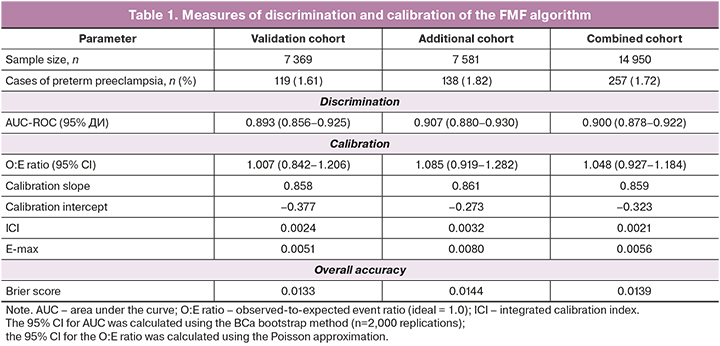
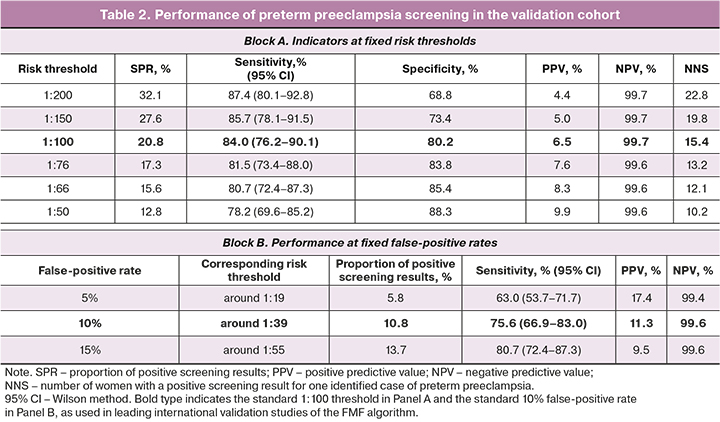
The results are presented in Table 1 and Figures 1 and 2.
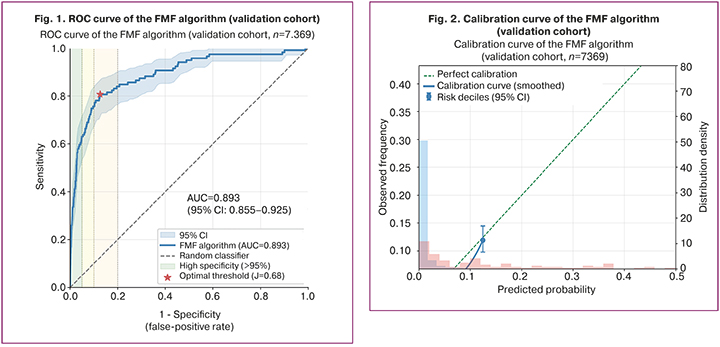
The AUC in the validation cohort was 0.893, indicating high discriminative ability (Fig. 1).
Calibration was good: O:E ratio=1.007, with the 95% CI including unity, indicating the absence of systematic prediction error. An ICI of 0.0024 confirmed minimal discrepancy between predicted and observed values. The calibration curve (Fig. 2) was close to the diagonal of perfect calibration across the full range of predicted probabilities. In the additional cohort, the results were reproduced: AUC=0.907, O:E=1.085. The distribution of predicted risks in the validation cohort is presented in Appendix Figure S3.
Screening performance at different risk thresholds
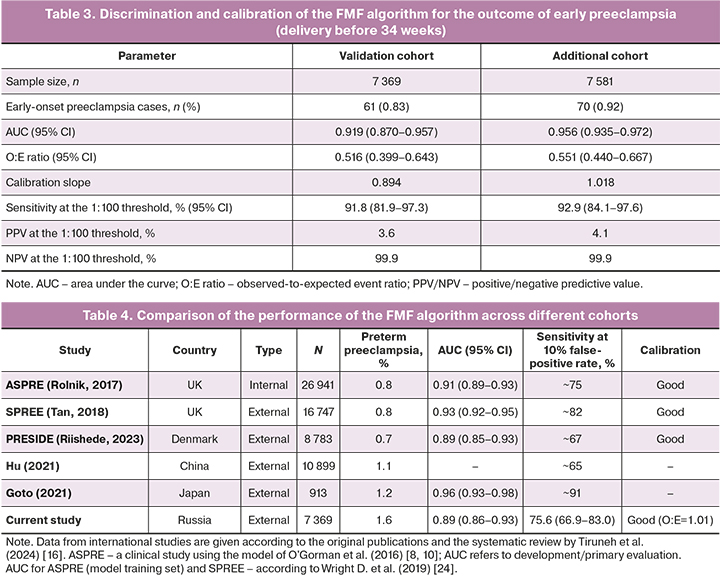
Screening performance at different thresholds is presented in Table 2 (graphical representation in Appendix Figure S2).
At the standard 1:100 threshold, sensitivity was 84.0% with a screen-positive rate of 20.8%. An NPV of 99.7% ensured reliable exclusion of preterm preeclampsia. At the more stringent 1:50 threshold, sensitivity decreased to 78.2%, but the screen-positive rate decreased to 12.8%.
At a fixed false-positive rate of 10%, traditionally used in key international studies of the FMF algorithm (the ASPRE and PRESIDE cohorts) [10, 12], the sensitivity of the algorithm in the validation cohort was 75.6% (95% CI: 66.9–83.0). This value is comparable to the results of leading international studies at the same false-positive rate: ASPRE – approximately 75% [10], SPREE – approximately 75% [13], PRESIDE – approximately 67% [12]. At a more stringent level (5% false-positive rate), sensitivity was 63.0% (95% CI: 53.7–71.7); at a more liberal level (15%), it was 80.7% (95% CI: 72.4–87.3).
Subgroup analysis
Subgroup analysis (Appendix, Table S3, Figure S4) revealed significant heterogeneity in calibration. The most pronounced deviation was found in women with chronic arterial hypertension (n=237, 15 cases): O:E=0.41 (95% CI: 0.25–0.68; p for heterogeneity <0.0001), indicating overestimation of risk. In women with a history of preeclampsia (n=416, 43 cases): O:E=1.35 (95% CI: 1.00–1.82; p for heterogeneity 0.0003), sensitivity 97.7% at the 1:100 threshold. Discrimination was significantly higher in multiparous women (AUC=0.944) compared with nulliparous women (AUC=0.815; p=0.003). Calibration was stable across age groups (O:E=0.96–1.09). An overestimation of the risk was identified in women with a normal body mass index (O:E=0.61; 95% CI: 0.41–0.90), and a tendency towards underestimation was observed in cases of obesity (O:E=1.25; 95% CI: 0.94–1.68).
Additional analysis of the distribution of MAP MoM in the subgroup with chronic arterial hypertension showed statistically significantly higher values compared with the subgroup without chronic hypertension: median MAP MoM 1.232 [1.167; 1.305] (n=237) versus 1.050 [0.991; 1.112] (n=7,132); Mann–Whitney U test, p<0.0001. These findings do not support the hypothesis of possible systematic underestimation of MAP MoM values in this subgroup due to antihypertensive therapy and are consistent with the clinically expected pattern of increasing baseline blood pressure in chronic hypertension.
Given the disproportionately high contribution of the "history of preeclampsia" subgroup to the total number of events (43 of 119 cases of preterm preeclampsia in the validation cohort, 36.1%), a sensitivity analysis was performed excluding this subgroup. In the subsample without a history of preeclampsia (n=6,953, 76 cases), the AUC decreased from 0.893 to 0.861, the calibration slope decreased from 0.858 to 0.756, and sensitivity at the 1:100 threshold decreased from 84.0% to 76.3% (Appendix, Table S4). This result empirically confirms the substantial independent contribution of obstetric history as a powerful predictor in the multiparametric FMF model.
Analysis of the secondary outcome: early preeclampsia (delivery before 34 weeks)
In the validation cohort, 61 cases of early preeclampsia were recorded (0.83%); in the additional cohort, 70 cases (0.92%); in the combined sample, 131 cases. The number of events achieved exceeds the minimum recommended by Riley R.D. et al. (2020) [23] for reliable assessment of calibration and discrimination, which allows the results to be regarded as robust. The main measures are presented in Table 3.
The discriminative ability of the algorithm for early preeclampsia in both cohorts was higher than the corresponding measures for preterm preeclampsia overall: AUC 0.919 versus 0.893 in the validation cohort and 0.956 versus 0.907 in the additional cohort. The calibration slope was close to the ideal value (0.894 in the validation cohort, 1.018 in the additional cohort). Sensitivity at the standard 1:100 threshold exceeded 90% in both cohorts, while NPV remained at 99.9%.
At the same time, calibration by O:E ratio for early preeclampsia deviated substantially from ideal: values of 0.516 and 0.551 in two independent cohorts, with 95% CIs that confidently did not cross unity. This indicates systematic overestimation by the algorithm of the calculated risk of early preeclampsia relative to the actually observed frequency. Possible mechanisms of this finding are discussed in the corresponding subsection of the Discussion.
Analysis of clinical utility
Decision curve analysis (DCA; Fig. 3) confirmed a positive net benefit of the FMF algorithm across the threshold range of 0.5–8%. At the 1:100 threshold, the Net Benefit was 0.0116, exceeding the Net Benefit of the "treat all" strategy (0.0062). The advantage amounted to 54 cases per 10,000 women.
Comparison with international validation studies
The comparison is presented in Table 4 (Appendix, Figure S5).
Discrimination in the cohort of Russian women (AUC=0.893) was comparable to the results of PRESIDE (0.89), SPREE (0.93), ASPRE (0.91), and Cuenca-Gómez (0.92). Sensitivity at the 10% fixed false-positive rate standard for FMF validations was 75.6% (95% CI: 66.9–83.0), which is directly comparable to the performance of leading European studies (approximately 75% in ASPRE and 82% in SPREE) and substantially exceeds the values in the Chinese cohort (65%). Calibration on O:E ratio (1.007 in the validation cohort, 1.085 in the additional cohort) is among the best reported in published validation studies of the FMF algorithm.
Discussion
This study presents the first large-scale external validation of the FMF algorithm for predicting preterm preeclampsia in a cohort of Russian women. High discrimination (AUC=0.893) and good calibration (O:E=1.007) were demonstrated, indicating that the algorithm can be applied without local recalibration using the standard risk threshold within first-trimester screening. When the algorithm is expanded with second-trimester data, calibration requires separate evaluation.
Comparison with the literature
The AUC=0.893 is comparable to the combined estimate from the meta‑analysis by Tiruneh S.A. et al. (AUC=0.90) [16] and to the results of PRESIDE (0.89) [12] and the external validation by Wright D. et al. (0.91–0.93) [24]. The ethnic heterogeneity of the cohort and its relation to international populations are discussed in detail in the subsection "Limitations/Ethnic Composition of the Cohorts".
The O:E=1.007 indicates high concordance between predictions and the observed outcome frequency. A calibration slope of 0.858 indicates moderate shrinkage of predictions in the extreme risk ranges – a typical phenomenon in external validation [18] that has minimal impact on classification at the standard threshold of 1:100. In previous domestic studies [17], validation of the FMF algorithm was limited to the assessment of discrimination without calibration analysis. In the study by Ivshin A.A. et al. [25], calibration was evaluated for ML-models, but not for the FMF algorithm. This study provides the first comprehensive evaluation of the calibration of the FMF algorithm in cohort of Russian women.
Of note is the comparability of sensitivity rates at a fixed false-positive rate of 10%, which is standardized for international FMF studies. The obtained value of 75.6% (95% CI: 66.9–83.0) is nearly identical to the rates in the ASPRE (approximately 75%) and SPREE (approximately 82%) studies and exceeds the value reported in Chinese cohort (65% in the study by Hu J. et al. [14]). This comparison, performed using a unified threshold criterion, represents one of the most objective confirmations of the international comparability of the FMF algorithm results in cohort of Russian women.
The present work was conducted in accordance with the TRIPOD 2015 guidelines [19] as the reporting standard for the validation of classical prediction models. Published in 2024, the TRIPOD+AI extension [26] is specifically designed for the evaluation of machine learning-based models and is not applicable to the validation of the parametric FMF regression model; its provisions will be considered in subsequent work by the authors comparing FMF with machine learning models.
Subgroup heterogeneity
The systematic overestimation of risk in chronic hypertension (O:E=0.41; 95% CI: 0.25–0.68) diverges from cohort data ASPRE and SPREE, in which calibration of algorithm in this subgroup was adequate [27], and deserves discussion of possible mechanisms. Additional analysis of the mean arterial pressure multiples of the median (MAP MoM) distribution in this subgroup showed statistically significantly higher median values (1.232 [1.167; 1.305] versus 1.050 [0.991; 1.112] in the subgroup without chronic hypertension; p<0.0001), which does not support the hypothesis of a potential systematic underestimation of MAP MoM due to antihypertensive therapy: the informative pressure signal in this subgroup is preserved. Furthermore, the direction of the observed calibration error contradicts this hypothesis: underestimation of MAP MoM by therapy would lead to a lower calculated risk and, consequently, to an underestimation of event rates (O:E>1), whereas an overestimation is actually observed (O:E=0.41). More likely mechanisms for the observed risk overestimation include: (a) the routine use of acetylsalicylic acid prophylaxis in patients with chronic hypertension in accordance with current clinical guidelines, an effect that the validated FMF algorithm does not model; (b) specific calibration characteristics of the original model in the chronic hypertension subgroup, where the baseline incidence of preterm preeclampsia in the algorithm development cohort may have differed from that observed in Russian clinical practice.
The underestimation of risk in a history of preeclampsia (O:E=1.35; 95% CI: 1.00–1.82), despite the simultaneously high sensitivity of the algorithm in this subgroup (97.7% at a 1:100 threshold), indicates the potential for improving the algorithm through more accurate modeling of recurrence risk [9, 24]. Given the disproportionately high contribution of this subgroup to the total number of events (5.6% of the cohort contains 36.1% of all preterm preeclampsia cases), a sensitivity analysis excluding this subgroup was performed. The decrease in AUC from 0.893 to 0.861 upon exclusion of this subgroup empirically confirms the substantial independent contribution of obstetric history as a strong predictor and directly validates the methodological concept of the model's authors (O'Gorman N. et al., 2016 [8]) regarding the value of incorporating prior pregnancy data into multi-parameter assessment.
The identified subgroup heterogeneity does not preclude the application of the algorithm in the general cohort, but it requires consideration during individual counseling, which is discussed in more detail in the subsection "Clinical Implications."
Prediction of early preeclampsia
Secondary analysis for the outcome of early preeclampsia (delivery before 34 weeks of gestation), based on 131 cases in the combined sample, revealed two clinically significant features of the algorithm's performance.
First, the discriminative capacity of the algorithm for early preeclampsia in both cohorts was higher than that for preterm preeclampsia overall (AUC 0.919 versus 0.893 in the validation cohort; 0.956 versus 0.907 in the additional cohort). This result is biologically consistent with the pathophysiological concept of early preeclampsia as a "placental" phenotype: first-trimester placentation disorders, which are most pronounced in the early form of the disease, are reflected in the strongest signal from first-trimester biomarkers of placental function (PlGF, PAPP-A) and uteroplacental perfusion (UtAPI). A similar relationship between discrimination for the early and late phenotypes is observed in the derivation studies of the FMF algorithm [8] and international validation reports.
Second, a systematic overestimation of the calculated risk of early preeclampsia by the algorithm was identified: the O:E ratio was 0.516 (95% CI: 0.399–0.643) in the validation cohort and 0.551 (95% CI: 0.440–0.667) in the additional cohort, with confidence intervals in both cohorts reliably not crossing unity. The replication of the direction and magnitude of the effect in two independent cohorts rules out the possibility of a random finding. The most plausible explanation is the differential effect of acetylsalicylic acid prophylaxis: the ASPRE study [10] demonstrated that the reduction in the incidence of early preeclampsia under aspirin treatment (approximately 82%) significantly exceeds the reduction in the incidence of preterm preeclampsia (<37 weeks) overall (62%). Against the background of aspirin prophylaxis gradually being implemented in Russian clinical practice after 2018–2019, the actual incidence of early preeclampsia decreases disproportionately more than the overall incidence of preterm preeclampsia, leading to a systematic excess of the predicted incidence over the observed incidence specifically for the early phenotype.
Alternative explanations that do not exclude the primary hypothesis include possible interpopulation differences in the baseline incidence of early preeclampsia between the cohort of Russian women and the FMF algorithm development cohort, as well as specific features of gestational age classification at delivery. Verification of the primary hypothesis regarding the contribution of aspirin prophylaxis will require a prospective phase of the study with systematic data collection on drug administration.
Despite the identified calibration issue, the high sensitivity of the algorithm for early preeclampsia (91.8 and 92.9% at the 1:100 threshold in the two cohorts) with NPV of 99.9% preserves its value as a screening tool to exclude high risk for this clinically most severe phenotype.
Calibration slope and risk individualization
A calibration slope of 0.858 for the primary outcome indicates a moderate shrinkage of algorithm predictions in the tails of the distribution – a typical phenomenon in the external validation of regression models [18]. Under the binary stratification strategy with a single 1:100 threshold currently operating in the Russian prenatal screening system ("prescribe aspirin prophylaxis/do not prescribe"), prediction shrinkage has virtually no effect on patient classification. However, with the transition to strategies with differentiated monitoring intensity involving multiple risk levels, the systematic deviation from the ideal slope becomes clinically significant.
Quantitative estimation of the shrinkage effect: at a slope of 0.858, the relative deviation between the predicted and true probability at a calculated risk of 1:20 is approximately 12–15% (in the direction of underestimated predicted probability); at a calculated risk of 1:200, the direction of the deviation is opposite – an overestimation of the predicted probability by a percentage of similar absolute magnitude. The threshold range in which shrinkage becomes clinically significant is approximately 1:10 to 1:30 (for high risks) and 1:200 to 1:500 (for low risks).
For routine screening purposes at a 1:100 threshold, the obtained calibration of the algorithm is satisfactory. Relevant practical considerations for individual counseling are formulated in the following subsection.
Clinical implications
At the standard risk threshold of 1:100, the FMF algorithm in the cohort of Russian women ensures the detection of 84.0% of preterm preeclampsia cases, enabling timely prescription of acetylsalicylic acid prophylaxis [10, 11] in accordance with current FIGO guidelines and Russian clinical guidelines. A negative predictive value of 99.7% provides reliable exclusion of high risk upon a negative screening result. Decision curve analysis confirmed the advantage of targeted screening over the universal prophylaxis strategy. All necessary biomarkers are measured within routine first-trimester screening, ensuring the practical feasibility of the algorithm within the existing prenatal screening system.
Given the identified subgroup heterogeneity, the following approaches to individual counseling are recommended:
- In women with chronic hypertension, the calculated risk according to the FMF algorithm may be systematically overestimated, according to our data (O:E=0.41; 95% CI: 0.25–0.68). In the absence of other high-risk factors, a conservative interpretation of the 1:100 threshold is advisable, with a primary focus on clinical monitoring (blood pressure dynamics, proteinuria, fetal condition) and without automatically reclassifying all patients in this subgroup into the maximum-risk category. At the same time, the mere presence of chronic hypertension remains an indication for prophylactic acetylsalicylic acid intake in accordance with current clinical guidelines, regardless of the calculated risk by the FMF algorithm.
- In women with a history of preeclampsia and borderline calculated risk values (approaching the 1:100 threshold), prophylactic acetylsalicylic acid intake is recommended with a cautious bias toward prescription, which is consistent with the provisions of FIGO and Russian clinical guidelines. The high sensitivity of the algorithm in this subgroup (97.7% at the 1:100 threshold) ensures reliable identification of cases warranting prophylaxis.
- With a calculated risk in the range of 1:10 to 1:20, the true risk, given the calibration slope of 0.858, is likely even higher than predicted, which strengthens the rationale for intensive monitoring in addition to aspirin prophylaxis.
Comparative evaluation of the FMF algorithm with machine learning models [28] in the cohort of Russian women [25, 29, 30], as well as the assessment of the additional prognostic value of second-trimester biomarker measurement in two-stage screening, are promising directions for further research.
Limitations
Retrospective design. The use of retrospective data from the MARS registry is associated with a risk of information bias, which is nevertheless limited by the standardization of screening procedures and the uniformity of ISSHP diagnostic criteria applied to all cases regardless of the year of initial diagnosis.
Impact of acetylsalicylic acid prophylaxis. Systematic data on acetylsalicylic acid prescription in the study cohorts are absent, which is a major limitation. In a significant proportion of observations, electronic medical records do not contain structured information regarding aspirin intake in the first half of pregnancy. Indirectly, it can be stated that in the Russian Federation, systematic prophylactic prescription of aspirin based on first-trimester screening results was implemented predominantly after 2018–2019 due to the publication of FIGO recommendations and the subsequent inclusion of relevant provisions in the clinical guidelines of the Ministry of Health of Russia. Before 2018, routine use of prophylaxis within first-trimester screening in domestic clinical practice was limited. The data collection period in the cohorts (2011–2025) covers both phases, and potential bias in calibration estimation due to partial prophylaxis most likely manifests in the direction of lowered O:E ratio values. The comparability of results between two independent cohorts with different regional compositions and time spans (O:E 1.007 and 1.085) serves as indirect confirmation of the robustness of the calibration assessment. At the same time, an exact quantitative assessment of the effect of aspirin on the algorithm calibration in the subgroup of actually treated patients is not possible in this retrospective study and is designated as a priority task for the prospective part of the project.
Conceptual definition of the outcome. The operational definition of preterm preeclampsia used in this work ("preeclampsia with delivery before 37 weeks of gestation") corresponds to the definitions applied in all key international validation studies of the FMF algorithm (ASPRE, SPREE, PRESIDE, Cuenca-Gómez D. et al., 2023). In a strict methodological sense, this definition is not identical to the original definition of the model by Wright D. et al. ("preeclampsia requiring delivery before 37 weeks"). However, the retrospective differentiation of iatrogenic and spontaneous preterm births against the background of preeclampsia is methodologically difficult, and the proportion of spontaneous preterm births in women with preeclampsia <37 weeks, according to international data, does not exceed 5–10%, which cannot significantly alter estimates at the level of the cohort as a whole.
Ethnic composition of the cohorts. In the Russian medical documentation system, the race and ethnicity of patients are not recorded, making individual analysis of algorithm performance by ethnic stratification impossible in the retrospective cohort. Indirect assessment based on data from the 2020 All-Russian Population Census: the study cohorts include regions with a significant proportion of indigenous populations of Mongoloid and Finno-Ugric anthropological groups – the Republic of Buryatia (approximately 30% Buryats), the Republic of Bashkortostan (approximately 30% Bashkirs and 25% Tatars), the Yamalo-Nenets Autonomous Okrug (approximately 10% indigenous small-numbered peoples of the North), and the Republic of Karelia (approximately 8% Karelians and Veps). Despite this heterogeneity, the obtained metrics are comparable to those of European validation studies. A differentiated evaluation of the algorithm in ethnically homogeneous subgroups represents a separate research task for the prospective part of the project with voluntary indication of ethnic self-identification.
Temporal analysis. In the MARS registry dataset prepared for the validation study, the year of first-trimester screening was not preserved as a separate variable, which precluded a direct analysis of algorithm performance across temporal subperiods. Recovering exact screening dates from primary sources for each of the 14,950 observations within the current work proved technically unfeasible. Indirect evidence of the temporal stability of the results includes: (a) the proximity of biomarker medians in multiples of the median format to unity in both cohorts, indicating the absence of significant temporal drift in measurement quality; (b) the comparability of results between two cohorts with different temporal coverage and regional composition. Data collection with preservation of the screening date is planned within the framework of the ongoing prospective part of the study.
Analysis of early preeclampsia. Despite achieving the methodological minimum of 100 events in the combined sample (131 cases), the number of early preeclampsia cases in each individual cohort remains limited (61 and 70), which is reflected in relatively wide confidence intervals for the observed-to-expected ratio. The obtained estimates require confirmation in larger prospective cohorts.
Data availability
Anonymized data are available upon reasonable request to the corresponding author in accordance with the requirements of Federal Law No. 152-FZ "On Personal Data". Supplementary materials (Appendices) are publicly available at: https://doi.org/10.5281/zenodo.19286495
Summary
- The FMF algorithm demonstrated high discriminative capacity for predicting preterm preeclampsia in the cohort of Russian women: AUC=0.893 (95% CI: 0.856–0.925), which is comparable to the results of leading European validation studies including ASPRE (0.91), PRESIDE (0.89), SPREE (0.93), and Cuenca-Gómez et al. (0.92).
- Algorithm calibration was characterized by adequate concordance between predicted and observed probabilities: O:E ratio=1.007 (95% CI: 0.842–1.206), which justifies the application of the algorithm without local recalibration when using the standard threshold of 1:100.
- At the standard risk threshold of 1:100, the sensitivity was 84.0% (95% CI: 76.2–90.1%) with a specificity of 80.2% and NPV of 99.7%. At a fixed false-positive rate of 10% (the standard for international FMF validations), the sensitivity was 75.6% (95% CI: 66.9–83.0%), which is directly comparable to the rates in the ASPRE and SPREE studies.
- Decision curve analysis confirmed the positive net benefit of the FMF algorithm across the range of clinically relevant thresholds of 0.5–8%, indicating the superiority of targeted screening over the universal prophylaxis strategy.
- Subgroup analysis revealed significant calibration heterogeneity: systematic risk overestimation in chronic hypertension (O:E=0.41) and underestimation in a history of preeclampsia (O:E=1.35), which must be considered during individual counseling. Analysis of mean arterial pressure multiples of the median did not confirm the hypothesis of biomarker underestimation due to antihypertensive therapy in the chronic hypertension subgroup.
- Secondary analysis for the outcome of early preeclampsia (delivery before 34 weeks of gestation; n=61 in the validation cohort, n=70 in the additional cohort) revealed high discriminative capacity of the algorithm (AUC 0.919 and 0.956) with a systematic overestimation of calculated risk (O:E 0.516 and 0.551). The replication of the effect direction and magnitude in two independent cohorts indicates the potential impact of gradually implemented acetylsalicylic acid prophylaxis and justifies the need for prospective confirmation and potential local recalibration of the algorithm for predicting early preeclampsia in the cohort of Russian women.
Conclusion
The external validation performed on two independent cohorts of 14,950 pregnant women confirmed high discrimination (AUC 0.893 and 0.907) and adequate calibration at the standard 1:100 threshold (O:E 1.007 and 1.085) of the FMF algorithm for predicting preterm preeclampsia in the cohort of Russian women. The sensitivity at a fixed false-positive rate of 10% was 75.6%, which is directly comparable to leading European validation studies. These findings justify the application of the algorithm in the Russian prenatal screening system at the standard 1:100 threshold. The identified subgroup calibration heterogeneity and the systematic overestimation of calculated risk for early preeclampsia by the algorithm require cautious interpretation of individual risks and substantiate the need for prospective confirmation with systematic data collection on aspirin prophylaxis. Comparison with machine learning models and evaluation of two-stage screening incorporating second-trimester biomarkers are priority directions for future research.
References
- Brown M.A., Magee L.A., Kenny L.C., Karumanchi S.A., McCarthy F.P., Saito S. et al. Hypertensive disorders of pregnancy: ISSHP classification, diagnosis, and management recommendations for international practice. Hypertension. 2018; 72(1): 24-43. https://dx.doi.org/10.1161/HYPERTENSIONAHA.117.10803
- Сидорова И.С., Никитина Н.А., Филиппов О.С., Гусева Е.В., Агеев М.Б., Кокин А.А. Решенные и нерешенные вопросы преэклампсии по результатам анализа материнской смертности за последние 10 лет. Акушерство и гинекология. 2021; 4: 64-74. https://dx.doi.org/10.18565/aig.2021.4.64-74 [Sidorova I.S., Nikitina N.A., Filippov O.S., Guseva E.V., Ageev M.B., Kokin A.A. Current issues in preeclampsia: a ten-year analysis of maternal mortality. Obstetrics and Gynecology. 2021; (4): 64-74 (in Russian). https://dx.doi.org/10.18565/aig.2021.4.64-74].
- Сидорова И.С., Никитина Н.А., Унанян А.Л. Преэклампсия и снижение материнской смертности в России. Акушерство и гинекология. 2018; 1: 107-12. https://dx.doi.org/10.18565/aig.2018.1.107-112 [Sidorova I.S., Nikitina N.A., Unanyan A.L. Preeclampsia and lower maternal mortality in Russia. Obstetrics and Gynecology. 2018; (1): 107-12 (in Russian). https://dx.doi.org/10.18565/aig.2018.1.107-112].
- Министерство здравоохранения Российской Федерации. Клинические рекомендации. Преэклампсия. Эклампсия. Отеки, протеинурия и гипертензивные расстройства во время беременности, в родах и послеродовом периоде. 2024. Доступно по: https://cr.minzdrav.gov.ru/view-cr/637_2 [Ministry of Health of the Russian Federation. Clinical guidelines. Preeclampsia. Eclampsia. Edema, proteinuria and hypertensive disorders during pregnancy, labor and the postpartum period: clinical guidelines. 2024. Available at: https://cr.minzdrav.gov.ru/view-cr/637_2 (in Russian)].
- Хлестова Г.В., Карапетян А.О., Шакая М.Н., Романов А.Ю., Баев О.Р. Материнские и перинатальные исходы при ранней и поздней преэклампсии. Акушерство и гинекология. 2017; 6: 41-7. https://dx.doi.org/10.18565/aig.2017.6.41-7 [Khlestova G.V., Karapetyan A.O., Shakaya M.N., Romanov A.Yu., Baev O.R. Maternal and perinatal outcomes in early and late preeclampsia. Obstetrics and Gynecology. 2017; (6): 41-7(in Russian). https://dx.doi.org/10.18565/aig.2017.6.41-7]
- Кан Н.Е., Беднягин Л.А., Долгушина Н.В., Тютюнник В.Л., Ховхаева П.А., Сергунина О.А., Тютюнник Н.В., Амирасланов Э.Ю. Клинико-анамнестические факторы риска развития преэклампсии у беременных. Акушерство и гинекология. 2016; 6: 39-44. https://dx.doi.org/10.18565/aig.2016.6.39-44 [Kan N.E., Bednyagin L.A., Dolgushina N.V., Tyutyunnik V.L., Khovkhaeva P.A., Sergunina O.A., Tyutyunnik N.V., Amiraslanov E.Yu. Clinical and anamnestic risk factors for preeclampsia in pregnant women. Obstetrics and Gynecology. 2016; (6): 39-44 (in Russian). https://dx.doi.org/10.18565/aig.2016.6.39-44].
- Wright D., Syngelaki A., Akolekar R., Poon L.C., Nicolaides K.H. Competing risks model in screening for preeclampsia by maternal characteristics and medical history. Am. J. Obstet. Gynecol. 2015; 213(1): 62.e1-62.e10. https://dx.doi.org/10.1016/j.ajog.2015.02.018
- O’Gorman N., Wright D., Syngelaki A., Akolekar R., Wright A., Poon L.C. et al. Competing risks model in screening for preeclampsia by maternal factors and biomarkers at 11–13 weeks gestation. Am. J. Obstet. Gynecol. 2016; 214(1): 103.e1-103.e12. https://dx.doi.org/10.1016/j.ajog.2015.08.034
- Tan M.Y., Syngelaki A., Poon L.C., Rolnik D.L., O’Gorman N., Delgado J.L. et al. Screening for pre-eclampsia by maternal factors and biomarkers at 11–13 weeks’ gestation. Ultrasound Obstet. Gynecol. 2018; 52(2): 186-95. https://dx.doi.org/10.1002/uog.19112
- Rolnik D.L., Wright D., Poon L.C., O’Gorman N., Syngelaki A., de Paco Matallana C. et al. Aspirin versus placebo in pregnancies at high risk for preterm preeclampsia. N. Engl. J. Med. 2017; 377(7): 613-22. https://dx.doi.org/10.1056/NEJMoa1704559
- Poon L.C., Shennan A., Hyett J.A., Kapur A., Hadar E., Divakar H. et al. The International Federation of Gynecology and Obstetrics (FIGO) initiative on pre-eclampsia: A pragmatic guide for first-trimester screening and prevention. Int. J. Gynaecol. Obstet. 2019; 145(S1): 1-33. https://dx.doi.org/10.1002/ijgo.12802
- Riishede I., Rode L., Sperling L., Overgaard M., Ravn J.D., Sandager P. et al. et al. Pre‐eclampsia screening in Denmark (PRESIDE): national validation study. Ultrasound Obstet. Gynecol. 2023; 61(6): 682-90. https://dx.doi.org/10.1002/uog.26183
- Tan M.Y., Wright D., Syngelaki A., Akolekar R., Cicero S., Janga D. et al. Comparison of diagnostic accuracy of early screening for pre-eclampsia by NICE guidelines and a method combining maternal factors and biomarkers: results of SPREE. Ultrasound Obstet. Gynecol. 2018; 51(6): 743-50. https://dx.doi.org/10.1002/uog.19039
- Hu J., Gao J., Liu J., Meng H., Hao N., Song Y. et al. Prospective evaluation of first-trimester screening strategy for preterm pre-eclampsia and its clinical applicability in China. Ultrasound Obstet. Gynecol. 2021; 58(4): 529-39. https://dx.doi.org/10.1002/uog.23645
- Goto M., Koide K., Tokunaka M., Takita H., Hamada S., Nakamura M. et al. Accuracy of the FMF Bayes theorem-based model for predicting preeclampsia at 11–13 weeks of gestation in a Japanese population. Hypertens. Res. 2021; 44(6): 685-91. https://dx.doi.org/10.1038/s41440-020-00571-4
- Tiruneh S.A., Vu C.T., Moran L.J., Callander E.J., Allotey J., Thangaratinam S. et al. Externally validated prediction models for pre-eclampsia: systematic review and meta-analysis. Ultrasound Obstet. Gynecol. 2024; 63(5): 592-604. https://dx.doi.org/10.1002/uog.27490
- Холин А.М., Муминова К.Т., Балашов И.С., Ходжаева З.С., Боровиков П.И., Иванец Т.Ю., Гус А.И. Прогнозирование преэклампсии в первом триместре беременности: валидация алгоритмов скрининга на российской популяции. Акушерство и гинекология. 2017; 8: 74-84. https://dx.doi.org/10.18565/aig.2017.8.74-84 [Kholin A.M., Muminova K.T., Balashov I.S., Khodzhaeva Z.S., Borovikov P.I., Ivanets T.Yu., Gus A.I. First-trimester prediction of preeclampsia: validation of screening algorithms in a Russian population. Obstetrics and Gynecology. 2017; (8): 74-84 (in Russian). https://dx.doi.org/10.18565/aig.2017.8.74-84].
- Van Calster B., McLernon D.J., van Smeden M., Wynants L., Steyerberg E.W.; Topic Group ‘Evaluating diagnostic tests and prediction models’ of the STRATOS initiative. Calibration: the Achilles heel of predictive analytics. BMC Med. 2019; 17(1): 230. https://dx.doi.org/10.1186/s12916-019-1466-7
- Collins G.S., Reitsma J.B., Altman D.G., Moons K.G.M. Transparent reporting of a multivariable prediction model for individual prognosis or diagnosis (TRIPOD): the TRIPOD statement. BMJ. 2015; 350: g7594. https://dx.doi.org/10.1136/bmj.g7594
- Cuenca-Gómez D., de Paco Matallana C., Rolle V., Valiño N., Revello R., Adiego B. et al. Performance of first-trimester combined screening for preterm pre-eclampsia: findings from cohort of 10 110 pregnancies in Spain. Ultrasound Obstet. Gynecol. 2023; 62(4): 522-30. https://dx.doi.org/10.1002/uog.26233
- Steyerberg E.W. Clinical prediction models: A practical approach to development, validation, and updating. 2nd ed. Cham: Springer; 2019. https://dx.doi.org/10.1007/978-3-030-16399-0
- Vickers A.J., Van Calster B., Steyerberg E.W. A simple, step-by-step guide to interpreting decision curve analysis. Diagn. Progn. Res. 2019; 3: 18. https://dx.doi.org/10.1186/s41512-019-0064-7
- Riley R.D., Ensor J., Snell K.I.E., Harrell F.E. Jr, Martin G.P., Reitsma J.B. et al. Calculating the sample size required for developing a clinical prediction model. BMJ. 2020; 368: m441. https://dx.doi.org/10.1136/bmj.m441
- Wright D., Tan M.Y., O’Gorman N., Poon L.C., Syngelaki A., Wright A. et al. Predictive performance of the competing risk model in screening for preeclampsia. Am. J. Obstet. Gynecol. 2019; 220(2): 199.e1-199.e13. https://dx.doi.org/10.1016/j.ajog.2018.11.1087
- Ившин А.А., Малышев Н.А. Ранняя стратификация риска преэклампсии на основе мультипараметрической модели машинного обучения и рутинных клинических данных. Акушерство, Гинекология и Репродукция. 2026; 20(1): 111-29. https://dx.doi.org/10.17749/2313-7347/ob.gyn.rep.2025.706 [Ivshin A.A., Malyshev N.A. Preeclampsia early risk stratification based on a multiparametric machine learning model and routinely collected clinical data. Obstetrics, Gynecology and Reproduction. 2026; 20(1): 111-29 (in Russian). https://dx.doi.org/10.17749/2313-7347/ob.gyn.rep.2025.706].
- Collins G.S., Moons K.G.M., Dhiman P., Riley R.D., Beam A.L., Van Calster B. et al. TRIPOD+AI statement: updated guidance for reporting clinical prediction models that use regression or machine learning methods. BMJ. 2024; 385: e078378. https://dx.doi.org/10.1136/bmj-2023-078378
- Rolnik D.L., Gil-Pugliese S., Syngelaki A., Bujold E., Wright D., Poon L.C., Nicolaides K.H. First-trimester prediction and prevention of preterm pre-eclampsia in women with chronic hypertension. Ultrasound Obstet. Gynecol. 2026; 67(5): 613-22. https://dx.doi.org/10.1002/uog.70212
- Ranjbar A., Montazeri F., Ghamsari S.R., Mehrnoush V., Roozbeh N., Darsareh F. Machine learning models for predicting preeclampsia: a systematic review. BMC Pregnancy Childbirth. 2024; 24(1): 6. https://dx.doi.org/10.1186/s12884-023-06220-1
- Андрейченко А.Е., Лучинин А.С., Ившин А.А., Ермак А.Д., Новицкий Р.Э., Гусев А.В. Разработка и валидация моделей прогнозирования общего риска преэклампсии и риска ранней преэклампсии с использованием алгоритмов машинного обучения в первом триместре беременности. Акушерство и гинекология. 2023; 10: 94-107. https://dx.doi.org/10.18565/aig.2023.101 [Andreychenko A.E., Luchinin A.S., Ivshin A.A., Ermak A.D., Novitskiy R.E., Gusev A.V. Development and validation of models to predict total and early-onset preeclampsia in the first trimester of pregnancy using machine learning algorithms. Obstetrics and Gynecology. 2023; (10): 94-107 (in Russian). https://dx.doi.org/10.18565/aig.2023.101].
- Ившин А.А., Багаудин Т.З., Гусев А.В. Прогнозирование преэклампсии с использованием технологий искусственного интеллекта. Акушерство, Гинекология и Репродукция. 2021; 15(5): 576-85. https://dx.doi.org/10.17749/2313-7347/ob.gyn.rep.2021.229 [Ivshin A.A., Bagaudin T.Z., Gusev A.V. Artificial intelligence technologies in predicting preeclampsia. Obstetrics, Gynecology and Reproduction. 2021; 15(5): 576-85 (in Russian). https://dx.doi.org/10.17749/2313-7347/ob.gyn.rep.2021.229].
Received 31.03.2026
Accepted 02.10.2026
About the Authors
Aleksandr A. Ivshin, PhD, Associate Professor, Head of the Department of Obstetrics and Gynecology, Dermatovenerology of the Medical Institute, Petrozavodsk State University, 31, Krasnoarmeyskaya str., Petrozavodsk, Republic of Karelia, 185035, Russia, +7(909)567-12-51, scipeople@mail.ru, https://orcid.org/0000-0001-7834-096XSimilar Articles