
Comprehensive analysis of oral and cervical microbiocenosis and gut microbiota in pregnant women with gingivitis
Burduli A.G., Tetruashvili N.K., Balmasova I.P., Donnikov A.E., Krasheninnikova R.V., Arutyunov S.D.
Objective. To perform comprehensive analysis of the clinical features of the course of pregnancy, cervical and oral microbiocenosis, and gut microbiota in women with gingivitis.
Materials and methods. A prospective cohort study was conducted from 2023 to 2024. It included 98 pregnant women without complicated obstetric and gynecological history. The patients were divided into 4 groups based on the presence or absence of gingivitis and inflammation index (II) calculation, that was calculated via matrix mRNA expression of innate immunity-related genes in cervical canal scraping samples. Group 1 (n=22) included women without gingivitis; II≤ 60%. Group 2I (n=6) included women with gingivitis; II≤60%. Group 3 (n=58) comprised women without gingivitis; II>60%. Group 4 comprised women with gingivitis; II>60%. The study assessed pregnancy complications, current pregnancy outcomes, characteristics of oral and cervical microbiocenosis, and gut microbiota. Statistical data analysis was performed using one-way analysis of variance (one-way ANOVA). In hypotheses testing the differences were considered statistically significant at p<0.05. Spearman’s rank correlation was used to determine statistically significant relationship between the variables at p<0.05.
Results. Comparison of the frequency of pregnancy complications found the difference in premature rupture of fetal membranes (PROM) (F=12.96, p<0.001). The intergroup analysis showed the difference in this parameter between Groups 1 and 4 – 0/22 (0%) versus 6/12 (50%), p<0.001. The greatest changes in species composition and quantitative representation in the cervical and oral microbiocenosis and gut microbiota were found in groups 2 and 4 with gingivitis compared to group 1. Correlation analysis of relationship between microorganisms in the composition of the analyzed microbiocenosis and premature rupture of membranes showed statistically significant relationship between this clinical parameter and periodontal pathogens P. gingivalis, Tr. denticola и C. albicans in the gingival sulcus, opportunistic pathogens Streptococcus spp. in the cervical canal in group 4, and Peptoniphilaceae, Prevotella spp., E. coli. in the large intestine in groups 3 and 4.
Conclusion. The role of the infectious factor in the pathogenesis of PROM as pregnancy complication, traditionally suggests analysis of the reproductive tract microbiota. Analysis of microbiocenosis of other biotopes, especially in cases of distant inflammation (gingivitis), made it possible to identify oral, cervical canal and gut microbial species that form correlation pairs with premature rupture of membranes. The obtained data indicate the importance of the integrated (exploration of microbiocenosis of different biotopes) and multidisciplinary approach (importance of taking into account dental health status) to identify risk groups for premature rupture of membranes.
Authors' contributions. Burduli A.G., Balmasova I.P., Tetruashvili N.K. – the study concept and design; Burduli A.G., Donnikov A.E., Krasheninnikova R.V. – material collection and processing; Burduli A.G., Balmasova I.P. – data analysis; Burduli A.G. – manuscript writing; Tetruashvili N.K., Donnikov A.E., Arutyunov S.D. – manuscript editing.
Conflicts of interest. The authors confirm that they have no conflicts of interest to declare.
Funding. The study was conducted without any sponsorship.
Ethical Approval. The study was approved by the local Ethics Committee of V.I. Kulakov National Medical Research Center for Obstetrics, Gynecology and Perinatology of the Ministry of Health of Russia (protocol No 6 of September 17, 2023.
Generative Artificial Intelligence. No generative AI was used in preparing this article.
Patient Consent for Publication. The patients have signed informed consent for publication of their data.
Authors' Data Sharing Statement. The data supporting the findings of this study are available on request from the corresponding author after approval from the principal investigator.
For citation: Burduli A.G., Tetruashvili N.K., Balmasova I.P., Donnikov A.E., Krasheninnikova R.V., Arutyunov S.D. Comprehensive analysis of oral and cervical microbiocenosis and gut microbiota in pregnant women with gingivitis.
Akusherstvo i Ginekologiya/Obstetrics and Gynecology. 2026; (10): 81-88 (in Russian)
https://dx.doi.org/10.18565/aig.2026.131
Keywords
premature rupture of membranes
microbiocenosis
microbiome
microbiota
gingivitis
Infection and inflammation contribute to pregnancy complications, that is a pressing healthcare issue. Despite improvement of healthcare quality and accessibility, the incidence of preterm births and other reproductive losses associated with infectious factors remains extremely high. The most common pathway of intrauterine infection transmission is an ascending route. However, the studies on the microbiota of different biotopes of non-reproductive system have shown the relationship between the presence of distant foci of infection in periodontal tissues, as well as dysbiotic processes in the gut, and adverse pregnancy outcomes [1]. Hormonal, immune, and metabolic changes in pregnancy threaten the microbial ecosystem stability not only of the genitourinary system, but also of the oral cavity and gastrointestinal tract. Dysbiotic changes in dentogingival unit occur due to an increase in opportunistic oral pathogens, that leads to the development of concomitant gingivitis, and its severity increases progressively throughout pregnancy [2]. Gingivitis is an inflammation of the gums without involvement of periodontal ligaments in the inflammatory process, and it is common in pregnancy [3]. The clinical significance of gingivitis is often underestimated by obstetricians and gynecologists despite the data on the impact of periodontitis and periodontal pathogens on preterm birth and low birth weight [4].
The gut microbiota varies in normal and complicated pregnancy, and physiological changes including increased progesterone levels influence the composition of the maternal microbiome. Some researchers suggest that the microbiome of pregnant women contains higher proportions of bifidobacteria, as well as proteobacteria and actinobacteria [5]. However, as it turned out later, the composition of the gut microbiota largely depends on the trimester of pregnancy [6]. During the third trimester, maternal gut microbes experience the most remarkable changes, including a decrease in alpha diversity and in the abundance of butyrate-producing bacteria exerting anti-inflammatory effect [7].
Analysis of the microbiota composition undergoing changes during pregnancy, indicates its pivotal role in supporting the maternal immune system both by inducing protective responses against pathogens and keeping opportunistic microorganisms in check. Analysis of pregnancy-related changes in the composition of the microbiota emphasizes its key role in maintenance of the maternal immune system for induction of protective responses against pathogens and control of opportunistic pathogenic bacteria [8]. Optimal interaction between the microbiota and the immune system implies a balance of pro- and anti-inflammatory mechanisms.
The objective of the study was to perform a comprehensive analysis of the clinical features of the course of pregnancy, cervical and oral microbiocenoses, and gut microbiota in women with and without gingivitis.
Materials and methods
This prospective cohort study included 98 pregnant women who were divided into 4 groups. Group 1 included 22 women without gingivitis (inflammation index (II) ≤ 60%; II was defined as an integrative indicator based on the expression levels of innate immunity genes in cervical smear). Group 2 included 6 women with gingivitis (II≤60%). Group 3 (n=58) comprised 58 women without gingivitis (II>60%). Group 4 comprised 12 women with gingivitis (II>60%).
Inclusion criteria were women aged 18–42 years, regular menstrual cycle before pregnancy, gestational age 10–14 weeks at the time of inclusion in the study; a history of any number of pregnancies and births.
Non-inclusion criteria were severe somatic pathology, oncological and autoimmune diseases, exacerbation of chronic extragenital diseases, infertility, chronic anovulation, abnormalities of the reproductive tract, gynecological pathology requiring surgical treatment prior to pregnancy, karyotype abnormalities, refusal to participate in the study.
Inclusion criteria was based on analysis of the course of current pregnancy and included multiple pregnancy, Rh sensitization, congenital malformations and/or fetal chromosomal anomalies, placenta previa, sexually transmitted infections, and pregnant women infected with the human immunodeficiency virus.
According to the World Medical Association Declaration of Helsinki all pregnant women signed informed consent to participate in the study. The protocol of the study No. 6 of September 17, 2023 was approved in was approved by the local Ethics Committee.
Weight and height parameters were assessed by calculating the body mass index (BMI, kg/m²). The main parameters of menstrual function in all women, as well as the course and outcomes of pregnancies were analyzed.
At 10–14 weeks of pregnancy, a dental consultation was conducted to assess oral health status of patients regarding the existing periodontal diseases and to collect the samples from the gingival sulcus. Additionally, the samples were collected from the analyzed biotopes for molecular and genetic testing by the obstetrician-gynecologist.
* The expression of matrix RNA (mRNA) of the innate immunity genes interleukin (IL)-1β, IL-10, IL-18, tumor necrosis factor-α (TNF-α), Toll-like receptor 4 (TLR4), GATA-binding protein 3 (GATA3), cluster of differentiation 68 (CD68), and Beta-2 Microglobulin (B2M) was evaluated in the endocervical scrapings. The integrated inflammation index (II) was calculated using the ImmunoKvantex test system (LLC “DNA-Technology”, Moscow). Endocervical sampling was performed by cytobrush (together with obtaining material for assessment of microbiocenosis of this biotope). To prevent mRNA degradation, cervical canal secretions were transferred to a plastic tube containing 500 μl of RNA stabilization solution (lysing solution from the PROBA NK extraction reagent kit (LLC “DNA-Technology”). The presence of local inflammatory reaction was revealed with the means of real-time amplificator built-in software
* Identification of periodontopathogens (Porphyromonas gingivalis, Prevotella intermedia, Tannerella forsythia, Aggregatibacter аctinomycetemcomitans, Treponema denticola, Candida albicans) in the gingival sulcus and assessment of microbiocenosis in endocervical scrapings represented by Lactobacillus spp., Enterobacteriaceae spp., Streptococcus spp., Staphylococcus spp., Gardnerella vaginalis, Prevotella, Porphyromonas spp., Eubacterium spp., Sneathia spp., Leptotrichia spp., Fusobacterium spp., Megasphaera spp., Veillonella spp., Dialister spp., Lachnobacterium spp., Corynebacterium spp., Mobiluncus spp., Peptostreptococcus spp., Atopobium vaginae, Ureaplasma urealyticum, Ureaplasma parvum, Mycoplasma hominis, Candida spp., Mycoplasma genitalium) were performed using the Parodontoscreen and Femoflor-16 test systems (LLC “DNA-Technology, Moscow), respectively.
* The PCR-based Enteroflor assay was performed for the quantitative analysis of gut microbiota composition. Fecal samples (0.1–0.2 ml) from female patients were placed into 1.5 ml plastic test tubes containing 1.0 ml of sterile saline solution. After the vortex resuspension for 5–10 s, DNA extraction was performed using the PROBA-MCH MAX reagent kit (LLC “DNA-Technology TS” for DNA-based detection of the microorganisms – Firmicutes, Proteobacteria, Bacteroidetes, Actinobacteria, Fusobacteria, Verrucomicrobia, Euryarchaeota, fungi of the Candida genus, as well as methicillin resistance in Staphylococcus spp. caused by mecA gene, C. difficile, Str. agalactiae with the invasiveness marker gene (srr2). The results were obtained using automatic detection system.
Statistical analysis
Statistical analysis was performed using software package SPSS Statistics, Version 23 (IBM, USA). The anthropometric data and parameters of the menstrual function are represented as the median (Me), the 25% and 75% quartiles (Q25; Q75). One-way analysis of variance (one-way ANOVA) using Fisher’s F-test was performed to determine the differences in the frequency of pregnancy complications. The differences were considered statistically significant at р<0.05. Comparison of relative values was conducted using Pearson’s chi-squared test. The threshold for p-value was 0.05. Spearman’s rank correlation coefficient (r) was used to measure the strength and direction of association between different variables. The results were considered statistically significant at р<0.05.
Results
The medians [Me (25%;75%)] of anthropometric data were the following: age of women – 33 years (30; 36), height – 167 cm (158;173), body weight – 65 kg (53; 79), BMI – 23 kg/m2 (20; 24). The median age at menarche was 13.3 years (12; 14.4). The median duration of the menstrual cycle was 26.2 days (24.4; 28) and menstrual blood loss was 52.5 ml (39; 71).
Among registered pregnancy complications, the difference between the groups was in the incidence of premature rupture of membranes (PROM) (F=12.96, p<0.001) (Table).
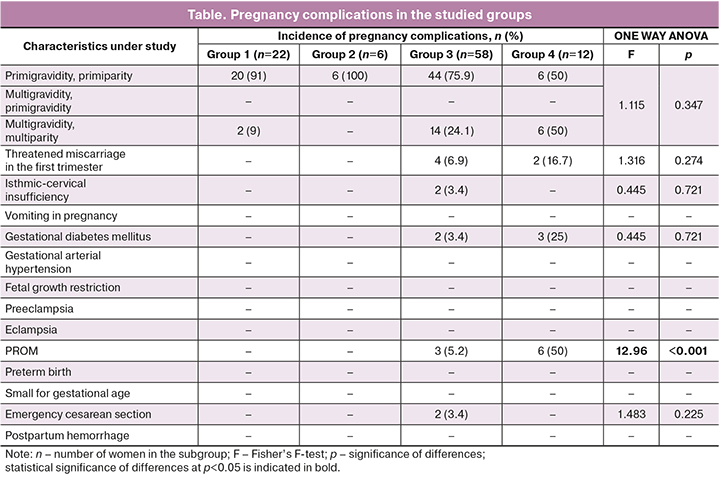
One-way ANOVA was used for intergroup comparisons of groups 2,3,4 with group 1. Statistically significant difference was found only for groups 1 and 4 (р<0.001) (Fig. 1).
ROC analysis was performed to assess the potential prognostic significance of inflammatory foci in the periodontium (gingivitis) and the lower reproductive tract (II>60%) in pregnant women in the studied groups (Fig. 2), where the incidence of PPROM was a control variable, and assignment of a woman to group 4 was a state variable.
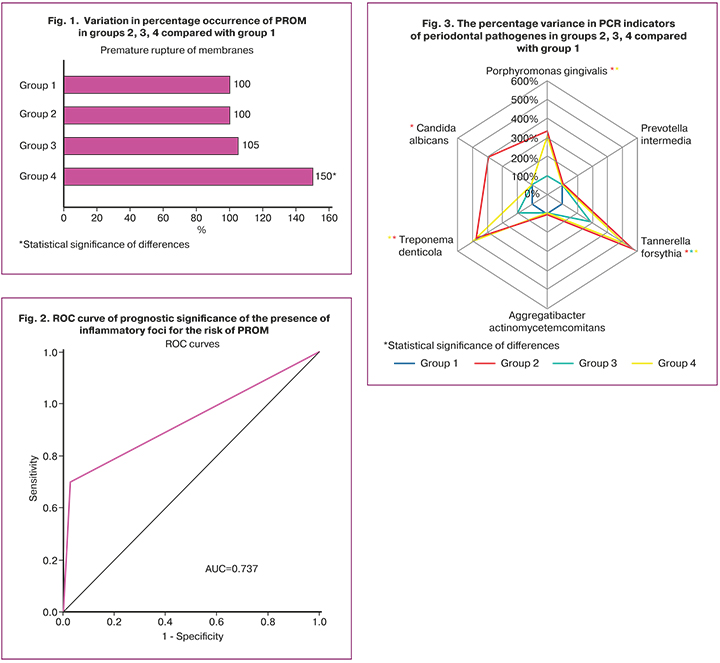
Simultaneous presence of concomitant inflammatory foci in the periodontium and the lower reproductive tract based on the values of II exceeding 60% (group 4) had moderate prognostic significance (AUC=0.737) and indicated the risk of PROM.
Further, microbiocenosis of the gingival sulcus (Fig. 3) and biocenosis in the endocervical scrapings (Fig. 4) were evaluated in the groups. Significant shifts were found in species composition and quantitative representation. The most marked shifts were found in pregnant women with gingivitis (groups 2, 4) compared with the groups without gingivitis and local inflammatory reaction in the endocervical scrapings (group 1).
In concomitant gingivitis without local inflammatory reaction in the endocervical scrapings (group 2), in addition to high prevalence of the bacterial genera such as Staphylococcus spp., Streptococcus spp., and Peptostreptococcus spp. in the cervical canal microbiocenosis, statistically significant overgrowth of members of the genera Eubacterium and Candida was found. The composition of abundant bacterial associations in the reproductive tract microbiota changed. In concomitant gingivitis the prevalence of these associations increased: Mobiluncus spp. + Corynebacterium spp. (group 2), Gardnerella vaginalis + Prevotella bivia + Porphyromonas spp. (groups 2, 4) and Sneathia spp.+Leptotrichia spp.+Fusobacterium spp. (group 4).
In group 3 (in cases of positive local inflammatory reaction in endocervical scrapings from pregnant women without gingivitis), there was a significant shift in the cervical canal microbiocenosis that included bacterial associations Gardnerella vaginalis + Prevotella bivia + Porphyromonas spp.
Analysis of the quantitative changes in the taxonomic composition of the large intestine showed that most significant changes in composition and abundance of microorganisms (Fig. 5) belonging to specific bacterial taxa within the identified phylum Firmicutes (species Lactococcus lactis species, the family Peptoniphilaceae), Bacteroidetes (the genus Prevotella), Proteobacteria (the genus Desulfovibrio, species Escherichia coli), Actinobacteria (species Bifidobacterium adolescentis and Bifidobacterium longum subsp. longum), as well as fungi of the genus Candida were found in group 2 compared with group 1.
Further, correlation analysis was performed to identify the relationship between the established clinical and immunological sign of PROM and individual microbial taxa that exhibited statistically significant shifts in the bacterial composition in the gingival sulcus (Fig. 3), cervical canal (Fig. 4), and the large intestine (Fig. 5).
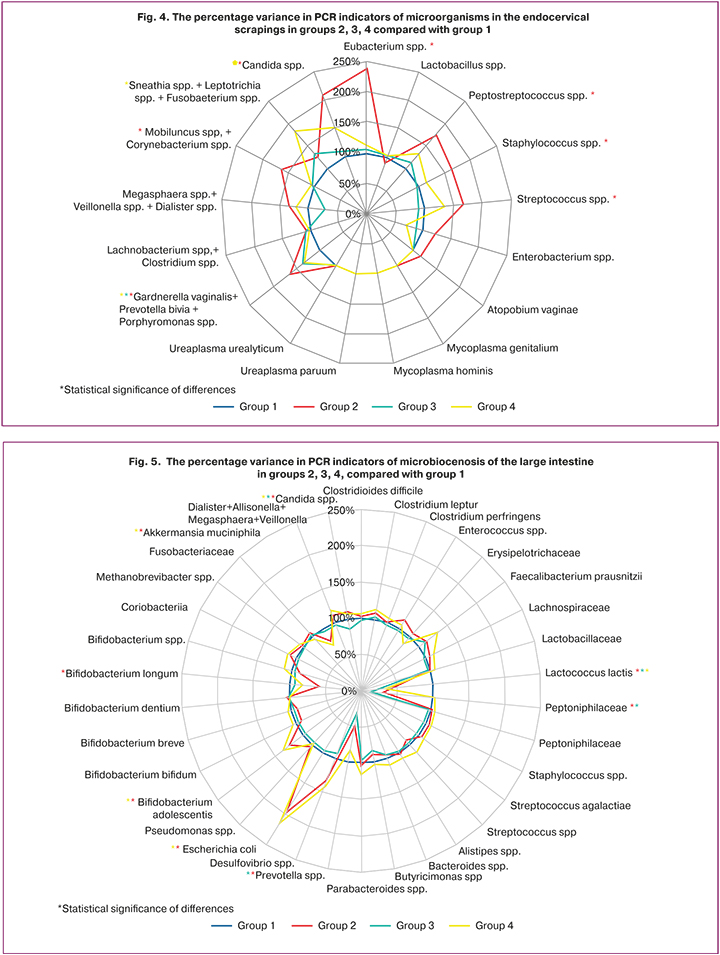
Among all groups in the study, group 4 demonstrated statistically significant correlations between the clinical sign of PROM and periodontopathogenic bacteria Porphyromonas gingivalis and Treponema denticola (a positive correlation), as well as Candida albicans (a negative correlation) in the gingival sulcus; and Streptococcus spp. in the cervical canal (a positive correlation).
Correlation analysis showed that among all groups in the study, groups 3 and 4 showed positive correlations between PROM and some representatives of gut microbiota, such as Peptoniphilaceae spp. (group 4), Prevotella spp. (groups 3 and 4), and Escherichia coli (group 3).
Discussion
Along with preterm birth, PPROM is a pathological condition that leads to high rates of neonatal and pediatric morbidity and negatively affects reproductive outcomes in subsequent pregnancies [9]. It is known that PROM is associated with a high risk of infectious complications also in full-term pregnancies [10, 11]. PROM was the most common complication of full-term pregnancy in women included in our study.
The established relationship between microorganisms and PROM can indicate that one of the potential maternal pathogenetic triggers of PROM are infectious and inflammatory factors associated with opportunistic pathogens in the urogenital system microbiota. The probability of adverse pregnancy outcomes associated both with periodontopathogenic bacteria [2, 13, 14] and gut dysbiosis [15] is widely debated. From this point of view, of particular interest was a snapshot analysis of microbiocenoses of different biotopes, such as endocervical mucosa, the gingival sulcus, and the large intestine. The groups of women with gingivitis (groups 2 and 4) exhibited the marked changes in the species composition and quantitative representation in microbiocenoses of all explored biotopes. At the same time, the prevalence of concomitant gingivitis in women with uncomplicated obstetric and gynecological history was only 6%. Additionally, in 13% of cases gingivitis was registered in combination with local inflammatory reaction in endocervical mucosa that was identified based on II >60%.
Pairwise correlation was performed between 14 informatively significant representatives of microbiocenosis of the cervical canal and the clinical-immunological marker (PPROM). There was a direct correlation only between the opportunistic pathogenes of the Streptococcus genus and the incidence of PROM in Group 4. Moreover, periodontopathogenic microorganisms, such as Porphyromonas gingivalis, Treponema denticola, and Candida albicans were found in the gingival sulcus in Group 4.
Exploration of the species composition and abundance of intestinal microorganisms is of particular importance, given the data on the role of representatives of intestinal microbiocenosis in the development of intrauterine infection, that is confirmed by their presence in the amniotic fluid in women who experienced premature rupture of membranes [12, 16]. In our study, direct correlations were found between the incidence of PROM in groups 3 and 4 and the intestinal microorganisms, such as Peptoniphilaceae spp. (group 4), Prevotella spp. (groups 3 and 4), and Escherichia coli (group 3).
Limitations. Limitations of our study included a small sample size of women with gingivitis and a limited number of cases with PROM. Furthermore, there were no cases of PROM in incomplete pregnancy. However, the identified association between pathogenic bacteria and PROM lays the ground for further research in this area.
Conclusion
The role of infectious and inflammatory factors in the pathogenesis of pregnancy complication, such as PROM necessitates assessment of inflammatory pathology both in the reproductive system and in the extragenital regions. A snapshot analysis of microbiocenoses of the cervical canal, the gingival sulcus, and the large intestine in pregnant women with gingivitis who had uncomplicated obstetric and gynecological history made it possible to detect relationship between the representatives of the opportunistic microflora of the reproductive and extragenital systems and PROM.
The findings in our study can be useful for obstetricians and gynecologists in management of pregnancy in women at risk of complications associated with periodontal diseases, and necessitates a multidisciplinary approach involving interdisciplinary specialists.
References
- Miao Z., Hu S., Wu P., Lai Y., Chen L.T., Huang M. et al. Maternal gut microbiome during early pregnancy predicts preterm birth. Cell Host Microbe. 2025; 33(9): 1623-1639.e8. https://dx.doi.org/10.1016/j.chom.2025.08.004
- Yang I., Claussen H., Arthur R.A., Hertzberg V.S., Geurs N., Corwin E.J. et al. Subgingival microbiome in pregnancy and a potential relationship to early term birth. Front. Cell. Infect. Microbiol. 2022; 12: 873683. https://dx.doi.org/10.3389/fcimb.2022.873683
- Balan P., Brandt B.W., Chong Y.S., Crielaard W., Wong M.L., Lopez V. et al. Subgingival microbiota during healthy pregnancy and pregnancy gingivitis. JDR Clin. Trans. Res. 2021; 6(3): 343-51. https://dx.doi.org/10.1177/2380084420948779
- Xu H., Cai M., Xu H., Shen X.J., Liu J. Role of periodontal treatment in pregnancy gingivitis and adverse outcomes: a systematic review and meta-analysis. J. Matern. Fetal Neonatal. Med. 2025; 38(1): 2416595. https://dx.doi.org/10.1080/14767058.2024.2416595
- Koren O., Goodrich J.K., Cullender T.C., Spor A., Laitinen K., Bäckhed H.K. et al. Host remodeling of the gut microbiome and metabolic changes during pregnancy. Cell. 2012; 150(3): 470-80. https://dx.doi.org/10.1016/j.cell.2012.07.008
- Wang J., Shi Z.H., Yang J., Wei Y., Wang X.Y., Zhao Y.Y. Gut microbiota dysbiosis in preeclampsia patients in the second and third trimesters. Chin. Med. J. (Engl.). 2020; 133(9): 1057-65. https://dx.doi.org/10.1097/CM9.0000000000000734
- Zakaria Z.Z., Al-Rumaihi S., Al-Absi R.S., Farah H., Elamin M., Nader R. et al. Physiological changes and interactions between microbiome and the host during pregnancy. Front. Cell Infect. Microbiol. 2022; 12: 824925. https://dx/doi.org/10.3389/fcimb.2022.824925
- Николаева А.В., Козлова А.А., Баранов И.И., Припутневич Т.В. Современные представления о взаимосвязи кишечной и вагинальной микробиот. Акушерство и гинекология. 2021; 9: 5-11. https://dx.doi.org/10.18565/aig.2021.9.5-11 [Nikolaeva A.V., Kozlova A.A., Baranov I.I., Priputnevich T.V. Current understanding of the relationship between gut and vaginal microbiotas. Obstetrics and Gynecology. 2021; (9): 5-11 (in Russian). https://dx.doi.org/10.18565/aig.2021.9.5-11].
- Енькова Е.В., Фомина А.С., Хоперская О.В., Киселева Е.В., Енькова В.В., Корж Е.В. Преждевременный разрыв плодных оболочек, преждевременные роды. Современные представления об этиологии и патогенезе (краткий обзор литературы). Вестник новых медицинских технологий. 2020; 14(6): 63-9. https://dx.doi.org/10.24411/2075-4094-2020-16779 [Enkova E.V., Fomina A.S., Khoperskaya O.V., Kiseleva E.V., Enkova V.V., Korzh E.V. Premature rupture of membranes, premature labor. Modern concepts of etiology and pathogenesis (brief review of literature). Journal of New Medical Technologies. 2020; 14(6): 63-9 (in Russian). https://dx.doi.org/10.24411/2075-4094-2020-16779].
- Ramirez-Montesinos L., Downe S., Ramsden A. Systematic review on the management of term prelabour rupture of membranes. BMC Pregnancy Childbirth. 2023; 23(1): 650. https://dx.doi.org/10.1186/s12884-023-05878-x
- Alansari B., Almiraisi H., Alani R., Abozenah Y., Ghorabah M. Immediate induction versus expectant management in term premature rupture of membranes: A longitudinal analysis of maternal and neonatal outcomes. Cureus. 2025; 17(7): e87640. https://dx.doi.org/10.7759/cureus.87640
- Edwards S.M., Cunningham S.A., Dunlop A.L., Corwin E.J. The maternal gut microbiome during pregnancy. MCN Am. J. Matern. Child. Nurs. 2017; 42(6): 310-7. https://dx.doi.org/10.1097/NMC.0000000000000372
- Ye C., Xia Z., Tang J., Khemwong T., Kapila Y., Kuraji R. et al. Unculturable and culturable periodontal-related bacteria are associated with periodontal inflammation during pregnancy and with preterm low birth weight delivery. Sci. Rep. 2020; 10(1): 15807. https://dx.doi.org/10.1038/s41598-020-72807-9
- Cassini M.A., Pilloni A., Condo S.G., Vitali L.A., Pasquantonio G., Cerroni L. Periodontal bacteria in the genital tract: are they related to adverse pregnancy outcome? Int. J. Immunopathol. Pharmacol. 2013; 26(4): 931-9.
- Sinha T., Brushett S., Prins J., Zhernakova A. The maternal gut microbiome during pregnancy and its role in maternal and infant health. Curr. Opin. Microbiol. 2023; 74: 102309. https://dx.doi.org/10.1016/j.mib.2023.102309
- Ahmadi S., Alikamali M., Nezhadi J., Ghotaslou R. The relationship between gut microbiota and preterm premature rupture of membranes: Mechanisms of action and clinical applications. Microb. Pathog. 2025; 205: 107673.https://dx.doi.org/10.1016/j.micpath.2025.107673
Received 22.04.2026
Accepted 02.10.2026
About the Authors
Anna G. Burduli, PhD, Senior Researcher at the B.V. Leonov Department of Assisted Technologies for the Treatment of Infertility, Academician V.I. Kulakov National Medical Research Center for Obstetrics, Gynecology and Perinatology, Ministry of Health of Russia, 117997, Russia, Moscow, Acad. Oparin str. 4, +7(495)531-44-44,+7(985)120-36-14, burdulianna@gmail.com, https://orcid.org/0000-0002-2849-5426
Nana K. Tetruashvili, PhD, Head of the Obstetric Department of Pregnancy Pathology No. 2, Academician V.I. Kulakov National Medical Research Center for Obstetrics, Gynecology and Perinatology, Ministry of Health of Russia, 117997, Russia, Moscow, Acad. Oparin str. 4+7(495)438-14-77, n_tetruashvili@oparina4.ru,
https://orcid.org/0000-0002-9201-2281
Irina P. Balmasova, Dr. Med. Sci., Professor, Leading Researcher at the Laboratory of Molecular Biological Research, Scientific Research Medical Dentistry Institution, Scientific and Educational Institution of Basic Medicine named after V.I. Pokrovsky, Russian University of Medicine, Ministry of Health of Russia, Moscow, Russian Federation,
27006, Russia, Moscow, Dolgorukovskaya str., 4, +7(910)468-97-72, iri.balm@mail.ru, https://orcid.org/0000-0001-8194-2419
Andrey E. Donnikov, PhD, Head of the Laboratory of Molecular Genetic Methods, Academician V.I. Kulakov National Medical Research Center for Obstetrics, Gynecology and Perinatology, Ministry of Health of Russia, 117997, Russia, Moscow, Ac. Oparina str., 4, +7(495)438-49-51, a_donnikov@oparina4.ru, https://orcid.org/0000-0003-3504-2406
Regina V. Krasheninnikova, Geneticist at the Laboratory of Molecular Genetic Methods, Academician V.I. Kulakov National Medical Research Center for Obstetrics, Gynecology and Perinatology, Ministry of Health of Russia, 117997, Russia, Moscow, Oparina str., 4, +7(495)438-49-51 ex. 3101, r_krasheninnikova@oparina4.ru,
https://orcid.org/0009-0002-2903-1225
Sergey D. Arutyunov, Dr. Med. Sci., Professor, Head of Department of Orthopedic Dentistry and Digital Technologies, Russian University of Medicine,
Ministry of Health of Russia, 127473, Russia, Moscow, Delegatskaya str., 20-1, sd.arutyunov@mail.ru, https://orcid.org/0000-0001-6512-8724
Corresponding author: Anna G. Burduli, burdulianna@gmail.com
Similar Articles