
Biofilm formation by opportunistic microorganisms isolated from the vaginal biotope
Khusnutdinova T.A., Shalepo K.V., Budilovskaya O.V., Krysanova A.A., Savicheva A.M., Bespalova O.N.
Objective. To assess the ability of opportunistic microorganisms isolated from the vaginal biotope to form single-species biofilms in vitro.
Materials and methods. The study included 142 isolates of opportunistic microorganisms from the vaginal biotope: Lactobacillus crispatus (n=9), Lactobacillus jensenii (n=6), Lactobacillus iners (n=1), Lactobacillus rhamnosus(n=1), Lactobacillus reuteri (n=1), Gardnerella vaginalis (n=13), Escherichia coli (n=23), Streptococcus agalactiae (n=39), Enterococcus faecalis (n=29) and yeast-like fungi of the Candida genus (n=20). Biofilm formation was assessed in a 96-well sterile flat-bottom polystyrene microplate.
Results. In vitro biofilm formation by 108/142 (76.1%) isolates of microorganisms was observed. The biofilm-producing ability of most clinical isolates of Lactobacillus spp. (17/18; 94.4%) was different. L. crispatus (9/9; 100%) and most L. jensenii (5/6; 83.3%) formed weak or moderate biofilms; L. rhamnosus, L. reuteri and one isolate of L. jensenii formed strong biofilms. All isolates of G. vaginalis had biofilm-producing ability: 2/13 (15.4%) were weak biofilm producers, 3/13 (23.1%) were moderate and 8/13 (61.5%) were strong. Among Candida spp. isolates, in vitro biofilms were formed by 18/20 (90%). At the same time, none of them were classified as weak biofilm producers. The biofilm-forming ability of different density was detected in 26/39 (66.7%) S. agalactiae isolates, 15/29 (51.7%) Enterococcus faecalis isolates, and 19/23 (82.6%) E. coli isolates.
Conclusion. Opportunistic microorganisms isolated from the vaginal biotope have the ability to form single-species biofilms in vitro. Further research is needed to create special conditions for formation of mixed-species or polymicrobial biofilms in vitro.
Authors' contributions. Khusnutdinova T.A. – literature review, microbiological testing, analysis of obtained data, manuscript writing and editing; Shalepo K.V. – microbiological testing, analysis of obtained data, manuscript writing and editing; Budilovskaya O.V., Krysanova A.A. – processing and analysis of obtained data; manuscript editing; Savicheva A.M., Bespalova O.N. –the study concept and design, manuscript editing, approval of the final version of the manuscript. All authors have made substantial contributions to the conception of the study, carrying out the study and writing the manuscript. The authors have read and approved the final version before publication.
Conflicts of interest. The authors declare that they have no conflicts of interest related to publication of this article.
Funding. The study was carried out within the framework of Fundamental Scientific Research “Creation of biological models of reproductive disorders for the development of individual approaches to pharmacological correction” (FGWN-2026-0008),
reg. No. 1025102300010-7-3.2.2.
Ethical Approval. The study was approved by the local Ethics Committee of D.O. Ott Research Institute of Obstetrics, Gynecology and Reproductology (protocol No. 147 of March 05, 2026).
Generative Artificial Intelligence. No generative AI was used in preparing this article.
Authors' Data Sharing Statement. The data supporting the findings of this study are available on request from the corresponding author after approval from the principal investigator.
For citation: Khusnutdinova T.A., Shalepo K.V., Budilovskaya O.V., Krysanova A.A., Savicheva A.M.,
Bespalova O.N., Biofilm formation by opportunistic microorganisms isolated from the vaginal biotope.
Akusherstvo i Ginekologiya/Obstetrics and Gynecology. 2026; (9): 117-125 (in Russian)
https://dx.doi.org/10.18565/aig.2026.109
Keywords
vaginal biotope
opportunistic microorganisms
clinical isolates
single-species biofilms
The vaginal microbiome is an essential component of female reproductive health and is a complex and dynamic ecosystem that plays an important role both in physiological processes and in the development of pathological conditions. Lactobacilli play a key role in the maintenance of homeostasis of the vaginal microecosystem by producing various antimicrobial compounds, such as lactic acid, hydrogen peroxide, and bacteriocins. The vaginal microbiota of healthy women is characterized by colonization and dominance of lactobacilli (Lactobacillus crispatus, Lactobacillus gasseri, Lactobacillus jensenii, and Lactobacillus iners), while microbial imbalance – reduced lactobacilli and/or overgrowth of opportunistic microorganisms leads to vaginal dysbiosis. The dysbiotic state is characterized by replacement of Lactobacillus species as normal microflora with a large number of obligate and facultative anaerobic microorganisms, such as Gardnerella vaginalis, Fannyhessea vaginae, Prevotella spp., Mobiluncus spp., and other, that leads to the development of bacterial vaginosis. Aerobic vaginitis is characterized by the dominance of aerobic opportunistic microflora, in particular, Streptococcus spp., Staphylococcus spp., Enterococcus spp., and bacteria of the family Enterobacteriaceae (Escherichia coli and Klebsiella spp. and other). Streptococcus agalactiae can cause severe pathology in pregnant women, puerperant women and newborns. In most cases, yeast-like fungi of the Candida genus are the cause of vulvovaginal candidiasis [1]. Furthermore, vaginal microflora can be a source of contamination of the distal urethra, potentially leading to either asymptomatic or clinically manifested bacteriuria [2]. Simultaneous presence of multiple pathogens (aerobic and/or facultative anaerobic microorganisms and/or fungi) promote the disruption of the vaginal microbiota and clinical presentation of vulvovaginitis of mixed etiology [3]. Recurrent vulvovaginal infections pose a significant clinical problem. Biofilm formation is considered one of the causes of these infections.
Biofilm are complex structures consisting of microbial communities embedded in an extracellular polymeric substances matrix. The cells in biofilms are less susceptible to host immune defense mechanisms and are more resistant to chemotherapeutic agents compared to planktonic cells. Moreover, microorganisms in biofilms can enter a dormant or slow-growing state, that makes them less susceptible to multiple drugs [4].
There is a wide range of methods to assess the biofilm-forming ability of microorganisms including such as the microtiter plate biofilm formation assay; fluorescence in situ hybridization (FISH). Electron microscopy and confocal laser scanning microscopy (CLSM) are used to examine the ultrastucture of microbial communities [5, 6]. Given the simplicity, high-throughput, and low cost method for detecting biofilms in flat-bottomed polystyrene plates as well as the feasibility to assess biofilm formation ability of different strains (bacteria, fungi) under different conditions, this method is the primary tool used for studying the biofilm-forming ability of microorganisms.
The method is based on adsorption of dye molecules in biofilm structures, followed by their elution (desorption) in organic solvents. This detection technique is most commonly used in static biofilm cultivation methods and allows quantification of the formed microbial communities. With increased biofilm matrix formation, dye adsorption capacity on the surface is greater, and the optical density of the sample is higher.
The objective of the study was to assess the ability of opportunistic microorganisms isolated from the vaginal biotope to form single-species biofilms in vitro.
Materials and methods
The isolates used in the study were obtained by analysis of clinical material (vaginal discharge) from women of reproductive age, who underwent examination at D.O. Ott Research Institute of Obstetrics, Gynecology and Reproductology in the period from 2024 to 2025. The total of 142 isolates of microorganisms were tested including Lactobacillus crispatus (n=9), Lactobacillus jensenii (n=6), Lactobacillus iners (n=1), Lactobacillus rhamnosus (n=1), Lactobacillus reuteri (n=1), Gardnerella vaginalis (n=13), Escherichia coli (n=23), Streptococcus agalactiae (n=39), Enterococcus faecalis (n=29), and yeast-like fungi of the Candida genus (n=20). Performance of correlation analysis of the biofilm-forming ability of microorganisms in the symptoms of vaginal diseases, their recurrence, or treatment outcomes was not intended in this study.
For culturing, storage, and further testing the following solid and liquid culture media were used: blood agar with 5% defibrinated blood, Sabouraud agar and Sabouraud broth, trypticase soy broth (TSB), trypticase soy broth with 10% glycerol, MRS agar, and MRS broth. The species of isolated microorganisms were identified using time-of-flight mass spectrometry (TOF-MS) (MALDI-TOF MS, BRUKER Daltonics, Germany).
The ability of clinical isolates of microorganisms to form single-species biofilms was assessed by quantitative determination of optical density of biofilms in a sterile, flat bottom, 96-well polystyrene plate using a modified microtiter-plate test by Christensen et al. A fresh 24-hour culture of each isolates of microorganisms was inoculated into 5 ml of nutrient broth (TSB, MRS, or Sabouraud medium) and incubated for 24 hours at 36°C and a CO2 concentration of 5%. The concentration of the cultured microorganisms was adjusted to match the 0.5 McFarland standard that corresponded approximately to 1–2×10⁸ CFU/mL for Escherichia coli. The density of suspension was measured using a CrystalSpec nephelometer (Becton Dickinson, USA). The suspension was shaken by using a vortex mixer in two serial ten-fold dilutions to achieve the final concentration of 10⁶ CFU/mL. Aliquots of 200 µL of the microorganism suspension at the final dilution were aseptically dispensed into the wells of a sterile, flat bottom, 96-well polystyrene plate. To ensure the reliability of the test, the suspension of each microorganism was added to three wells. The wells containing 200 µL of bacteria-free nutrient broth served as the negative control – C (-). After the samples were added to the plate, the plate was covered and incubated for 48 h at 36°C in an atmosphere containing 5% CO2. After incubation each well was washed three times with 300 µL of sterile phosphate-buffered saline (pH 7.2) at room temperature to remove free-floating planktonic microorganisms. After each washing step, the plate was emptied by a single vigorous shaking. Subsequently, it was air-dried at room temperature and fixed for 20 minutes by adding 150 µL of ethanol to each well. The alcohol was removed from the wells, and the plate was left to dry. Biofilms were visualized by staining with 2% gentian violet for 15 minutes. After staining, the dye was removed, and the wells were washed with running water until the water ran clear. To elute the dye from the cells, 150 µL of 95% ethanol was added to each well, and the covered plate was incubated at room temperature for 30 minutes. The eluate from the stained wells was transferred to a new 96-well plate. Optical density (OD) of each well was measured by spectrophotometry using Tecan Sunrise microplate reader with a test wavelength of 570 nm and a reference wavelength of 620 nm. The mean optical density was calculated for the negative control and test samples.
The results were interpreted in the following way:
- non-biofilm-forming clinical isolates – OD of the sample was less or equal to OD of the negative control;
- weak biofilm-forming clinical isolates – OD of the sample exceeded OD of the negative control by no more than 2 times;
- moderate biofilm-forming clinical isolates – OD of the sample exceeded OD of the negative control by 2–4 times;
- strong biofilm-forming clinical isolates – OD exceeded OD of the negative control by more than 4 times.
Results
A total of 142 clinical isolates were tested. Most of them (108/142; 76.1%) formed biofilms, while high ability to form biofilms was noted for 38 (35.2%) clinical isolates, 70 (64.8%) were classified as microorganisms that weakly and moderately form biofilms. The remaining 34/108 (23,9%) isolates did not form biofilm (Table 1).


Most of Lactobacillus spp. clinical isolates – 17/18 (94.4%) formed biofilms of different optical density with the exception of one L. iners isolate, which did not form biofilm. All L. Crispatus clinical isolates – 9/9 (100%) and most L. jensenii isolates – 5/6 (83.3%) were weak or moderate biofilm producers. Clinical isolates of L. rhamnosus, L. reuteri and one isolate of L. jensenii were strong biofilm producers (Table 2. Fig. 1).

The tested G. vaginalis clinical isolates were characterized by different levels of biofilm formation: weak – 2/13 (15.4%), moderate – 3/13 (23.1%) and strong – 8/13 (61.5%) (Table 3, Fig. 2).

Most Candida spp. clinical isolates – 18/20 (90%) formed biofilms in vitro, and none of them was classified as weak biofilm-forming isolate. Among all tested Candida albicans isolates, 9/11 (81.8%) had moderate ability to form biofilms, two isolates did not form biofilms. All clinical isolates of Candida glabrata and Candida parapsilosis formed strong biofilms in vitro (Table 4, Fig. 3).
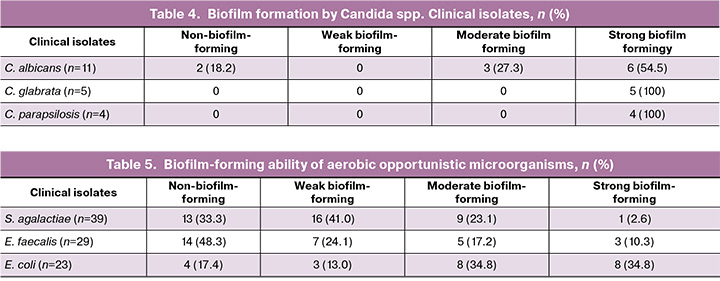
Biofilm-forming ability of aerobic opportunistic microorganisms is represented in Table 3. The ability to form biofilms of different optical density was found in 66.7% of S. agalactiae isolates. Most of them – 16/39 (41.0%) were weak biofilm producers, 9/39 (23.1%) were moderate biofilm producers, and only one isolate of S. agalactiae (2.6%) was a strong biofilm producer. Among clinical isolates of E. faecalis, 7 (24.1%), 5 (17.2%) and 3 (10.3%) were classified as weak, moderate and strong biofilm-forming isolates, respectively. Most E. coli isolates (16/23; 69.6%) formed moderate and strong biofilms, and 3/23 (13%) formed weak biofilms. Non-biofilm-forming isolates included 33.3% (13/39) of S. agalactiae clinical isolates, 48.3% (14/29) of E. faecalis, and 17.4% (4/23) of E. coli. (Table 5).
Discussion
The issues of biofilm formation and their role in the pathological processes are of great interest in medicine. Recent studies have shown that the majority of diseases of microbial etiology are accompanied or mediated by biofilm formation. Treatment failure and recurrence of the disease are associated with biofilm formation [7, 8]. Microorganisms in biofilms acquire new qualitative properties compared to their planktonic forms. They display greater resistance to adverse physical, chemical, and biological factors. Biofilms are resistant to high concentrations of antibiotics, exceeding the minimum inhibitory concentration by 100 – 1.000 times. In clinical settings, high survival rate of biofilm-associated microorganisms leads to the recurrence and chronicity of the infectious process. [9, 10].
More than 90% of the tested bacterial species have the ability to form biofilms. On the one hand, biofilm formation by the human normal microbiota protects the body from invasion by pathogens. On the other hand, the ability of bacteria to form biofilms is currently regarded as one of pathogenicity factors and is a primary cause of recurrent infectious processes localized in different parts of the body. According to the results of our study, 76.1% (108/142) of isolates of microorganisms from vaginal biotope formed biofilms of different optical density in vitro.
The vaginal microbiota of women of reproductive age is dominated by Lactobacillus spp. The ability of lactobacilli to form biofilms in vivo is accompanied by stable colonization of the genital tract mucosa, that creates a barrier preventing pathogen adhesion to epithelial cells. The study by Parolin C. et al. (2021) evaluated the ability of 16 Lactobacillus strains (L. crispatus, L. gasseri, L. vaginalis, and L. plantarum) to form biofilms. All tested lactobacilli formed biofilms. High variability in the level of biofilm formation was registered among L. crispatus and L. gasseri strains (moderate and strong biofilm producers). L. vaginalis formed weak biofilms. L. plantarum formed biofilms with the highest optical density, that was associated with specific properties of probiotic strains. Their genome encodes sugar transporters, extracellular proteins, and regulatory peptides enabling adaptation to various ecological niches [11]. Similar result was obtained in our study – 94.4% of Lactobacillus isolates formed biofilms of different density. All L. crispatus isolates (100%) and most L. jensenii isolates (83.3%) formed weak or moderate biofilms. One isolate of L. jensenii, L. rhamnosus and L. reuteri formed strong biofilms.
Limitation of our study is assessment of biofilm-forming ability of some of Lactobacillus isolates, such as L. rhamnosus, L. reuteri, and L. iners. In addition, L. iners is difficult to culture. Therefore, specific conditions are required to assess their ability to form biofilms.
One of the most topical issues in obstetric and gynecological practice is disruption of the vaginal microbiome in women of reproductive age. Bacterial vaginosis is the most common disturbance of the normal (physiological) vaginal microbiocenosis in women of reproductive age. The disease is often characterized by recurrence – 50–70% of women experience recurrence of bacterial vaginosis within 3–6 months after completion of therapy, and up to 80% of women experience recurrence of the disease at a later period of time. Biofilm formation is a key mechanism in the pathogenesis and failure of drug treatment of bacterial vaginosis [12, 13]. Among the bacteria associated with bacterial vaginosis, G. vaginalis has a high virulence potential, exhibiting higher adhesion and cytotoxic effects, as well as a greater tendency toward biofilm formation [14]. Clinical isolates of G. vaginalis tested in our study, formed biofilms in vitro in 100% of cases. At the same time, most of them – 84.6% (11/13) were strong or moderate biofilm producers.
Vulvovaginal candidiasis ranks second in the prevalence of vaginal infections. Between 75% and 80% of women experience at least one episode of vulvovaginal candidiasis throughout life, and approximately 9% of them have recurrent episodes of infection. Most often, C. albicans is an etiologic factor for vulvovaginal candidiasis (about 70–90%), and rarely other species of the Candida genus – C. glabrata, C. parapsilosis, C. krusei and C. tropicalis [15]. The pathogenicity of Candida spp. is attributed to the ability to form hyphae, adhesion to the epithelium, and production of extracellular enzymes. [16]. Currently, it has been shown that Candida spp. have the ability to form biofilms, that is also a key factor of treatment tolerance contributing to recurrent candidiasis [17]. In our study, clinical isolates of C. albicans, C. glabrata and C. parapsilosis formed biofilms in vitro in most cases – 80, 100 and 100%, respectively. At the same time, none of them were weak biofilm producers.
Currently it is believed that the microflora in aerobic vaginitis is composed of commensal aerobic microorganisms of intestinal origin, and the most frequently encountered bacteria are E. coli, E. faecalis, and S. agalactiae [18]. Biofilm formation is the major virulence factor for E. coli. The study by Mahale R.P. et al. (2025) compared biofilm-forming ability of commensal and uropathogenic E. coli isolates – 72.22% of uropathogenic E. coli isolates formed biofilms, while only 6.6% of commensal E. coli had biofilm-forming ability [19]. According to the results of a systematic review, biofilm formation of E. faecalis clinical isolates is widespread, and the global pooled prevalence is 68.68%. The density of E. faecalis biofilm formation varied widely: 47.92% of clinical isolates formed strong biofilms, 38.06% formed moderate biofilms, and 26.88% formed weak biofilms. Optical density of biofilms formed by E. faecalis varied widely – 47.92% of clinical isolates were strong, 38.06% were moderate and 26.88% were weak biofilm-forming producers [20]. Like other bacteria, S. agalactiae also form biofilms, promoting colonization of the vaginal mucosa and are a virulence factor playing a role in pathogenesis. The study by Kaminska D. et al. (2020) evaluated antimicrobial susceptibility, distribution of serotypes and virulence determinants, as well as biofilm-forming ability in 165 S. agalactiae isolates from pregnant women, newborns, and symptomatic adults. All S. agalactiae strains formed biofilms: more than half of the isolates (86/165; 52.1%) formed moderate biofilms, 72/165 (43.6%) formed weak biofilms, and 7/165 (4.2%) formed strong biofilms. [21]. According to the results of our study, E. faecalis isolated from vaginal biotope formed biofilms in half of cases (51.7%). However, strong biofilms were formed only in 10.3%; More than half of S. agalactiae (66.7%) isolates from asymptomatic pregnant women formed biofilms. Biofilms with different optical density were formed by 82.6% of E. coli isolates.
Biofilm can consist of microorganisms of a single species, but most often biofilm is a polymicrobial community. For example, it has been shown that formation of polymicrobial biofilms composed of Candida spp., G. vaginalis, and E. coli in the vaginal microbiota was associated with a severe clinical course due to reduced effectiveness of antimicrobial therapy [22]. Moreover, both synergistic and antagonistic interactions exist between microorganisms in mixed-species biofilms. For example, an exopolysaccharides secreted by lactobacilli stimulate their growth and formation of their own biofilms, and conversely inhibit biofilm formation formed by E. coli, Staphylococcus spp., Enterococcus spp., S. agalactiae и Candida spp. [23]. The study by Li M. et al. (2024), evaluated the influence of S. agalactiae on biofilm formation by G. vaginalis in co-cultivation. The results showed that S. agalactiae significantly increased the G. vaginalis biomass in 48-hour dual-species biofilms [24]. It should be noted that currently there is a limited number of studies on interspecies interaction between several pathogens. The development of new cultivation methods and creation of conditions for formation of mixed-species or polymicrobial biofilms in vitro are of great scientific interest to assess their role in the pathogenesis of infectious diseases and evaluate potential therapies for mixed infections.
Conclusion
Thus, our study showed that isolates of opportunistic microorganisms from the vaginal biotope have the ability to forming single-species biofilms in vitro. However, microorganisms involved in pathological processes exist in complex microbial communities. Further research is needed to develop the methods for creating conditions for formation of mixed-species or polymicrobial biofilms in vitro, as well as to explore synergistic and/or antagonistic interactions of microorganisms in biofilm formation. Of particular interest is research on correlation between biofilm-forming microorganisms and clinical manifestations of vaginal infections, particularly those with recurrent course.
References
- Радзинский В.Е., Савичева А.М., ред. Биоценоз влагалища. Норма. Нарушения. Восстановление. М.: Редакция журнала Status Praesens; 2023. 360 с. https://dx.doi.org/10.29039/978-5-907218-72-7 [Radzinsky V.E., Savicheva A.M., eds. Vaginal biocenosis. Standard. Violations. Restoration. Moscow: Editorial Board of the Status Praesens journal; 2023. 360 p. (in Russian). https://dx.doi.org/10.29039/978-5-907218-72-7].
- Зайцев А.В., Аполихина И.А., Ходырева Л.А., Берников А.Н., Куприянов Ю.А., Строганов Р.В., Арефьева О.А., Тетерина Т.А. Роль нарушения микробиоты влагалища в патогенезе рецидивирующей инфекции нижних мочевыводящих путей: современный взгляд на проблему. Акушерство и гинекология. 2021; 5: 40-6. https://dx.doi.org/10.18565/aig.2021.5.40-46 [Zaitsev A.V., Apolikhina I.A., Khodyreva L.A., Bernikov A.N., Kupriyanov Yu.A., Stroganov R.V., Arefyeva O.A., Teterina T.A. Role of abnormal vaginal microbiota in the pathogenesis of recurrent lower urinary tract infection: a modern view of the problem. Obstetrics and Gynecology. 2021; (5): 40-6 (in Russian). https://dx.doi.org/10.18565/aig.2021.5.40-46].
- Доброхотова Ю.Э., Маркова Э.А. Смешанный вагинит в современных условиях: особенности течения и выбор подходов к лечению. Проблемы репродукции. 2022; 28(4): 137-44. https://dx.doi.org/10.17116/repro202228041137 [Dobrokhotova Yu.E., Markova E.A. Mixed vaginitis. What's new? Features of the course and therapy of mixed vaginitis. Russian Journal of Human Reproduction. 2022; 28(4): 137-44 (in Russian). https://dx.doi.org/10.17116/repro202228041137].
- Ильина Т.С., Романова Ю.М. Бактериальные биопленки: роль в хронических инфекционных процессах и поиск средств борьбы с ними. Молекулярная генетика, микробиология и вирусология. 2021; 39(2): 14 24. https://dx.doi.org/10.17116/molgen20213902114 [Ilyina T.S., Romanova Yu. M. Bacterial biofilms: their role in chronical infection processes and the means to combat them. Molecular Genetics, Microbiology and Virology. 2021; 39(2): 14-24. (in Russian). https://dx.doi.org/10.17116/molgen20213902114].
- Нурузова З.А., Байматов Р.А., Толипова Г.К. Биопленка микроорганизмов – апробированные методы исследования. Биология и интегративная медицина. 2019; 3(31): 5-17. [Nuruzova Z.A., Baimatov R.A., Tolipova G.K. Microbial biofilm – proven research methods. Biology and Integrative Medicine. 2019; 3(31): 5-17 (in Russian)].
- Шалепо К.В., Спасибова Е.В., Крысанова А.А, Хуснутдинова Т.А., Будиловская О.В., Сторожева К.В, Тапильская Н.И., Савичева А.М., Коган И.Ю. Сравнение методов выявления биопленочного синдрома при бактериальном вагинозе. Акушерство и гинекология. 2025; 7: 121-9. https://doi.org/10.18565/aig.2025.117 [Shalepo K.V.,Spasibova E.V., Krysanova A.A., Khusnutdinova T.A., Budilovskaya O.V., Storozheva K.V., Tapilskaya N.I., Savicheva A.M., Kogan I.Yu. Comparison of methods for detecting biofilm syndrome in bacterial vaginosis. Obstetrics and Gynecology. 2025; (7): 121-9 (in Russian). https://dx.doi.org/10.18565/aig.2025.117].
- Rather M.A., Gupta K., Mandal M. Microbial biofilm: formation, architecture, antibiotic resistance, and control strategies. Braz. J. Microbiol. 2021; 52(4): 1701-18. https://doi.org/10.1007/s42770-021-00624-x
- Jamal M., Ahmad W., Andleeb S., Jalil F., Imran M., Nawaz M.A. et al. Bacterial biofilm and associated infections. J. Chin. Med. Assoc. 2018; 81(1): 7-11. https://doi.org/10.1016/j.jcma.2017.07.012
- Хрянин А.А. Биопленки микроорганизмов: современные представления. Антибиотики и Химиотерапия. 2020; 65(5-6): 70-7. https://dx.doi.org/10.37489/0235-2990-2020-65-5-6-70-77 [Khryanin A.A. Microbial biofilms: modern concepts. Antibiotics and Chemotherapy. 2020; 65(5-6): 70-7 (in Russian). https://dx.doi.org/10.37489/0235-2990-2020-65-5-6-70-77].
- Zhao X., Yu Z., Ding T. Quorum-sensing regulation of antimicrobial resistance in bacteria. Microorganisms. 2020; 8(3): 425. https://dx.doi.org/10.3390/microorganisms8030425
- Parolin C., Croatti V., Giordani B., Vitali B. Vaginal Lactobacillus impair Candida dimorphic switching and biofilm formation. Microorganisms. 2022; 10(10): 2091. https://dx.doi.org/10.3390/microorganisms10102091
- Arias Valverde J., Alvarado Fernández M.L., Alvarado Mora M.L., Arias Alvarado M.J., Vanegas Navarro P. Probiotics as a preventive strategy for recurrent bacterial vaginosis: a narrative review. Cureus. 2025; 17(8): e89764. https://dx.doi.org/10.7759/cureus.89764
- Verstraelen H., Swidsinski A. The biofilm in bacterial vaginosis: implications for epidemiology, diagnosis and treatment: 2018 update. Curr. Opin. Infect. Dis. 2019; 32(1): 38-42. https://dx.doi.org/10.1097/QCO.0000000000000516
- Qin H., Liu Y., Zhai Z., Xiao B. Biofilm-forming capacity and drug resistance of different Gardnerella subgroups associated with bacterial vaginosis. Microorganisms. 2023; 11(9): 2186. https://dx.doi.org/10.3390/microorganisms11092186
- Faustino M., Ferreira C.M.H., Pereira A.M., Carvalho A.P. Candida albicans: the current status regarding vaginal infections. Appl. Microbiol. Biotechnol. 2025; 109(1): 91. https://dx.doi:10.1007/s00253-025-13478-2
- Mohammadi F., Hemmat N., Bajalan Z., Javadi A. Analysis of biofilm-related genes and antifungal susceptibility pattern of vaginal Candida albicans and non-Candida albicans species. Biomed. Res. Int. 2021; 2021: 5598907. https://dx.doi.org/10.1155/2021/5598907
- Rodríguez-Cerdeira C., Gregorio M.C., Molares-Vila A., López-Barcenas A., Fabbrocini G., Bardhi B. et al. Biofilms and vulvovaginal candidiasis. Colloids Surf. B Biointerfaces. 2019; 174: 110-125. https://dx.doi.org/10.1016/j.colsurfb.2018.11.011
- Ma X., Wu M., Wang C., Li H., Fan A., Wang Y., Han C., Xue F. The pathogenesis of prevalent aerobic bacteria in aerobic vaginitis and adverse pregnancy outcomes: a narrative review. Reprod. Health. 2022; 19: 21. https://dx.doi.org/10.1186/s12978-021-01292-8
- Mahale R.P. K. A., Princy A., Maheshwarappa Y.D., Sumana M.N. Comparative evaluation of biofilm-forming capacity in uropathogenic and commensal Escherichia coli. Front. Cell. Infect. Microbiol. 2025; 15: 1570422. https://dx.doi.org/10.3389/fcimb.2025.1570422
- Tamrat E., Asmare Z., Geteneh A., Sisay A., Getachew E., Kassanew B. et al. The global prevalence of biofilm-forming Enterococcus faecalis in clinical isolates: a systematic review and meta-analysis. BMC Infect. Dis. 2025; 25(1): 981. https://dx.doi.org/10.1186/s12879-025-11399-z
- Kaminska D., Ratajczak M., Szumała-Kąkol A., Dlugaszewska J., Nowak-Malczewska D.M., Gajecka M. Increasing resistance and changes in distribution of serotypes of Streptococcus agalactiae in Poland. Pathogens. 2020; 9(7): 526. https://dx.doi.org/10.3390/pathogens9070526
- Shang X., Bai H., Fan L., Zhang X., Zhao X., Liu Z. In vitro biofilm formation of Gardnerella vaginalis and Escherichia coli associated with bacterial vaginosis and aerobic vaginitis. Front. Cell. Infect. Microbiol. 2024; 14:1387414. https://dx.doi.org/10.3389/fcimb.2024.1387414
- Giordani B., Naldi M., Croatti V., Parolin C., Erdoğan Ü., Bartolini M. et al. Exopolysaccharides from vaginal lactobacilli modulate microbial biofilms. Microb. Cell. Fact. 2023; 22(1): 45. https://doi.org/10.1186/s12934-023-02053-x
- Li M., Zeng Z., Wang X., Liu Y., Wei H., Liu J. et al. Mechanisms ofS. agalactiae promoting G. vaginalis biofilm formation leading to recurrence of BV. NPJ Biofilms Microbiomes. 2024; 10(1): 138. https://dx.doi.org/10.1038/s41522-024-00601-w
Received 02.04.2026
Accepted 03.09.2026
About the Authors
Tatiana A. Khusnutdinova, PhD, Senior Researcher of the Experimental Microbiology Group, D.O. Ott Research Institute of Obstetrics, Gynecology and Reproductology,3 Mendeleyevskaya Line, 199034, St. Petersburg, Russia, husnutdinovat@yandex.ru, https://orcid.org/0000-0002-2742-2655
Kira V. Shalepo, PhD, Senior Researcher of the Experimental Microbiology Group, D.O. Ott Research Institute of Obstetrics, Gynecology and Reproductology,
3 Mendeleyevskaya Line, 199034, St. Petersburg, Russia, 2474151@mail.ru, https://orcid.org/ 0000-0002-3002-3874
Olga V. Budilovskaya, PhD, Senior Researcher of the Experimental Microbiology Group, D.O. Ott Research Institute of Obstetrics, Gynecology and Reproductology,
3 Mendeleyevskaya Line, 199034, St. Petersburg, Russia, o.budilovskaya@gmail.com, https://orcid.org/0000-0001-7673-6274
Anna A. Krysanova, PhD, Senior Researcher of the Experimental Microbiology Group, D.O. Ott Research Institute of Obstetrics, Gynecology and Reproductology,
3 Mendeleyevskaya Line, 199034, St. Petersburg, Russia, krusanova.anna@mail.ru, https://orcid.org/ 0000-0003-4798-1881
Alevtina M. Savicheva, Dr. Med. Sci., Professor, Head of the Department of Medical Microbiology, D.O. Ott Research Institute of Obstetrics, Gynecology and Reproductology, 3 Mendeleyevskaya Line, 199034, St. Petersburg, Russia, savitcheva@mail.ru, https://orcid.org/ 0000-0003-3870-5930
Olesya N. Bespalova, Dr. Med. Sci., Deputy Director of the Institute for Scientific Work, D.O. Ott Research Institute of Obstetrics, Gynecology and Reproductology»,
3 Mendeleyevskaya Line, 199034, St. Petersburg, Russia, shiggerra@mail.ru, https://orcid.org/0000-0002-6542-5953
Corresponding author: Tatiana A. Khusnutdinova, husnutdinovat@yandex.ru
Similar Articles