Аномальные маточные кровотечения (АМК) – распространенное, зачастую изнуряющее состояние, от которого страдают от 27 до 50% и более девочек и женщин репродуктивного возраста [1–3]. АМК называют любое отклонение от нормального менструального цикла [4]; это совокупность симптомов, включающих межменструальные кровотечения, нарушения продолжительности менструации и/или менструального цикла и/или нарушение регулярности менструаций [1–4].
У десятков миллионов женщин во всем мире менструация оказывает серьезное негативное влияние на физическое, психическое и социальное здоровье [5]. У женщин именно обильные менструальные кровотечения (ОМК) чаще всего приводят к латентному дефициту железа (ЛДЖ) и развитию железодефицитной анемии (ЖДА) [1]. У женщин репродуктивного возраста формированию железодефицитных состояний (ЖДС) могут способствовать АМК и ОМК, обусловленные миомой матки, дисфункцией яичников, эндометриозом, а также способ контрацепции (негормональные внутриматочные средства увеличивают объем кровопотери) [6]. В Российской Федерации, по данным исследования «Лебедь», ОМК регистрируются у каждой второй женщины в возрасте 18–35 лет [7].
В настоящее время ЖДА занимает первое место среди всех анемий (80–90%) и является одним из самых распространенных заболеваний [6]. Согласно данным крупнейшего международного исследования, примерно 1,2 млрд человек во всем мире имеют ЖДА, в то время как ЛДЖ встречается примерно в 2 раза чаще [6]. Охватывая почти 30% населения планеты, включая детей, ЖДА представляет серьезную проблему для общественного здравоохранения. Девочки и женщины репродуктивного возраста страдают от ЖДА непропорционально чаще [6]. При беременности распространенность анемии составляет в среднем 38,2% во всем мире и значительно выше в странах с низким и средним уровнем дохода [6]. В настоящее время общепризнано, что связь между АМК, ЛДЖ и ЖДА недооценена. Дефицит железа представляет собой проблему, передающуюся из поколения в поколение. ОМК встречаются гораздо чаще, чем принято считать, оказывая неблагоприятное воздействие на здоровье женщины в различные возрастные периоды [8, 9]. ЖДС неблагоприятно влияет на развитие нервной системы плода, вызывая стойкие когнитивные и психологические расстройства. Считается, что направленность политики здравоохранения на профилактику, скрининг, диагностику и правильное ведение ЖДА является крайне важной приоритетной задачей [9]. В настоящее время ЖДС занимает одну из ведущих позиций в рутинной клинической практике врача акушера-гинеколога, поскольку ЖДА во время беременности может вызвать неблагоприятные перинатальные исходы, включая преждевременные роды, преждевременный разрыв плодных оболочек и повышение материнской и младенческой смертности [10]. Наиболее важно выявление и коррекция этого состояния до наступления беременности. При этом лечение препаратами железа должно проводиться одновременно с мероприятиями, направленными на уменьшение менструальной кровопотери [11–14], поскольку продолжающееся кровотечение может свести на нет эффект от приема препаратов железа [15].
Однако существуют и препятствия для эффективной терапии ЖДС. Несмотря на то, что увеличение потребления железа с пищей важно, основным методом лечения как ЛДЖ, так и ЖДА остается назначение пероральных препаратов железа. Пероральный прием железа часто неэффективен из-за проблем с соблюдением режима лечения пациентами, обычно связанных с побочными эффектами со стороны желудочно-кишечного тракта (ЖКТ) [9]. С другой стороны, у женщин репродуктивного и перименопаузального возраста недостаточная эффективность лечения ЖДС может быть обусловлена неэффективным лечением заболевания, которое вызвало АМК [15]. В настоящее время для лечения ЖДС имеется широкий спектр препаратов железа, и врачу-клиницисту не всегда бывает просто выбрать препарат, который будет оптимальным для лечения конкретной пациентки [16].
Цель исследования: оценить эффективность препарата, содержащего железа фумарат (эквивалентно 50 мг железа) и фолиевую кислоту 0,5 мг, у пациенток с АМК.
Материалы и методы
Дизайн исследования: одноцентровое сплошное наблюдательное исследование. Исследование проводилось на клинической базе ФГОУ ВО «Кемеровский государственный медицинский университет» Минздрава России ООО «Клиника женского и мужского здоровья «Фенарета» (Кемерово). Исследование одобрено Этическим комитетом ФГБОУ ВО «Кемеровский государственный медицинский университет» Минздрава России (протокол № 362 от 25.02.2026 ).
В исследование включены 75 пациенток, соответствующих критериям включения/исключения, обратившихся в клинику за период с 1 января 2025 г. по 1 января 2026 г.
Критерии включения: репродуктивный и перименопаузальный возраст, наличие спонтанных менструаций, диагноз АМК (согласно классификации FIGO PALM-COEIN [17, 18]), наличие ЖДС: ЛДЖ (уровень ферритина <30 нг/мл при концентрации гемоглобина (Hb) ≥120 г/л) или ЖДА (концентрация Hb <120 г/л, уровень ферритина <15 нг/мл) [19], прием препарата железа (фумарат железа в комбинации с фолиевой кислотой по 1 капсуле 2 раза в сутки в течение 12 недель), согласие на участие в исследовании.
Критерии исключения: возраст моложе 18 лет и старше 49 лет; наличие аменореи (3 месяца и более); применение гормональных методов контрацепции и менопаузальной гормональной терапии; анемия тяжелой степени (концентрация Hb 70 г/л и менее); беременность и лактация, другие причины анемии (В12-дефицитная, фолиеводефицитная анемия, талассемия или гемоглобинопатии); подозрение на злокачественные новообразования, заболевания ЖКТ (язвенная болезнь в фазе обострения, болезнь Крона, язвенный колит или синдром мальабсорбции); тяжелые экстрагенитальные заболевания (почечная или печеночная недостаточность, тяжелые декомпенсированные заболевания сердечно-сосудистой системы); недавняя терапия (прием препаратов железа или переливание крови в последние 3 месяца), отказ от участия в исследовании.
Анамнестические сведения, сведения о наличии жалоб, клинических особенностях, а также лабораторные показатели были получены путем выкопировки из амбулаторных карт пациенток.
Концентрацию Hb, гематокрита (Ht), эритроцитов (Er) определяли на гематологических анализаторах (модели XS 800i, XT 2000i, XE 2100, Япония), измерение ферритина проводилось на иммунохемилюминесцентных анализаторах: Abbott Architect i (Abbott Laboratories, США) и Roche Cobas e (Roche Diagnostics, Швейцария). Проводили расчет следующих показателей: средний объем эритроцита (MCV), среднее содержание Hb в эритроците (MCH), средняя концентрация Hb в эритроцитах (MCHC).
Статистический анализ
Статистическая обработка результатов исследования проведена с применением пакета программ STATISTICA 6.0 fоr Windоws (StatSоft, США), MedCalc Versiоn 11.0 (Sоftwa, Бельгия). Результаты представлены в виде медианы и межквартильного интервала в формате Me (Q1; Q3). Качественные данные исследования представлены с использованием абсолютных и относительных показателей в формате n/N (%), где n – абсолютное значение частоты признака, N – общее число наблюдений в исследуемой группе, а % – относительное значение частоты признака. Соответствие распределения признаков, измеренных на непрерывной шкале, нормальному закону оценивалось с помощью критерия согласия Колмогорова–Смирнова. Сравнение мер центральной тенденции проводилось с применением критерия Вилкоксона (Wilcoxon W-test) для порядковых данных, критерия Мак–Немара (McNemar’s test) – для номинальных данных. Уровень статистической значимости для ошибки первого рода установлен при р<0,05.
Результаты
Краткая клинико-анамнестическая характеристика обследованных пациенток представлена в таблице 1.
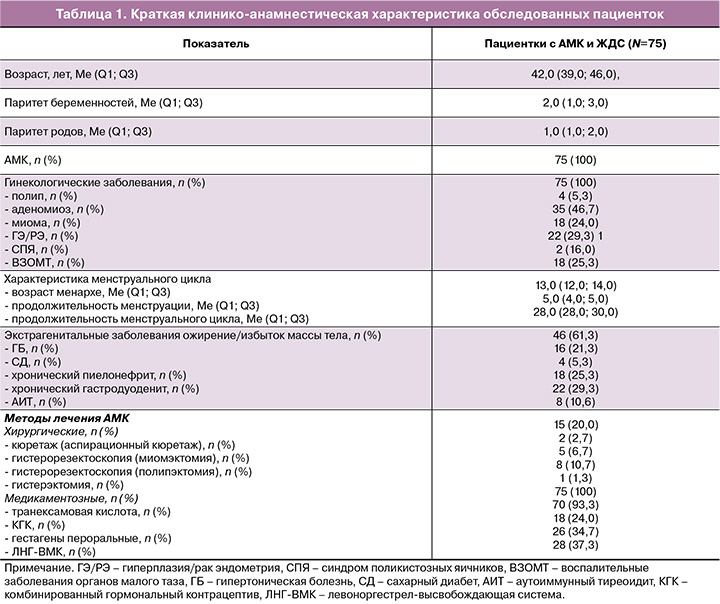
В исследование были включены пациентки в возрасте от 20 до 49 лет, Ме возраста составила 42,0 (39,0; 46,0) года. Согласно критериям включения, все пациентки страдали АМК. Все пациентки с АМК имели гинекологические заболевания, в структуре которых преобладал аденомиоз – у 35/75 (46,7%), гиперплазия эндометрия – у 22/75 (29,3%) и миома матки – у 18/75 (24,0%). Аденомиоз изолированно у пациенток с АМК регистрировался только в 18/75 (24,0%) случаях, аденомиоз сочетался с миомой матки в 17/75 (22,7%) случаях и с миомой матки и ГЭ – в 40/75 (53,3%) случаях. Всем пациенткам применялись медикаментозные методы лечения АМК (транексамовая кислота, комбинированные гормональные контрацептивы, гестагены), и только 15/75 (20,0%) женщин потребовали хирургического лечения (кюретаж, гистерорезектоскопия). Одной пациентке проведена тотальная гистерэктомия лапароскопическим доступом.
Динамика симптомов у женщин с АМК через 12 недель лечения препаратом фумарата железа в сочетании с фолиевой кислотой представлена в таблице 2.
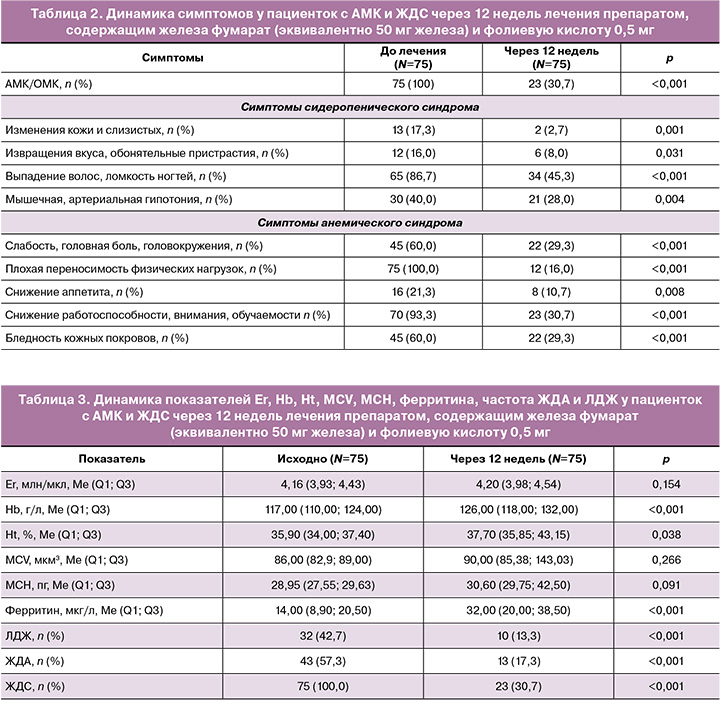
Все пациентки с ЖДС имели от 1 до 10 клинических симптомов заболевания. У пациенток с АМК среди симптомов сидеропенического синдрома преобладали жалобы со стороны дериватов кожи (выпадение волос, ломкость ногтей) – у 65/75 (86,7%), среди симптомов анемического синдрома – снижение работоспособности, внимания, обучаемости – у 70/75 (93,3%) женщин. Через 12 недель лечения препаратом, содержащим железа фумарат и фолиевую кислоту, у пациенток с АМК значимо снизилась частота всех клинических проявлений заболевания: сидеропенического синдрома – с 86,7 до 45,3% (р<0,001), анемического синдрома – с 93,3 до 30,7% (р<0,001). Однако АМК/ОМК сохранились через 12 недель, несмотря на проводимую гормональную терапию и хирургическое лечение, у 23/75 (30,7%) женщин.
Динамика показателей Er, Hb, Ht, MCV, MCH, ферритина, частота ЖДА и ЛДЖ у пациенток с АМК и ЖДС через 12 недель лечения препаратом, содержащим железа фумарат и фолиевую кислоту, представлена в таблице 3.
У пациенток с АМК и ЖДС через 12 недель лечения препаратом, содержащим железа фумарат и фолиевую кислоту, зарегистрировано статистически значимое увеличение концентрации Hb – с 117,00 (110,00; 124,00) до 126,00 (118,00; 132,00) г/л (р<0,001), Ht – с 35,90 (34,00; 37,40) до 37,70 (35,85; 43,15)% (р=0,038), ферритина – с 14,00 (8,90; 20,50) до 32,00 (20,00; 38,50) мкг/л (р<0,001). При этом частота ЖДС снизилась более чем в 3 раза: ЛДЖ – с 42,7 до 13,3%, ЖДА – с 57,33 до 17,3% (р<0,001).
Серьезных нежелательных явлений при приеме препарата, содержащего железа фумарат и фолиевую кислоту, зарегистрировано не было. Незначительные нежелательные явления (легкой степени) были зарегистрированы у 3/75 (4,0%) пациенток: 2 женщины отмечали наличие диспептических проявлений и 1 – затруднение при дефекации (запор), при этом все пациентки завершили запланированный курс лечения.
Обсуждение
Результаты проведенного исследования подтвердили имеющиеся ранее сведения о том, что АМК являются значимой причиной ЖДС у женщин репродуктивного возраста [20].
В структуре причин АМК в возрастной группе 42,0 (39,0; 46,0) лет преобладают органические причины (аденомиоз, ГЭ, миома), которые могут встречаться изолированно, но в большинстве случаев сочетаются между собой. Наиболее частой причиной АМК является аденомиоз, который изолированно встречался только у 24% женщин. Несколько ранее в крупном исследовании Cao Y. et al., включавшем 5648 пациенток, было также продемонстрировано, что изолированный аденомиоз выявляется только в 16,7% случаев, в то время как у 82,3% пациентов имеется как минимум одно сопутствующее заболевание, а у 31,9% – два и более [21]. Такая высокая частота сочетаний объясняется общностью механизмов развития этих заболеваний, в частности «эстрогеновой теорией» и нарушениями в системе метаболизма гормонов [22, 23].
Всем пациенткам для остановки АМК проводилась медикаментозная терапия и 20% женщин подверглись различным вариантам хирургического лечения, тем не менее у 1/3 пациенток через 12 недель сохранялись клинические проявления АМК согласно классификации FIGO (2012, 2018) [17, 18]. Несмотря на отсутствие эффективного гемостаза у значительного количества пациенток, включенных в исследование, применение препарата, содержащего фумарат железа в сочетании с фолиевой кислотой, продемонстрировало высокую эффективность при крайне невысокой частоте легких нежелательных явлений (4%). Частота ЛДЖ после терапии снизилась в 3,2 раза, ЖДА – в 3,3 раза.
В настоящее время комбинация железа фумарат 163,56 мг (эквивалентно 50 мг железа) + фолиевая кислота 540 мкг (эквивалентно 500 мкг сухого вещества) включена в клинические рекомендации Минздрава России «Железодефицитная анемия» (2024) [19]. Капсульная форма комплекса фумарата железа (II) с фолиевой кислотой обладает рядом преимуществ и в отдельных аспектах превосходит иные препараты железа. Ключевой момент: фармакокинетика препарата зависит от валентности. В ЖКТ всасываются исключительно двухвалентные ионы, тогда как трехвалентные предварительно восстанавливаются до Fe²+, и лишь затем белки-переносчики доставляют железо в энтероциты. В каждой капсуле препарата «Ферретаб комп.» – три мини-
таблетки с фумаратом железа и одна с фолиевой кислотой. Такая конструкция дает фармакокинетическое преимущество: соли двухвалентного железа абсорбируются именно в двенадцатиперстной и тощей кишке, где физиологически происходит всасывание. Следовательно, данный препарат с замедленным высвобождением отличается высокой биодоступностью и, очевидно, менее выраженным побочным действием на слизистую ЖКТ по сравнению с препаратами трехвалентного железа [16].
Ранее в исследовании, проведенном Кузнецовой И.В. у женщин со средним возрастом 34,3±8,6 года, ОМК и ЖДС, применение препарата, содержащего железа фумарат (эквивалентно 50 мг железа) и фолиевую кислоту 0,5 мг, также продемонстрировало высокую эффективность в восстановлении концентрации Hb и запасов железа [20].
В 2025 г. Громова О.А. и соавт. провели систематический компьютерный анализ фармакологии препарата, содержащего железа фумарат и фолиевую кислоту, при ЛДЖ и ЖДА. В работе представлена сравнительная оценка разных солей железа, их влияние на гемосидероз тканей, синергизм фумарата с фолатами и другими микронутриентами, а также роль микробиома и пребиотиков в улучшении всасывания. Показано, что препараты фумарата железа целесообразны при необходимости субстратной поддержки аэробного и анаэробного энергообмена (от митохондрий до организма) и мобилизации адаптивных реакций, а также что пероральные соли фумарата действуют мягче и безопаснее. В условиях гипоксии и аэробного метаболизма, типичных для дефицита железа, они проявляют противострессовые и противогипоксические свойства. Проведенное исследование подтвердило эффективность и безопасность препарата, содержащего железа фумарат и фолиевую кислоту [24].
Ранее в 2024 г. Ших Е.В. и соавт. также отметили ряд преимуществ фумарата железа (II) при изучении его соответствия профилю растворения требованиям, предъявляемым к лекарственным препаратам модифицированного высвобождения: высокая биодоступность, отсутствие характерного железного привкуса и связывания с белками в верхних отделах ЖКТ [25].
Заключение
Таким образом, лечение пациенток с АМК и установленными ЖДС препаратом «Ферретаб комп.» в течение 12 недель в наблюдательном исследовании показало высокую эффективность и безопасность.