
Unexplained infertility in assisted reproductive technology cycles: clinical significance of PGT-A and whole-exome sequencing in early embryonic developmental arrest
Ishchuk M.P., Tsabai P.N., Perminova S.G., Ekimov A.N., Ritcher O.V., Mukosey I.S.
Objective. To evaluate the embryological and clinical outcomes of assisted reproductive technology cycles in couples with unexplained infertility based on the use of preimplantation genetic testing for aneuploidy
(PGT-A) and to assess the diagnostic value of whole-exome sequencing in couples with recurrent early embryonic developmental arrest.
Materials and methods. A retrospective analysis of 226 assisted reproductive technology cycles in couples with unexplained infertility treated at a single center was performed: 122 cycles without PGT-A and 104 cycles with PGT-A. The groups were defined based on the actual use of PGT-A in the index cycle. The primary analysis of clinical outcomes was performed per each oocyte retrieval. The cumulative live birth rate was calculated considering all embryo transfers derived from a single oocyte retrieval, including subsequent frozen-thawed embryo transfers. For binary clinical outcomes, relative risks (RRs) with 95% confidence intervals (CIs) were calculated. To assess the association between PGT-A use and binary live birth outcomes after index oocyte retrieval, accounting for baseline between-group differences, a multivariate logistic regression model was constructed, adjusting for patient age, number of previous IVF attempts, and anti-Mullerian hormone levels. Whole-exome DNA sequencing was performed in a subgroup of 25 couples with recurrent early embryonic developmental arrest.
Results. Patients in the PGT-A group were older and had a higher number of previous IVF attempts. The main quantitative embryological parameters did not differ significantly between the groups. In the PGT-A group, 365 embryos were biopsied, and the proportion of euploid embryos decreased with increasing female age (p=0.006). Embryo transfer from the analyzed oocyte retrieval was performed less frequently in the PGT-A group, reflecting the stage of embryological and genetic selection process. Among performed embryo transfers, the clinical pregnancy rate was lower in the PGT-A group: 51/85 (60.0%) versus 91/121 (75.2%); RR 0.80; 95% CI 0.65–0.98; p=0.020. The cumulative live birth rate per oocyte retrieval was also lower in the PGT-A group (38/104 (36.5 %) vs. 68/122 (55.7 %); RR 0.66; 95% CI 0.49–0.88; p=0.004). In the multivariable logistic regression model, PGT-A use remained associated with lower odds of the binary live birth outcome after index oocyte retrieval, after adjustment for female age, number of previous IVF attempts, and anti-Müllerian hormone level: adjusted OR 0.50; 95% CI 0.28–0.89; p=0.020. Increasing female age was also associated with lower odds of the same binary live birth outcome (adjusted OR 0.91; 95% CI 0.84–0.99; p=0.025). In the subgroup of couples with early embryonic developmental arrest, whole-exome sequencing identified rare genetic variants potentially associated with the reproductive phenotype in 7/25 (28 %) couples, including variants in TLE6, PADI6, and TBPL2 in women, as well as variants in DNAH7, DNHD1, and STK33 and an Xp22.13–p22.12 duplication involving ADGRG2 in men.
Conclusion. In this sample of patients with unexplained infertility, PGT-A use was not associated with an increased cumulative live birth rate per oocyte retrieval and was accompanied by a higher frequency of embryo transfer cancellation after embryological and genetic selection. These findings highlight the need for cautious interpretation of PGT-A effectiveness in studies with baseline differences between the comparison groups. Whole-exome sequencing in couples with recurrent early embryonic developmental arrest may be informative for identifying rare genetic variants potentially associated with impaired early embryogenesis.
Authors' contributions. Perminova S.G. – conception and design of the study; Ishchuk M.P. – data collection, drafting of the manuscript, statistical analysis; Tsabai P.N. – organization and implementation of molecular genetic studies, scientific editing of the manuscript; Ekimov A.N., Ritcher O.V. – performance of PGT-A and evaluation of embryological material; Mukosey I.S. – bioinformatics processing of whole-exome sequencing data and interpretation of the identified genetic variants.
Conflicts of interest. The authors have no conflicts of interest to declare.
Funding. The study was supported by the grant of the Russian Science Foundation No. 25-65-00040.
Ethical Approval. The study was reviewed and approved by the Research Ethics Committee of the V.I. Kulakov NMRC for OG&P (protocol No. 5 dated November 12, 2023).
Generative Artificial Intelligence. During manuscript preparation, the DoTrace service was utilized for technical formatting and to ensure structural compliance with the journal's guidelines.
Patient Consent for Publication. All patients provided informed consent for the publication of their data.
Authors' Data Sharing Statement. The data supporting the findings of this study are available upon request from the corresponding author after approval from the principal investigator.
For citation Ishchuk M.P., Tsabai P.N., Perminova S.G., Ekimov A.N., Ritcher O.V., Mukosey I.S.
Unexplained infertility in assisted reproductive technology cycles: clinical significance of PGT-A
and whole-exome sequencing in early embryonic developmental arrest.
Akusherstvo i Ginekologiya/Obstetrics and Gynecology. 2026; (9): 95-108 (in Russian)
https://dx.doi.org/10.18565/aig.2026.189
Keywords
unexplained infertility
PGT-A
aneuploidy
euploid embryo
trophectoderm biopsy
whole-exome sequencing
live birth
assisted reproductive technology
Unexplained infertility (UI) has a distinct position in reproductive medicine. This diagnosis is established only after excluding the major known causes of infertility, including ovulatory, tubal-peritoneal, uterine, and severe male factor infertility [1,2]. According to the European Society of Human Reproduction and Embryology (ESHRE) guidelines (2023), UI accounts for up to 30% of infertility cases, although its prevalence decreases as the extent of diagnostic evaluation increases [2].
According to the ESHRE guidelines (2023), UI is a diagnosis of exclusion [2]. The guideline adopts the definition of the International Committee for Monitoring Assisted Reproductive Technologies (ICMART), according to which UI is diagnosed in couples with normal ovarian, tubal, uterine, cervical, and pelvic function, adequate frequency of sexual intercourse, normal male reproductive function, and normal semen parameters [2,3]. The ESHRE further emphasizes that the frequency of this diagnosis depends on the scope of the diagnostic work-up performed and the availability of diagnostic methods [2].
Embryonic aneuploidy has been proposed as one of the potential contributors to unsuccessful assisted reproductive technology (ART) treatment in couples with UI [4]. In clinical practice, preimplantation genetic testing for aneuploidy (PGT-A) is recommended for patients of advanced reproductive age, those with recurrent pregnancy loss (recurrent miscarriage), recurrent implantation failure, severe spermatogenic disorders, and selected clinical situations associated with an increased likelihood of generating aneuploid embryos [5, 6–8]. However, evidence supporting the routine use of PGT-A to improve ART outcomes remains inconsistent. The clinical benefit depends on maternal age, number of available blastocysts, patient's overall prognosis, and whether outcomes are analyzed per embryo transfer or per treatment cycle [5, 9–12].
Current clinical guidelines are inconclusive regarding the use of PGT-A in patients with UI. Russian clinical guidelines for female infertility do not recognize UI as an independent indication for PGT-A [4]. The 2024 American Society for Reproductive Medicine (ASRM) committee opinion states that PGT-A should not be used as a universal screening test for all ART patients because its value as a routine screening strategy has not yet been established. In multicenter randomized controlled trials, pregnancy outcomes following frozen embryo transfer were comparable between the PGT-A and conventional in vitro fertilization (IVF) groups, while the ability of PGT-A to reduce the risk of early pregnancy loss remains uncertain. The clinical utility of PGT-A depends on the characteristics of the study population, study design, and selected primary outcome [5].
In the Russian literature, the embryology phase of ART in patients with UI was comprehensively evaluated by Bachurin et al. (2022). The authors demonstrated that UI may be associated with impaired morphological quality of blastocysts and abnormalities during the early stages of embryonic development. In that study, PGT-A was performed more frequently in patients with UI than in those with tubal-peritoneal infertility; however, the proportion of euploid embryos did not differ significantly between the two groups [13].
PGT-A detects only numerical chromosomal abnormalities in embryos. Recurrent arrest of early embryonic development also occurs in euploid embryos, suggesting the involvement of monogenic mechanisms that cannot be identified by PGT-A [14]. This provides a rationale for a separate analysis of couples with recurrent embryonic developmental arrest using whole-exome sequencing (WES).
This study aimed to evaluate the embryological and clinical outcomes of ART in patients with UI according to the use of PGT-A and to analyze WES findings in couples with recurrent early embryonic developmental arrest.
UI itself is not an independent indication for PGT-A according to the treatment protocol approved by the Letter of the Ministry of Health of Russia dated 05.03.2019 [15]. The updated guidelines for female infertility in 2024 [4] also do not contain a separate list of indications for PGT-A. Nevertheless, in real clinical practice, the decision to use PGT-A in such patients is often made individually, taking into account age and history, which reflects a broader interpretation of the role of PGT-A presented in a number of foreign guidelines [5]. This study deliberately aims to assess the embryological and clinical outcomes of actual use of PGT-A in this population of patients with UI, outside the formal indications, since this area of clinical uncertainty is most in demand in the daily practice of ART.
Materials and methods
We performed a retrospective analysis of data from patients with UI who underwent ART treatment between September 2022 and May 2026. The study was conducted at the F. Paulsen ART Clinical Department of V.I. Kulakov National Medical Research Center for Obstetrics, Gynecology, and Perinatology. The analysis included a continuous consecutive sample of patients who met the inclusion and exclusion criteria (Fig. 1). For each patient, a single ART cycle corresponding to one oocyte retrieval was included in the analysis.
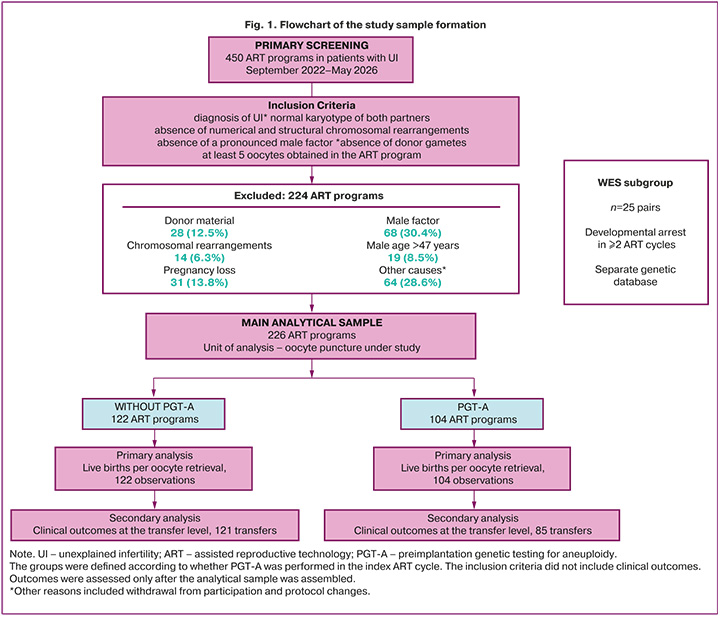
The comparison groups were defined according to whether PGT-A was performed in the index ART cycle: a non-PGT-A group and a PGT-A group. UI is not regarded as an independent formal indication for PGT-A; in real-world clinical practice, the decision to perform PGT-A is often made on an individual basis, considering the patient's age, reproductive history, and number of previous ART cycles.
Baseline comparability between groups was assessed using clinical, anamnestic, laboratory, and embryologic characteristics that were potentially associated with both PGT-A use and reproductive outcomes. Trophectoderm biopsy is performed at the blastocyst stage, after the number of oocytes, zygotes, and blastocysts has already been determined; therefore, the comparison of embryologic parameters between groups is independent of whether a biopsy was performed.
The inclusion criteria were as follows: diagnosis of UI, normal parental karyotypes without structural rearrangements, absence of severe male factor infertility, absence of donor oocytes, sperm, or embryos, and retrieval of at least five oocytes per cycle. An additional criterion for the whole-exome sequencing (WES) group (n=25) was recurrent developmental arrest in ≥2 ART cycles in the absence of other identifiable causes, including chromosomal abnormalities (normal karyotype, no rearrangements in either partner), male factor infertility, or laboratory/technical factors (a single standardized culture protocol).
The WES subgroup (n=25) and the main cohort (n=226) were derived from different sources. The unit of analysis in the main cohort was oocyte retrieval. The WES subgroup was identified from a separate laboratory database based on referrals for medical genetic counseling after developmental arrest in ≥2 cycles.
The exclusion criteria were as follows: use of donor material, severe male factor infertility, a history of recurrent pregnancy loss (≥2 clinical miscarriages), and male partner age older than 47 years (Figure 1). The upper age limit for male partners (47 years) was a pre-specified criterion established before patient enrollment began. This threshold reflects an extension of the conventional literature definition of advanced paternal age (40–45 years), which has been associated with sperm DNA fragmentation and an increased risk of de novo mutations and sperm aneuploidy [16, 17].
The clinical and anamnestic characteristics analyzed included patient age, body mass index, duration and type of infertility, ovarian reserve parameters, number of previous in vitro fertilization (IVF) attempts, history of pregnancy loss, ovarian stimulation protocol, and fertilization method. The number of previous IVF attempts was calculated as the ordinal number of the current attempt minus one.
The embryologic parameters included the number of oocytes retrieved, number of mature oocytes, number of normally fertilized zygotes, number of blastocysts suitable for biopsy or cryopreservation, and morphologic characteristics of the transferred blastocysts.
The primary clinical outcome was live birth following index oocyte retrieval, defined as the birth of a live infant after any embryo transfer (fresh or thawed) derived from that retrieval. A single binary outcome (yes/no) was recorded for each ART cycle in the study. The cumulative live birth rate per retrieval was calculated as the percentage of cycles with a positive outcome within each group, representing the group-level expression of this binary variable.
Secondary outcomes included performance of at least one embryo transfer from the index oocyte retrieval, clinical pregnancy rate per transfer, pregnancy rate at ≥12 weeks of gestation per transfer, and pregnancy loss rate among clinical pregnancies achieved.
No a priori sample size calculation was performed because of the retrospective design of the study. All patients who met the inclusion and exclusion criteria during the study period were included in the analysis.
Fertilization and embryo culture were performed according to standard laboratory protocols. Embryo development was subsequently monitored until the blastocyst stage. Blastocysts were graded according to the degree of expansion and morphological characteristics of the inner cell mass and trophectoderm using Gardner's criteria.
In the PGT-A group, biopsies were performed on blastocysts that had reached a developmental stage suitable for genetic testing. Trophectoderm biopsy was performed on days 5 or 6 of embryonic development. A laser was used to create a local opening in the zona pellucida, through which several trophectoderm cells were removed. The inner cell mass was not disturbed during this process. The biopsied material was transferred to a tube for subsequent molecular analyses. Following biopsy, blastocysts were cryopreserved by vitrification pending PGT-A results.
PGT-A was performed using next-generation sequencing (NGS). After whole-genome amplification (WGA) of trophectoderm cell DNA and library preparation with the AneuPGT kit (DNA-Technology LLC, Russia) for WGA and NGS library preparation, numerical chromosomal abnormalities were assessed using the SeqVario platform (DNA-Technology LLC). Based on the PGT-A results, embryos were classified as euploid, aneuploid, mosaic, or non-informative. To evaluate age-related trends in chromosomal status, PGT-A results were analyzed by maternal age group: ≤35, 36–38, 39–40, and 41–42 years.
Whole-exome sequencing (WES) was performed in the group with recurrent early embryonic developmental arrest. Biological material (blood) was collected in EDTA tubes, and DNA was extracted using PROBA-NK MAX kits (DNA-Technology) according to the manufacturer's protocol. Libraries were prepared using a whole-genome library preparation kit (DNA-Technology), and target enrichment was performed using the VAHTS Target Capture Core Exome Panel kit (Vazyme). The enriched fragments were sequenced using a NovaSeq 6000 platform. Sequencing data were processed using a pipeline that included alignment of reads to the hg38 reference genome, variant calling, and quality-based filtering of variants. All variants passing quality filtering were annotated using the Ensembl Variant Effect Predictor (VEP), and pathogenicity prediction was performed using several algorithms (SIFT, PolyPhen-2, SpliceAI). Population allele frequencies were assessed using the Genome Aggregation Database (gnomAD). The clinical relevance of the identified variants was evaluated using the OMIM, ClinVar, and LOVD databases, other specialized databases where available, and the published literature. Biological samples were stored in the biospecimen collection and storage laboratory (biobank) of V.I. Kulakov National Medical Research Center for Obstetrics, Gynecology and Perinatology. Variant interpretation followed the American College of Medical Genetics and Genomics (ACMG) recommendations for assessing clinical significance. Variants were not confirmed by Sanger sequencing (see Discussion and Limitations).
Statistical analysis
Statistical analysis was performed using IBM SPSS Statistics, version 27.0. The normality of continuous variables was assessed using the Shapiro–Wilk test. Continuous variables are presented as mean (SD) or median [Q1; Q3], depending on their distribution, and categorical variables as n/N (%). Continuous variables were compared using Student's t-test or the Mann–Whitney U test, with Welch's correction applied in cases of unequal variances. Categorical variables were compared using Pearson’s χ² or Fisher's exact test, as appropriate. For the four binary clinical outcomes, relative risk (RR) with 95% confidence intervals (95% CI) was calculated; for continuous and multicategorical embryologic parameters, only p values are reported (see "Relative Risk and Odds Ratio" below). The primary analysis of clinical outcomes was conducted per each oocyte retrieval. Differences were considered statistically significant at p<0.05.
Sample size justification
No a priori sample size calculation was performed, as this study was based on a retrospective analysis of a continuous, consecutive sample comprising all patients who met the inclusion and exclusion criteria during a fixed enrollment period; therefore, the final sample size was determined by the number of available observations. As an approximate post hoc estimate of the sensitivity of the available sample, at a two-sided significance level of α=0.05 and an assumed power of 80%, the minimum detectable difference in the cumulative live birth rate between groups (n=122 and n=104) was approximately 19 percentage points relative to a baseline rate of ~56% (calculated for the comparison of two independent proportions). The observed difference (55.7% vs. 36.5%; 19.2 percentage points) was close to this threshold, indicating a limited power to detect smaller differences. Rarer secondary outcomes, such as clinical pregnancy loss, may have gone undetected owing to the even lower statistical power. This limited, non-prespecified sample size is acknowledged as a study limitation.
Primary and secondary clinical outcomes
The primary clinical outcome was a live birth following index oocyte retrieval. For each ART cycle, corresponding to a single oocyte retrieval, a single binary outcome was recorded: whether at least one live birth occurred following the transfer of embryos derived from that retrieval, including subsequent frozen embryo transfers (yes/no). The cumulative live birth rate per retrieval represents the proportion of ART cycles with a "yes" outcome within each group; this is the same variable expressed at two levels: the individual level (yes/no, the dependent variable in the regression model) and the group level (percentage). Neither the logistic regression nor the term "cumulative rate" implies a separate event rate or per-cycle intensity model: in all analyses, the unit of analysis is a single ART cycle (oocyte retrieval) with one binary outcome per unit, and the cumulative rate is the proportion of positive outcomes among these units within a group. Secondary outcomes included the performance of at least one embryo transfer from the index oocyte retrieval, clinical pregnancy rate per transfer, pregnancy rate at ≥12 weeks' gestation per transfer, and pregnancy loss rate among clinical pregnancies.
Relative risk and odds ratio
Continuous embryologic parameters (number of oocytes, blastocysts, etc.) were compared using Student's t-test or the Mann–Whitney U test, and categorical variables with more than two levels (e.g., fertilization method) were compared using the Pearson χ² test. For these comparisons, Table 2 reports only p-values, with no relative risk calculated (indicated by a dash in the RR column). Relative risk (RR) with 95% confidence intervals (95% CI) was calculated separately for the four binary clinical outcomes – clinical pregnancy, pregnancy at ≥12 weeks, clinical pregnancy loss, and live birth (whose cumulative rate was calculated as the proportion of positive outcomes within each group; Table 2, "Clinical Outcomes" section). The odds ratio (OR) was derived from a multivariable regression model for live births (Table 2, Part B). RR and OR are not equivalent when outcomes are common (>10%) and should not be directly compared. RR was used as the primary effect measure for unadjusted between-group comparisons of clinical outcomes, as it allows for direct, substantively interpretable statements (e.g., "the risk of the outcome in the PGT-A group was X-fold lower/higher"). The OR was used exclusively as the output of the multivariable model, since logistic regression mathematically yields an odds ratio rather than a relative risk; it was not intended to compete with or substitute for RR as the primary effect measure.
Multivariable regression model
A multivariable logistic regression model was constructed to assess the association between PGT-A use and live birth while accounting for baseline differences between groups. For each ART cycle, a single value was entered into the model: whether at least one live birth had resulted from oocyte retrieval (yes/no). The cumulative live birth rate represents the proportion of oocyte retrievals with a "yes" outcome within each group; in other words, the regression model and the group-level percentages describe the same variable at two levels – the individual level (yes/no for each retrieval, the model's dependent variable) and the group level (percentage). The primary independent variable was PGT-A use (reference category: no PGT-A use).
Covariates for adjustment – patient age, number of previous IVF attempts, and anti-Müllerian hormone (AMH) level – were selected a priori, before model construction, based on their established clinical relevance as predictors of ART outcomes and on the results of the between-group comparison (Table 1), in which these variables differed significantly between groups (p<0.001 for age and number of IVF attempts; p=0.735 for AMH) and could potentially act as confounders linked to both the decision to use PGT-A and the probability of live birth. The full distribution of all three covariates in the study sample, stratified by the comparison group, is presented in Table 1. The combined presentation of both groups in this table reflects the distribution of covariates across the entire analytical sample (n=226).

An automated variable-selection procedure (stepwise regression, including preliminary univariable screening followed by the inclusion of variables found statistically significant in the univariable analysis) was deliberately not used. Such an approach risks the erroneous inclusion or exclusion of correlated variables based on statistical significance, which does not necessarily reflect their true clinical role as confounders. Instead, we used a limited set of a priori, clinically justified covariates; given an adequate ratio of outcomes to predictors (106 live births across four model variables, approximately 27 events per predictor – well above the commonly accepted minimum threshold of ≥10 events per predictor), this approach provides a more reliable effect estimate than data-driven selection procedures. Therefore, adjustment for potential confounders was performed using all three prespecified covariates; no separate univariable predictor screening step was performed or planned.
The model took the following form: ln[p/(1-p)] = β0 + β1X1 + β2X2 + β3X3 + β4X4, where p is the probability of live birth following the index oocyte retrieval, X1 is PGT-A use, X2 is patient age, X3 is the number of previous IVF attempts, and X4 is AMH level.
The results are presented as β coefficients, standard errors (SE), Wald statistics, p-values, and adjusted odds ratios with 95% CI for each independent variable (Table 2, Part B). Collinearity was assessed using the variance-inflation factor. Model fit was evaluated using the Hosmer–Lemeshow test (calibration) and Nagelkerke R² (explained variance) tests. Discriminative ability was assessed using the area under the receiver operating characteristic curve (AUC) with a 95% CI, and calibration was illustrated using a calibration plot. The classification performance (sensitivity, specificity, positive and negative predictive values, and accuracy) was calculated using 2×2 contingency tables at the predicted probability threshold that maximized the Youden index (sensitivity + specificity − 1).

Results
The study groups differed in several baseline characteristics. Patients in the PGT-A group were older, were more likely aged ≥35 years (Fig. 2), and had undergone a greater number of previous IVF attempts, indicating baseline group imbalance; these factors were accounted for in the multivariable analysis.

The groups differed with respect to the fertilization method: conventional IVF was used in 58/122 (47.5%) patients in the non-PGT-A group and in 35/104 (33.7%) patients in the PGT-A group, whereas intracytoplasmic sperm injection (ICSI) was used in 41/122 (33.6%) and 58/104 (55.8%) patients, respectively.
The key difference between the groups occurred at the transition from the embryology stage to embryo transfer. In the PGT-A group, embryo transfer from the index cycle was performed less frequently than in the non-PGT-A group: 69/104 (66.3%) versus 120/122 (98.4%). In addition, the PGT-A group had fewer embryo transfers and fewer embryos transferred from the first cycle. These measures were considered intermediate indicators of assisted reproductive technology (ART) programme implementation, reflecting the effects of embryological and genetic selection, rather than independent clinical endpoints.
Among the morphological characteristics of transferred blastocysts, a significant difference was observed in the proportion of blastocysts graded ≥3BB, which was higher in the PGT-A group: 72/76 (94.7%) versus 89/107 (83.2%). No statistically significant between-group differences were identified in inner cell mass or trophectoderm characteristics.
When clinical outcomes were assessed among completed embryo transfers, the clinical pregnancy rate was lower in the PGT-A group: 51/85 (60.0%) versus 91/121 (75.2%); RR 0.80; 95% CI 0.65–0.98. The rate of pregnancy lasting ≥12 weeks was also numerically lower in the PGT-A group: 42/85 (49.4%) versus 74/118 (62.7%); however, the difference did not reach statistical significance. Clinical pregnancy loss did not differ significantly between the groups.
The cumulative live birth rate was lower in the PGT-A group: 38/104 (36.5%) versus 68/122 (55.7%); RR 0.66; 95% CI 0.49–0.88. Thus, despite embryo selection and a higher proportion of transferred blastocysts with a morphological grade of ≥3BB, the use of PGT-A in this sample was not associated with improved clinical outcomes per oocyte retrieval.
The multivariable logistic regression model included 226 observations. PGT-A use was associated with lower odds of live birth after the index oocyte retrieval: b=-0.693; adjusted odds ratio (aOR) 0.50; 95% CI 0.28–0.89; p=0.020. Maternal age was also associated with lower odds of live birth: b=-0.091; aOR 0.91; 95% CI 0.84–0.99; p=0.025. The number of previous IVF attempts and anti-Müllerian hormone (AMH) concentration were not significantly associated with live birth. No evidence of collinearity was identified among the included variables; the maximum variance inflation factor was 1.24. Model performance was acceptable: Hosmer–Lemeshow χ²=8.56; df=8; p=0.381; Nagelkerke R²=0.078. Model calibration is additionally presented graphically in Figure 3 (calibration plot). The area under the receiver operating characteristic curve (AUC) was 0.644 (95% CI 0.569–0.712), indicating limited discriminative ability. The complete coefficient table is presented in Table 2 (Part B), and the ROC curve and calibration plot are shown in Figure 3.

In the subgroup of 25 couples with recurrent early embryonic developmental arrest, rare genetic variants in genes associated with early embryogenesis or male-factor infertility were identified in 7/25 (28%) couples. No clinically relevant variants corresponding to the investigated embryological phenotype were identified in 16 couples.
Phenotypically relevant findings included variants in TBPL2, DNAH7, TLE6, STK33, DNHD1, and PADI6, as well as a duplication at the Xp22.13–p22.12 locus involving the ADGRG2 gene. Some variants represented premature stop codons or structural rearrangements; however, most findings were classified as variants of uncertain clinical significance, requiring cautious interpretation in the context of the couple’s phenotype.
All variants were interpreted according to the criteria of the American College of Medical Genetics and Genomics (ACMG). A detailed description of the findings is presented in Table 3.

The TLE6 c.927C>G variant (NM_001143986.2, p.Ile309Met) is registered in dbSNP as rs761252299; its frequency in gnomAD v4.1.0 is 2 alleles among 1,613,976 chromosomes, with no homozygotes reported. Pathogenicity predictions were discordant (CADD, 20.4; PolyPhen-2, 0.421; SIFT, deleterious; REVEL, benign). Homozygous TLE6 variants have been reported in oocyte and embryonic maturation arrest (OMIM:616814). The Xp22.13–p22.12 duplication (chrX:19002846–19569188, GRCh38, approximately 566 kb) affects four genes according to DECIPHER, including exons 1–24 of ADGRG2; rsIDs are not assigned to structural variants. Loss of function of ADGRG2 has been reported in X-linked congenital absence of the vas deferens (OMIM:300985); duplications of this size are absent from DGV Gold, gnomAD SV, and gnomAD CNV.
Discussion
This study aimed to evaluate the embryological and clinical outcomes of real-world PGT-A use in patients with UI, given that the available data for this patient category remain limited. Unlike conditions associated with an established genetic risk, recurrent pregnancy loss, or repeated implantation failure, UI is a diagnosis of exclusion and is not an approved formal indication for PGT-A. Nevertheless, in real-world clinical practice, the decision to perform PGT-A is often made on an individual basis in patients with failed ART cycles, advanced reproductive age, unfavorable reproductive history, or a perceived risk of having no transferable embryo. Therefore, a gap exists between the formal clinical indications and the actual use of PGT-A in patients with UI. This zone of clinical uncertainty provides a rationale for the present study.
According to the treatment protocol approved by the Ministry of Health of the Russian Federation, the formal indications for PGT-A are: ≥2 spontaneous miscarriages, ≥3 failed embryo transfers in women younger than 35 years (≥2 in women aged ≥ 35 years), and severe pathozoospermia. The extent to which the study population met these criteria is detailed below [15].
In our cohort, none of the included patients (0/226) had a history of ≥2 spontaneous miscarriages, which was an expected finding, as recurrent pregnancy loss was an exclusion criterion. The number of prior failed embryo transfers (as distinct from the total number of IVF attempts and the severity of partner pathozoospermia were not among the prespecified variables of this analysis; consequently, the proportion of patients who met these two criteria could not be determined from the available data. This represents a limitation of the analysis rather than a gap in the underlying medical record. We identified this as a study limitation and a direction for future research. More detailed documentation of reproductive history in subsequent studies would allow the effect of PGT-A to be assessed separately in subgroups of patients who do and do not meet the formal criteria, which would have practical value for individualizing the management of patients with UI.
Therefore, the interpretation of the results should consider the baseline patient age, number of prior IVF attempts, and likelihood of transfer cancellation in the absence of a euploid embryo.
Among patients with UI younger than 39 years who underwent PGT-A, approximately half of the biopsied embryos were euploid, whereas this proportion declined markedly after 39 years of age. These findings are consistent with the established effect of maternal age on embryonic chromosomal status and suggest that UI should not be regarded as an independent risk factor for increased embryonic aneuploidy [5, 18].
These findings underscore the heterogeneity of the UI. In some patients, the decline in the proportion of euploid embryos is age-dependent, whereas in other couples, impaired embryogenesis is associated with rare genetic variants that may affect early embryonic development. Notably, the principal quantitative measures of ovarian response and early embryonic development were comparable between the groups.
The lower cumulative live birth rate in the PGT-A group was likely attributable to a higher rate of transfer cancellation owing to the absence of euploid embryos. These data indicate that, in UI cases, the clinical benefit of PGT-A depends on patient age, number of blastocysts, and probability of obtaining a euploid embryo.
Kato et al. (2023) analyzed data from 7,668 patients who underwent IVF with or without PGT-A. The authors reported that the live birth rate per frozen blastocyst transfer was higher in the PGT-A group across all age groups; however, an increase in the cumulative live birth rate over the treatment period was observed only in patients aged 40–42 years. Thus, the effect of PGT-A depends on both age and the chosen outcome measure [19].
In a meta-analysis by Kasaven L.S. et al. (2023), the beneficial effect of PGT-A was more pronounced when outcomes were analyzed per embryo transfer, although the authors emphasized substantial heterogeneity among studies, including differences in patient populations and outcome measures [12].
In the present study, the rate of clinical pregnancy loss did not differ significantly between the groups. Given the limited sample size, this finding should be interpreted cautiously and should not be considered as standalone evidence that PGT-A has no effect on the risk of pregnancy loss.
Trophectoderm biopsy is an invasive procedure; however, current blastocyst-stage biopsy techniques are considered safe [19, 20]. Simultaneously, PGT-A increases treatment costs and may result in transfer cancellation when no euploid embryos are available. Therefore, the decision to perform PGT-A in patients with UI should be individualized, considering age, number of blastocysts, prior reproductive history, and the couple's clinical expectations.
Taken together, these findings do not support UI as an independent indication for PGT-A but highlight the need for further research to identify subgroups of patients with UI in whom PGT-A may be clinically justified.
WES performed in a subgroup of couples with UI and early embryonic developmental arrest confirmed the heterogeneity of the molecular mechanisms potentially underlying UI. The identified variants affected genes involved in key processes of embryogenesis: the subcortical maternal complex (TLE6, PADI6), early developmental transcription (TBPL2), dynein structure and function (DNAH7, DNHD1), and kinase signaling during spermatogenesis (STK33). Other variants in these genes have been previously reported to cause early embryonic developmental arrest or severe male infertility [8,21–23]. However, most variants identified in this study were heterozygous carrier states in genes associated with autosomal recessive reproductive disorders and were classified as having uncertain clinical significance. Further whole-genome, segregation, and functional studies are needed to confirm the association between these variants and impaired embryogenesis.
Limitations. This study has several limitations, including its retrospective design, single-center setting, baseline differences between groups, and a limited sample size that was not pre-specified but determined by the number of cases available during the study period. Patients in the planned PGT-A group were older and had undergone more prior IVF attempts, which could have influenced clinical pregnancy and live birth rates independently of PGT-A. In addition, the selection criteria excluded patients with formal indications for PGT-A, notably those with recurrent pregnancy loss; therefore, the results should not be extrapolated to this patient category.
A further limitation is the incompleteness of retrospective data on the fate of some embryos derived from the oocyte retrievals included in this study; a subset of observations was excluded from the analysis for this reason (Fig. 1), reflecting a gap in the available medical records rather than in the analytic approach. Similarly, the number of prior failed embryo transfers and the severity of partner pathozoospermia, two of the three formal criteria specified in the treatment protocol for PGT-A indications [15], were not collected as discrete variables in the retrospective database (Table 1) and therefore could not be quantified. The only formal criterion that could be assessed from the available data (recurrent pregnancy loss) was an exclusion criterion for the study; consequently, by design, formal compliance with the PGT-A indication criteria could not be documented for any of the 226 included patients (0/226). In other words, PGT-A was used outside the formal clinical indications in every case in this cohort, which raises questions about the clinical justification for its use in patients with UI and should be considered when interpreting the results presented here.
Additional limitations include the unequal distribution of fertilization methods (conventional IVF/intracytoplasmic sperm injection [ICSI]/split IVF-ICSI) between groups (p=0.003, Table 1), reflecting clinical indications; the fertilization method was not included as a covariate in the model. The variants listed in Table 3 were not verified by Sanger sequencing; their classification was based on next-generation sequencing (NGS) read depth, concordance among SIFT, PolyPhen-2, and SpliceAI predictions, and annotation in the OMIM, ClinVar, LOVD, and gnomAD databases.
Strengths. A key strength of this study is its analysis of the complete clinical pathway from oocyte retrieval to live birth. This approach is particularly important in UI, since assessing outcomes per embryo transfer alone may overestimate the benefit of PGT-A and fail to capture the clinically significant rate of transfer cancellation in the PGT-A group.
Conclusion
In this retrospective cohort study, the use of PGT-A in patients with UI was not associated with a higher cumulative live birth rate per oocyte retrieval, primarily because of the high rate of embryo transfer cancellation in the absence of euploid embryos. In women older than 39 years, PGT-A may provide useful information regarding embryological prognosis; however, the decision to perform testing should be individualized, considering the number of blastocysts obtained, maternal age, and reproductive history. Whole-exome sequencing identified rare genetic variants in 7 of 25 (28%) couples with recurrent embryonic developmental arrest, the majority of which were variants of uncertain significance (VUS) detected in the heterozygous state, precluding the assessment of their pathogenicity in the absence of a second variant in the same gene. These findings highlight the genetic heterogeneity of unexplained infertility and support the need for further molecular genetic investigations of embryogenesis disorders.
References
- World Health Organization. WHO laboratory manual for the examination and processing of human semen. 6th ed. Geneva: World Health Organization; 2021. 276 p.
- Romualdi D., Ata B., Bhattacharya S., Bosch E., Costello M., Gersak K. et al. Evidence-based guideline: unexplained infertility. Hum. Reprod. 2023; 38(10): 1881-90. https://dx.doi.org/10.1093/humrep/dead150
- Zegers-Hochschild F., Adamson G.D., Dyer S., Racowsky C., de Mouzon J., Sokol R. et al. The International glossary on infertility and fertility care, 2017. Hum. Reprod. 2017; 32(9): 1786-801. https://dx.doi.org/10.1093/humrep/dex234
- Министерство здравоохранения Российской Федерации. Клинические рекомендации. Женское бесплодие. 2024. [Ministry of Health of the Russian Federation. Clinical guidelines. Female infertility. 2024 (in Russian)].
- Orvieto R. The use of preimplantation genetic testing for aneuploidy: a committee opinion. Fertil. Steril. 2024; 122(3): 421-34. https://dx.doi.org/10.1016/j.fertnstert.2024.05.166
- Gardner D.K., Schoolcraft W.B. In vitro culture of human blastocysts. In: Jansen R., Mortimer D., eds. Towards reproductive certainty: fertility and genetics Beyond 1999. Carnforth: Parthenon Publishing; 1999: 378-88.
- Rubio C., Bellver J., Rodrigo L., Castillón G., Guillén A., Vidal C. et al. In vitro fertilization with preimplantation genetic diagnosis for aneuploidies in advanced maternal age: a randomized, controlled study. Fertility and Sterility. 2017; 107(5): 1122-9. https://dx.doi.org/10.1016/j.fertnstert.2017.03.011
- Maddirevula S., Awartani K., Coskun S., AlNaim L.F., Ibrahim N., Abdulwahab F. et al. A genomics approach to females with infertility and recurrent pregnancy loss. Hum. Genet. 2020; 139(5): 605-13. https://dx.doi.org/10.1007/s00439-020-02143-5
- Yan J., Qin Y., Zhao H., Sun Y., Gong F., Li R. et al. Live birth with or without preimplantation genetic testing for aneuploidy. N. Engl. J. Med. 2021; 385(22): 2047-58. https://dx.doi.org/10.1056/NEJMoa2103613
- Munné S., Kaplan B., Frattarelli J.L., Child T., Nakhuda G., Shamma F.N. et al. Preimplantation genetic testing for aneuploidy versus morphology as selection criteria for single frozen-thawed embryo transfer in good-prognosis patients: a multicenter randomized clinical trial. Fertil. Steril. 2019; 112(6): 1071-9. https://dx.doi.org/10.1016/j.fertnstert.2019.07.1346
- Cornelisse S., Zagers M., Kostova E., Fleischer K., van Wely M., Mastenbroek S. Preimplantation genetic testing for aneuploidies in in vitro fertilisation. Cochrane Database of Syst. Rev. 2020; 2020(9): CD005291. https://dx.doi.org/10.1002/14651858
- Kasaven L.S., Marcus D., Theodorou E., Jones B.P., Saso S., Naja R. et al. Does pre-implantation genetic testing for aneuploidy at the blastocyst stage improve live birth rate? A systematic review and meta-analysis. J. Assist. Reprod. Genet. 2023; 40(10): 2297-316. https://dx.doi.org/10.1007/s10815-023-02866-0
- Бачурин А.В., Киракосян Е.В., Назаренко Т.А., Павлович С.В. Анализ эмбриологического этапа программ экстракорпорального оплодотворения у пациентов с бесплодием неясного генеза. Акушерство и гинекология. 2022; 9: 81-6. https://dx.doi.org/10.18565/aig.2022.9.81-86 [Bachurin A.V., Kirakosyan E.V., Nazarenko N.A., Pavlovich S.V. Analysis of the embryonic stage of in vitro fertilization programs in patients with unexplained infertility. Obstetrics and Gynecology. 2022; (9): 81-6 (in Russian). https://dx.doi.org/10.18565/aig.2022.9.81-86].
- Wei Y., Wang J., Qu R., Zhang W., Tan Y., Sha Y. et al. Genetic mechanisms of fertilization failure and early embryonic arrest: a comprehensive review. Hum. Reprod. Update. 2024; 30(1): 48-80. https://dx.doi.org/10.1093/humupd/dmad026
- Вспомогательные репродуктивные технологии и искусственная инсеминация. Клинические рекомендации (протокол лечения). Утв. письмом Минздрава России от 05.03.2019 № 15-4/И/2-1908. Доступно по: https://legalacts.ru/doc/pismo-minzdrava-rossii-ot-05032019-n-15-4i2-1908-o-napravlenii/ [Assisted reproductive technologies and artificial insemination. Clinical guidelines (treatment protocol). Approved by the Letter of the Ministry of Health of Russia dated 05.03.2019 No. 15-4/I/2-1908. Available at: https://legalacts.ru/doc/pismo-minzdrava-rossii-ot-05032019-n-15-4i2-1908-o-napravlenii/ (in Russian)].
- Kong A., Frigge M.L., Masson G., Besenbacher S., Sulem P., Magnusson G. et al. Rate of de novo mutations and the importance of father's age to disease risk. Nature. 2012; 488(7412): 471-5. https://dx.doi.org/10.1038/nature11396
- Ethics Committee of the American Society for Reproductive Medicine. Assisted reproduction with advancing paternal and maternal age: an Ethics Committee opinion. Fertil. Steril. 2025; 123(6): 999-1005. https://dx.doi.org/10.1016/j.fertnstert.2025.03.031
- Buckett W., Sierra S. The management of unexplained infertility: an evidence-based guideline from the Canadian Fertility and Andrology Society. Reproductive BioMedicine Online. 2019; 39(4): 633-40. https://dx.doi.org/10.1016/j.rbmo.2019.05.023
- Kato K., Ezoe K., Onogi S., Ito S., Egawa R., Aoyama N. et al. Comparison of 1-year cumulative live birth and perinatal outcomes following single blastocyst transfer with or without preimplantation genetic testing for aneuploidy: a propensity score-matched study. J. Assist. Reprod. Genet. 2023; 40(11): 2669-80. https://dx.doi.org/10.1007/s10815-023-02926-5
- Li Y., Wen Q., Liao J., Ma S., Zhang S., Gu Y. et al. Trophectoderm biopsy differentially influences the level of serum β-human chorionic gonadotropin with different embryonic trophectoderm scores in early pregnancy from 7847 single-blastocyst transfer cycles. Front. Endocrinol. (Lausanne). 2022; 13: 794720. https://dx.doi.org/10.3389/fendo.2022.794720
- Alazami A.M., Awad S.M., Coskun S., Al-Hassan S., Hijazi H., Abdulwahab F.M. et al. TLE6 mutation causes the earliest known human embryonic lethality. Genome Biol. 2015; 16: 240. https://dx.doi.org/10.1186/s13059-015-0792-0
- Xu X., Sha Y.W., Mei L.B., Ji Z.Y., Qiu P.P., Ji H. et al. A familial study of twins with severe asthenozoospermia identified a homozygous SPAG17 mutation by whole-exome sequencing. Clinical Genetics. 2017; 93(2): 298-305. https://dx.doi.org/10.1111/cge.13059
- Ma H., Li T., Xie X., Jiang L., Ye J., Gong C. et al. Novel frameshift mutation in STK33 is associated with asthenozoospermia and multiple morphological abnormalities of the flagella. Hum. Mol. Genet. 2021; 30(21): 1977-84. https://dx.doi.org/10.1093/hmg/ddab165
Received 19.06.2026
Accepted 10.07.2026
About the Authors
Maria P. Ishchuk, PhD Student, F. Paulsen Research and Educational Center for ART with the Clinical Department, Academician V.I. Kulakov National Medical Research Center for Obstetrics, Gynecology and Perinatology, Ministry of Health of Russia, 117997, Russia, Moscow, Ac. Oparina str., 4, marumariyaish@gmail.com,https://orcid.org/0000-0002-9577-1777
Polina N. Tsabai, geneticist, M.D., Department of Clinical Genetics, Academician V.I. Kulakov National Medical Research Center for Obstetrics, Gynecology, and Perinatology, 117997, Russia, Moscow, Ac. Oparina str., 44, Ac. Oparina str., Moscow, Russia, 117997, p_tsabai@oparina4.ru, https://orcid.org/0000-0001-5110-0827
Svetlana G. Perminova, Dr. Med. Sci., Professor, Leading Researcher, F. Paulsen Research and Educational Center for ART with the Clinical Department, Academician V.I. Kulakov National Medical Research Center for Obstetrics, Gynecology and Perinatology, Ministry of Health of Russia, 117997, Russia, Moscow, Ac. Oparin str., 4,
s_perminova@oparina4.ru, https://orcid.org/0000-0003-4438-1354
Аlexey N. Ekimov, PhD, Head of the Laboratory of Preimplantation Genetic Testing and Genetic Diagnostics, Academician V.I. Kulakov National Medical Research Center for Obstetrics, Gynecology and Perinatology, Ministry of Health of Russia, 117997, Russia, Moscow, Ac. Oparin str., 4, a_ekimov@oparina4.ru,
https://orcid.org/0000-0001-5029-0462
Olga V. Ritcher, doctor of clinical laboratory diagnostics at the Laboratory of Preimplantation Genetic Testing and Genetic Diagnostics, Academician V.I. Kulakov National Medical Research Center for Obstetrics, Gynecology and Perinatology, Ministry of Health of Russia, 117997, Russia, Moscow, Ac. Oparin str., 4, o_ritcher@oparina4.ru
Irina S. Mukosey, Researcher at the Laboratory of Genomic Data Analysis, Academician V.I. Kulakov National Medical Research Center for Obstetrics, Gynecology and Perinatology, Ministry of Health of Russia, 117997, Russia, Moscow, Ac. Oparin str., 4, i_mukosei@oparina4.ru, https://orcid.org/0000-0002-2225-8366
Corresponding author: Maria P. Ishchuk, marumariyaish@gmail.com
Similar Articles