
Linguistic and cultural adaptation and validation of the Vulvar Quality of Life Index (VQLI) in patients with vulvar lichen sclerosus
Apolikhina I.A., Balashiva Kh.B., Bychkova A.E., Teterina T.A., Yarotskaya E.L., Saidova A.S.
Objective. Linguistic and cultural adaptation and validation of the Russian version of the Vulvar Quality of Life Index (VQLI) in patients with vulvar lichen sclerosus (VLS) as an effective tool for assessment of the quality of life and monitoring of treatment effectiveness.
Materials and methods. The study was carried out at V.I. Kulakov National Medical Research Center for Obstetrics, Gynecology and Perinatology of the Ministry of Health of Russia from 2024 to 2026. Adaptation of the Vulvar Quality of Life Index (VQLI) questionnaire was carried out using standard process of linguistic and cultural adaptation and included direct and reverse translation. The resulting interim version was tested on 20 female patients and subsequently refined based on the identified remarks. The main study included 120 patients with VLS. The survey was conducted twice using test-retest reliability with 14-day interval. Convergent validity was assessed based on relationship between the total VQLI score and the Female Sexual Function Index (FSFI)ю
Results. Based on statistical data analysis, the Russian version of VQLI demonstrated good internal consistency (Cronbach's alpha =0.822; 95% CI 0.77–0.87), high test-retest reliability of the total score (ICC=0.987; 95% CI 0.98–0.99), near perfect test-retest consistency of certain questionnaire items, based on Cohen's linearly weighted kappa (kappa >0.81), and high convergent validity. A strong inverse correlation was found between the total VQLI score and FSFI (rs=-0.888; p<0.001; 95% CI -0.92–-0.84).
Conclusion. The obtained results indicate that the Russian version of VQLI is a reliable and validated tool for assessment of the quality of life of patients with vulvar diseases, in particular, with VLS. The use of this tool is considered justified both in scientific research and clinical practice, including outcome monitoring in therapy.
Authors' contributions. Apolikhina I.A. – patient recruitment and examination, development of the concept and manuscript editing; Balashova Kh.B. – patient recruitment and examination, literature review, collection and analysis of literature sources, translation of the VQLI questionnaire into Russian and its adaptation, analysis of the results, manuscript preparing and writing; Bychkova A.E. – translation of the VQLI questionnaire into Russian and its adaptation, patient recruitment and examination, development of the concept and manuscript editing; Teterina T.A. – patient recruitment and examination, development of the concept and manuscript editing; Saidova A.S. – patient recruitment and examination, manuscript editing; Yarotskaya E.L. – translation of the VQLI questionnaire into Russian and its adaptation, manuscript editing.
Conflicts of interest. The authors confirm that they have no conflicts of interest to declare.
Funding. The authors received no funding for this study.
Generative Artificial Intelligence. No generative AI was used in preparing this article.
Patient Consent for Publication. All patients have signed informed consent for participation in the study and publication of the obtained data.
Authors' Data Sharing Statement. The data supporting the findings of this study are available on request from the corresponding author after approval from the principal investigator.
For citation: Apolikhina I.A., Balashiva Kh.B., Bychkova A.E., Teterina T.A., Yarotskaya E.L., Saidova A.S.
Linguistic and cultural adaptation and validation of the Vulvar Quality of Life Index (VQLI) in patients with vulvar lichen sclerosus.
Akusherstvo i Ginekologiya/Obstetrics and Gynecology. 2026; (10): 100-109 (in Russian)
https://dx.doi.org/10.18565/aig.2026.142
Keywords
vulvar lichen sclerosus
vulvar diseases
quality of life
VQLI
validation
linguistic adaptation
cultural adaptation
questionnaire
FSFI
Vulvar diseases have a significant impact on patients’ quality of life, affecting physical activity, the psycho-emotional state, and sexual function. A number of universal tools, such as DLQI, Skindex-29, Skindex-15, and DQLS have been developed in dermatology to assess quality of life. However, they do not take into account specific characteristics of certain disorders. Due to this, specialized questionnaires (VIN-Q, FACT-V, SVQ) have been proposed for certain diseases, including vulvar cancer (VIN-Q, FACT-V, SVQ), as well as the questionnaires for sexual function assessment (FSDS, FSFI, SexFS). However, these tools do not provide a comprehensive assessment of quality of life in patients with vulvar diseases [1–4].
Assessment scales (for example, AVLSSS and CLISSCO) are used for evaluation of clinical manifestations and symptoms of vulvar lichen sclerosus (VLS), that improves reproducibility of the disease severity assessment. However, some clinical signs, such as hyperkeratosis, lichenification, and sclerosus are characterized by low inter-expert reproducibility, that limits their use in standardized scales, despite the widespread use of these scales in clinical practice [5, 6].
Some studies on sexual dysfunction in patients with VLS reported the lack of consensus regarding the unified tool for assessment of the impact of the disease on sexual function, that is also typical for other vulvar diseases [7, 8]. In 2023, the Delphi consensus identified the following three key parameters for outcome assessment in VLS: clinical (visual) signs, symptoms and disease-specific quality of life indicators [9]. The review by Simpson R.C. et al. including 28 randomized clinical trials reported that the effectiveness of therapeutic interventions in 25 trials was evaluated using 49 different scales for assessment of the same parameters. At the same time, the primary outcome was clearly defined only in 21% of trials, that suggested low standardization of indicators and significant variability of the used tools. Patient-oriented dominant indicators included reduced pain and subjective improvement of symptoms [10]. A systematic review including 35 publications and 26 different tools for assessment of VLS manifestations demonstrated that 8 scales were used more than once, that also confirms the marked heterogeneity of the used methods [8].
Thus, disease severity cannot be adequately determined based exclusively on visual assessment and requires taking into account the symptoms and quality of life indicators. Currently, there is no a unified validated tool for comprehensive assessment of the impact of VLS and other vulvar diseases on quality of life. This emphasizes the need to develop and validate standardized questionnaires.
The Vulvar Quality of Life Index (VQLI) questionnaire is a specialized tool for assessment of quality of life in patients with vulvar diseases. It was developed in 2020 by Saunderson R.B. et al. and published in Australasian Journal of Dermatology. VQLI reflects the development of previously proposed approaches to assessment of quality of life in women with vulvar pathology, including the Vulval Disease Quality of Life Index (VDQLI) developed by Harris V. et al. Creation of the VQLI was necessitated by the need for standardized evaluation of patient-oriented outcomes taking into account specific symptoms and the impact of vulvar pathology on quality of life [11].
The VQLI questionnaire is used both in clinical practice and scientific research to quantitatively assess the impact of vulvar diseases on different aspects of patient’s lives. It helps assess the dynamics of a patient’s condition during treatment and compare the results between different patient groups. The VQLI includes 15 questions and encompasses the key domains of quality of life, such as symptom severity (itching, pain, burning), daily activities, emotional state, and sexual function.
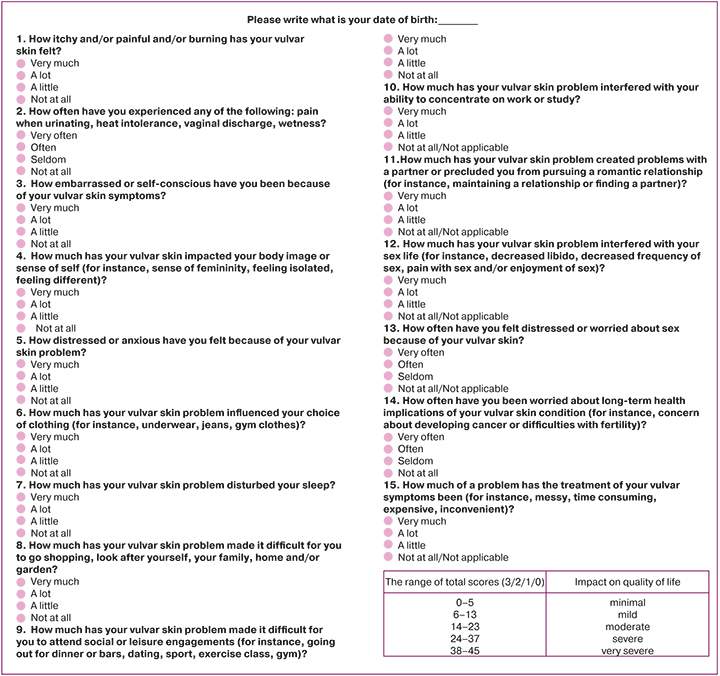
Each question is graded on a 4-point scale from 0 to 3, where “0” indicates absence of the disease impact on the given aspect of life, and “3” indicates a severe negative impact. The total score is calculated by summing the responses to all questions and ranges from 0 to 45. Higher scores reflect a marked decline in quality of life. Interpretation of the total score is categorized as follows: 0–5 indicates minimal impact, 6–13 mild impact, 14–23 moderate impact, 24–37 severe impact, and 38–45 – very severe impact on quality of life [11].
In the international literature, the VQLI questionnaire is used in a number of clinical studies including assessment of quality of life in patients with VLS and other inflammatory vulvar diseases, as well as in clinical intervention studies [12–15]. In domestic literature, there are some studies that used the VQLI questionnaire. However, its application is limited, and there is no the official Russian version of this questionnaire with linguistic and cultural adaptation. [16, 17].
Due to this, the objective of this study was linguistic and cultural adaptation and validation of the Russian version of the Vulvar Quality of Life Index (VQLI) among patients with VLS.
Materials and methods
The study was carried out at V.I. Kulakov National Medical Research Center for Obstetrics, Gynecology and Perinatology of the Ministry of Health of Russia from 2024 to 2026.
Linguistic and cultural adaptation of the VQLI questionnaire was performed using generally accepted methodology for quality of life assessment tools, including an appropriate translation, expert reconciliation of the wordings and preliminary testing on the target group of patients. Adaptation process involved two steps. Step 1 was translation of the original version of the questionnaire into Russian taking into account linguistic and cultural features. Step 2 was pilot testing of preliminary version of the tool. Further, the wordings were refined based on the participants’ remarks and expert assessment. After that, the final version of the questionnaire was used in the main study with subsequent statistical processing and assessment of psychometric characteristics. This step-by-step approach corresponds to the current methodology for linguistic and cultural adaptation of quality-of-life questionnaires [18–21]. In particular, in a study devoted to validation of the Russian-language version of the questionnaire to assess quality of life in patients with peripheral polyneuropathy, the adaptation and validation process was conducted in four sequential steps including translation of the tool, its cultural adaptation, pilot testing, and subsequent psychometric assessment [22].
The main group included 120 patients with clinical manifestations of VLS, who sought care at the Department of Aesthetic Gynecology and Rehabilitation, V.I. Kulakov National Medical Research Center for Obstetrics, Gynecology and Perinatology of the Ministry of Health of Russia from September, 2024 to January, 2026. The sample was formed by consecutive enrollment of patients who met the established inclusion and non-inclusion criteria. All participants signed informed consent forms. To assess reproducibility (test-retest reliability), the questionnaire was completed twice with a 14-day interval. This time frame was selected to minimize the effect of recall in maintaining the relative clinical stability in patients' clinical condition.
Inclusion criteria in the study were women aged 18–49 years with clinically and/or morphologically confirmed VLS, who complained of at least one of the symptoms: itching, burning, vulvar pain, dyspareunia; the ability of women to understand and fill in the offered questionnaires; written voluntary informed consent to participate in the study.
Non-inclusion criteria were the following: pregnancy, breastfeeding, postmenopause, premature ovarian insufficiency, oncological diseases, acute infectious and inflammatory diseases, decompensated somatic diseases, sexually transmitted infections, HIV infection, viral hepatitis B and C, syphilis, as well as conditions preventing self-completion of the questionnaires; initiation of treatment of vulvar disease during the period between filling in the VQLI questionnaire for the first and second time; medical interventions that can significantly change the severity of the diseases symptoms and quality of life during the test-retest interval.
Statistical analysis
Statistical processing of the results was performed using Python 3 programming language in Visual Studio Code, and Python libraries Pandas, Pingouin, Statsmodels. Distribution of the quantitative indicators was tested using the Shapiro-Wilk test. The dependent samples were compared using the Wilcoxon test. The results are represented as Me (Q1; Q3), where Me is the median, Q1 and Q3 is the first and the third quartile, respectively. Also, the data are represented as M (SD), where M is the mean value, SD is standard deviation. Additionally, the minimal (Min) and maximal (Max) values of the indicators were determined. Assessment of the questionnaire included analysis of reliability, internal consistency, and convergent validity. Internal consistency of the VQLI questionnaire was assessed using Cronbach's alpha [the lower bound for 95% CI; the upper bound for 95% CI], reflecting the degree of intercorrelation between individual items of the questionnaire and their contribution to the common scale structure. The results were interpreted as follows: the values >0.70 – acceptable; >0.80 – good; >0.90 – excellent. Test-retest reliability of the VQLI questionnaire was assessed using the intraclass correlation coefficient (ICC) [the lower bound of 95% CI; the upper bound of 95% CI] based on the data obtained from completion of the VQLI questionnaire for the first time and for second time with a 14-day interval. The results were interpreted as follows: the values <0.50 – poor reliability; from 0.50 to 0.75 – moderate reliability: from 0.75 to 0.90 – good reliability; above 0.90 – excellent reliability, that allowed to assess test-retest reproducibility of the results [23]. Reproducibility of individual questionnaire items according to test-retest data was assessed using Cohen's linearly weighted kappa. The results were interpreted as follows: the values <0.00 – no agreement, 0.00–0.20 – none, 0.21–0.40 – weak, 0.41–0.60 – moderate (minimal sufficient level of agreement), 0.61–0.80 – strong /substantial, 0.81–1.00 – almost perfect [24].
Convergent validity was assessed using Spearman’s rank correlation coefficient based on relationship between the total VQLI and the Female Sexual Function Index (FSFI) scores. The values (according to the module) >0.70 were interpreted as strong, and <0.50 as weak.
Given that higher VQLI scores reflect a marked decrease in quality of life, while higher FSFI scores indicate better sexual function, statistically significant negative correlation was implied between the results of these questionnaires. The obtained data made it possible to assess the degree of consistency between the indicators of quality of life affected by vulvar pathology and the sexual function of the patients, that is an important component of comprehensive evaluation of the validity of the explored tool. The differences were considered statistically significant at p < 0.05.
Thus, statistical methods used in our study including analysis of internal consistency using Cronbach’s Alpha, assessment of test-retest reliability using the intraclass correlation coefficient (ICC) and Cohen's linearly weighted kappa, as well as determination of convergent validity using Spearman’s rank correlation coefficient conform to current approaches to validation of the questionnaires and enables a comprehensive assessment of their reliability, reproducibility, and validity.
Results and discussion
Linguistic and cultural adaptation of the VQLI questionnaire
Direct translation and reconciliation of the wordings
Step 1 was independent direct adaptation of the original English-language version of the VQLI questionnaire in Russian. The translation was performed by a professional translator who is also a physician and has C1 Advance level of English, that ensured both linguistic accuracy and clinical relevancy of the wordings.
Back-translation and expert assessment
Back-translation of the preliminary Russian-language version into English was performed by independent specialists who were not involved in direct translation and were not familiarized with the original version of the questionnaire. The resulting version was then compared with the original version and analyzed during an expert discussion involving the authors of the study and the specialists who made the translation. No significant discrepancies between the meanings that could alter the content of individual questionnaire items were identified. Following the reconciliation, the final Russian-language version of the questionnaire was prepared, that conformed to the meaning of the original version and was adapted to the norms of the Russian language.
Pilot testing and finalization of the Russian-language version
To assess the clarity and accuracy of the wordings, pilot testing of the preliminary version was conducted on a sample of 20 female patients with clinical manifestations of the symptoms of VLS (itching, burning, dryness, dyspareunia). Based on the results of pilot testing, minor editorial clarifications were made. After that the final version of the VQLI questionnaire was approved and used in the main step of the study (Appendix).
Psychometric characteristics of the Russian-language version of the VQLI questionnaire
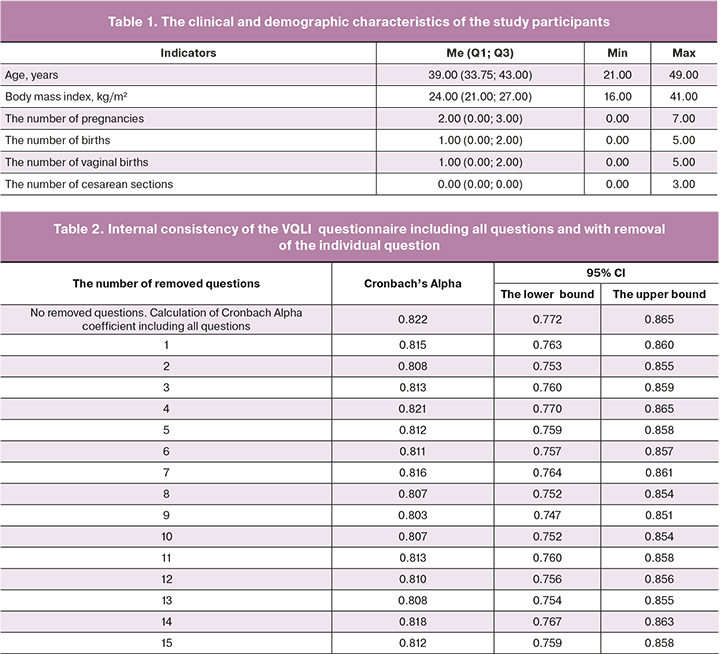
Psychometric assessment of the Russian-language version of the VQLI questionnaire was based on the indicators of internal consistency, test-retest reliability and convergent validity and involved 120 patients. The main clinical and demographic characteristics of the study participants are represented in Table 1.
Internal consistency
Internal consistency of the Russian-language version of the VQLI questionnaire was considered good. Cronbach's Alpha was equal to 0.822, that indicated a sufficient degree of homogeneity of the questionnaire items and their consistent focus on assessment of quality of life in patients with vulvar diseases.
Additionally, internal consistency was assessed by sequencial exclusion of each item of the questionnaire. In removing each of the question, the value of Cronbach’s Alpha did not exceed the overall value of 0.822. This indicated that there were no questions that reduced internal consistency of the scale and confirmed that each item contributed to the common scale structure of the questionnaire (Table 2).
Test-retest reliability
The mean VQLI total score was 20.98 (9.33) for the initial testing and 21.38 (9.44) for retesting. The median VQLI scores for testing and retesting were similar – 21.5, that indicated high reproducibility of the results. Total VQLI scores ranged from 3 to 40 for the initial testing, and from 4 to 41 for retesting. The mean total FSFI score was 21.79 (5.42) in the initial testing and 22.49 (5.50) in the repeated testing. The median values were 22.4 and 24.1, respectively. The obtained data reflect relative stability of the scores in the repeated testing (Table 3). Test-retest reliability of the questionnaire proved to be very high. The intraclass correlation coefficient (ICC) was 0.987, that indicated great stability of the results upon repeated completion of the questionnaire and high reproducibility of the tool.
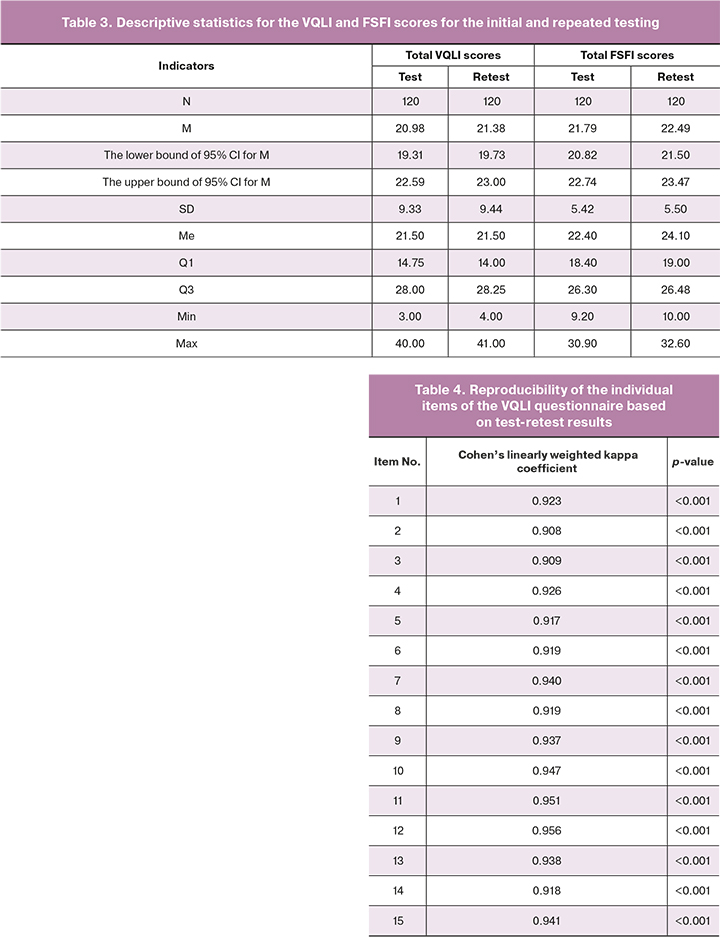
Analysis of the reproducibility of individual VQLI items showed that the values of Cohen’s weighted kappa coefficient for all questions exceeded 0.81, that corresponds to near-perfect agreement in test-retest results (Table 4).
Convergent validity
The FSFI questionnaire was used to assess convergent validity, since sexual function is an important part of quality of life in patients with vulvar diseases and is taken into account in the VQLI questionnaire. A strong reverse correlation was found between the total VQLI and FSFI scores – Spearman’s rank correlation coefficient (rs) was -0.888 (p<0.001). The obtained result indicates that a marked decline in quality of life assessed by the VQLI is associated with lower indicators of sexual function assessed by the FSFI. It should be noted that in reverse scoring of the FSFI scale correlation coefficient yields similar, but positive value, that additionally confirms strong relationship between the explored questionnaires.
Thus, validation results showed the Russian-language version of the VQLI questionnaire has good psychometric characteristics. The obtained values of Cronbach’s alpha coefficient indicate sufficient internal consistency of the scale, and high intraclass correlation coefficient. Cohen’s weighted kappa coefficient indicates high reproducibility of the results upon retesting. A marked correlation between the total VQLI and FSFI scores confirms high convergent validity of the tool.
Limitations. The limitation of the study is that the FSFI questionnaire is used as the only external tool for assessment of convergent validity.
Conclusion
The Russian-language version of the VQLI questionnaire successfully underwent linguistic and cultural adaptation and demonstrated satisfactory psychometric characteristics. High values of Cronbach’s alpha coefficient, the intraclass correlation coefficient, and Cohen’s linear weighted kappa coefficient, as well as a strong, statistically significant correlation with the FSFI scores confirm the reliability and validity of the tool. The VQLI questionnaire can be recommended for application in clinical practice and scientific research to provide a comprehensive assessment of the impact of vulvar diseases, in particular VLS, on patients' quality of life.
Appendix
The Vulvar Quality of Life Index (VQLI)
The aim of this questionnaire is to assess quality of life in women with vulvar diseases. Many women experience vulvar itching, burning, discomfort, and vulvar fissures. These symptoms can be mild, and can sometimes be severe.
Please answer the following question about the presence or absence of symptoms over the last month.
References
- Williams N., Wilson N., Fleay H., McElhinney B. Educational needs of patients with pre-cancerous vulval conditions: An audit and cross-sectional survey. Appl. Nurs Res. 2025; 83: 151951. https://dx.doi.org/10.1016/j.apnr.2025.151951
- Smith A.B., Muhammad N.I., Cigna S.T., Krapf J.M. A systematic review of sexual health consequences among women with lichen sclerosus. Sex. Med. Rev. 2023; 11(1): 8-14. https://dx.doi.org/10.1093/sxmrev/qeac002
- Vyas J., Johns J.R., Trivedi A., Ali F.M., Ingram J.R., Salek S. et al. Systematic review of the use of the Dermatology Life Quality Index in routine clinical practice: evidence from 287 articles across 56 countries. Clin. Exp. Dermatol. 2025; 50(12): 2456-65. https://dx.doi.org/10.1093/ced/llaf343
- Augustin M., Wenninger K., Amon U., Schroth M.J., Kuster W., Chren M. et al. German adaptation of the skindex-29 questionnaire on quality of life in dermatology: Validation and clinical results. Dermatology. 2004; 209(1): 14-20. https://dx.doi.org/10.1159/000078581
- Green N., Sheinis M., Selk A. Vulvar lichen sclerosus: outcomes important to patients in assessing disease severity. J. Low Genit. Tract Dis. 2020; 24(3): 299-304. https://dx.doi.org/10.1097/LGT.0000000000000547
- Erni B., Navarini A.A., Huang D., Schoetzau A., Kind A., Mueller S.M. Proposition of a severity scale for lichen sclerosus: The “Clinical Lichen Sclerosus Score”. Dermatol. Ther. 2021; 34(2): e14773. https://doi.org/10.1111/dth.14773
- Pope R., Lee M.H., Myers A., Song J., Abou Ghayda R., Kim J.Y. et al. Lichen sclerosus and sexual dysfunction: a systematic review and meta-analysis. J. Sex Med. 2022; 19(11): 1616-24. https://dx.doi.org/10.1016/j.jsxm.2022.07.011
- Morrel B., ten Kate-Booij M.J., van Dijk C., Bramer W.M., Burger C.W., Pasmans S.G.M.A. et al. Outcome measures in adult vulvar lichen sclerosus: a systematic review. J. Low Genit. Tract Dis. 2024; 28(3): 282-94. https://dx.doi.org/10.1097/LGT.0000000000000819
- Simpson R.C., Kirtschig G., Selk A., von Seitzberg S., Vittrup G., Bissonnette I. et al; the Core Outcomes for Research in Lichen Sclerosus (CORALS) initiative steering group. Core outcome domains for lichen sclerosus: A CORALS initiative consensus statement. Br. J. Dermatol. 2023; 188(5): 628-35. https://dx.doi.org/10.1093/bjd/ljac145
- Simpson R.C., Thomas K.S., Murphy R. Outcome measures for vulval skin conditions: A systematic review of randomized controlled trials. Br. J. Dermatol. 2013; 169(3): 494-501. https://dx.doi.org/10.1111/bjd.12391
- Saunderson R.B., Harris V., Yeh R., Mallitt K.A., Fischer G. Vulvar quality of life index (VQLI) – A simple tool to measure quality of life in patients with vulvar disease. Australas J. Dermatol. 2020; 61(2): 152-7. https://dx.doi.org/10.1111/ajd.13235
- Wijaya M., Lee G., Fischer G. Why do some patients with vulval lichen sclerosus on long-term topical corticosteroid treatment experience ongoing poor quality of life? Australas J. Dermatol. 2022; 63(4): 463-72. https://dx.doi.org/10.1111/ajd.13926
- Dinish U.S., Logan S., Balasundaram G., Xinhui V.T., Vinod Ram K., Ruochong Z. et al. Diffuse reflectance spectroscopy and imaging for non-invasive objective assessment of genitourinary syndrome of menopause: a pilot study. Sci. Rep. 2024; 14(1): 1085. https://dx.doi.org/10.1038/s41598-023-49655-4
- Pyle H.J., Evans J.C., Vandergriff T.W., Mauskar M.M. Vulvar lichen sclerosus clinical severity scales and histopathologic correlation: a case series. Am. J. Dermatopathol. 2023; 45(8): 588-92. https://dx.doi.org/10.1097/DAD.0000000000002471
- Kherlopian A., Fischer G. Comparing quality of life in women with vulvovaginal lichen planus treated with topical and systemic treatments using the vulvar quality of life index. Australas J. Dermatol. 2023; 64(2): e125-e134. https://dx.doi.org/10.1111/ajd.14032
- Колесникова Е.В., Жаров А.В., Мингалева Н.В., Пенжоян М.А. Комплексная противорецидивная терапия различных вариантов течения склеротического лихена вульвы. Гинекология. 2024; 26(2): 176-84. https://dx.doi.org/10.26442/20795696.2024.2.202663 [Kolesnikova E.V., Zharov A.V., Mingaleva N.V., Penzhoyan M.A. Complex anti-relapse therapy of various variants of the course of the vulvar lichen sclerosus: A randomized prospective study. Gynecology. 2024; 26(2): 176-84 (in Russian). https://dx.doi.org/10.26442/20795696.2024.2.202663].
- Чернова Н.И., Багаева М.И., Задорожная И.С., Кучеров В.А. Особенности течения и терапии склеротического лишая вульвы при папилломавирусной инфекции. Клиническая дерматология и венерология. 2020; 19(4): 483-8. https://dx.doi.org/10.17116/klinderma202019041483 [Chernova N.I., Bagaeva M.I., Zadorozhnaya I.S., Kucherov V.A. Features of the course and therapy of lichen sclerosus of the vulva with identified human papillomavirus infection. Russian Journal of Clinical Dermatology and Venereology. 2020; 19(4): 483-8 (in Russian). https://dx.doi.org/10.17116/klinderma202019041483].
- Аполихина И.А., Казакова С.Н., Яроцкая Е.Л., Горбунова Е.А., Бычкова А.Е. Языковая, культурная адаптация и валидация опросника вульвовагинальных симптомов среди пациенток с вульвовагинальной атрофией. Акушерство и гинекология. 2023; 10: 177-82. https://dx.doi.org/10.18565/aig.2023.228 [Apolikhina I.A., Kazakova S.N., Yarotskaya E.L., Gorbunova E.A., Bychkova A.E. Linguistic and cultural adaptation and validation of the questionnaire on vulvovaginal symptoms among the patients with vulvovaginal atrophy. Obstetrics and Gynecology. 2023; (10): 177-82 (in Russian). https://dx.doi.org/10.18565/aig.2023.228].
- Vincze A., Losonczi A., Stauder A. The validity of the diabetes self-management questionnaire (DSMQ) in Hungarian patients with type 2 diabetes. Health Qual. Life Outcomes. 2020; 18(1): 344. https://dx.doi.org/10.1186/s12955-020-01595-7
- Аполихина И.А., Тетерина Т.А., Арефьева О.А., Касян Г.Р., Кривобородов Г.Г., Ромих В.В., Миркин Я.Б., Фоменко О.Ю., Саидова А.С., Яроцкая Е.Л., Городнова Е.А., Пушкарь Д.Ю., Аполихин О.И., Гаджиева З.К., Коршунова Е.С., Филиппова Е.С., Кузьмин И.В., Шорников П.В. Языковая, культурная адаптация и валидация опросника OABSS (Overactive Bladder Symptom Score) среди пациентов с гиперактивным мочевым пузырем. Урология. 2023; (4): 31-9. https://dx.doi.org/10.18565/urology.2023.4.31-39 [Apolikhina I.A., Teterina T.A., Arefieva O.A., Kasyan G.R., Krivoborodov G.G., Romikh V.V., Mirkin Ya.B., Fomenko O.Yu., SaidovaA.S., Yarotskaya E.L., Gorodnova E.A., Pushkar D.Yu., Apolikhin O.I.,Gadzhieva Z.K., Korshunova E.S., Filippova E.S., Kuzmin I.V., Shornikov P.V. Language, cultural adaptation and validation of the OABSS (Overactive Bladder Symptom Score) questionnaire in patients with overactive bladder. Urologiia. 2023; 4: 31-9 (in Russian). https://dx.doi.org/10.18565/urology.2023.4.31-39].
- Сафонова Ю.А., Лесняк О.М., Баранова И.А., Сулейманова А.К., Зоткин Е.Г. Русский перевод и валидация SarQoL®-опросника качества жизни для пациентов с саркопенией. Научно-практическая ревматология. 2019; 57(1): 38-45. https://dx.doi.org/10.14412/1995-4484-2019-38-45 [Safonova Yu.A., Lesnyak O.M., Baranova I.A., Suleimanova A.K., Zotkin E.G. Russian translation and validation of SarQoL® – quality of life questionnaire for patients with sarcopenia. Rheumatology Science and Practice. 2019; 57(1): 38-45 (in Russian). https://dx.doi.org/10.14412/1995-4484-2019-38-45].
- Комелягина Е.Ю., Анциферов М.Б., Уварова О.М. Русскоязычная версия опросника для оценки качества жизни больных с периферической полинейропатией: валидация и перспективы применения. Сахарный диабет. 2014; 17(2): 56-65. https://dx.doi.org/10.14341/DM2014256-65 [Komelyagina E.Yu., Antsiferov M.B., Uvarova O.M. Validation and perspectives of the Russian version of the quality of life questionnaire in patients with diabetic peripheral polyneuropathy. Diabetes mellitus. 2014; 17(2): 56-65 (in Russian). https://dx.doi.org/10.14341/DM2014256-65].
- Koo T.K., Li M.Y. A Guideline of Selecting and Reporting Intraclass Correlation Coefficients for Reliability Research. J. Chiropr. Med. 2016; 15(2): 155-63. https://dx.doi.org/10.1016/j.jcm.2016.02.012
- Landis J.R., Koch G.G. The measurement of observer agreement for categorical data. Biometrics. 1977; 33(1): 159-74. https://dx.doi.org/10.2307/2529310
Received 27.04.2026
Accepted 08.09.2026
About the Authors
Inna A. Apolikhina, Dr. Med. Sci., Professor, Head of the Department of Aesthetic Gynecology and Rehabilitation, Professor at the Department of Obstetrics and Gynecology, Department of Vocational Education, V.I. Kulakov National Medical Research Center for Obstetrics, Gynecology and Perinatology, Ministry of Health of Russia, 117997, Russia, Moscow, Ac. Oparina str., 4; Professor at the Department of Obstetrics, Gynecology, Perinatology, and Reproductology, Institute of Professional Education,I.M. Sechenov First Moscow State Medical University, Ministry of Health of Russia (Sechenov University); President of the Association of Specialists in Aesthetic Gynecology (ASEG), apolikhina@inbox.ru, https://orcid.org/0000-0002-4581-6295
Khava B. Balashova, оbstetrician-gynecologist, postgraduate, V.I. Kulakov National Medical Research Center for Obstetrics, Gynecology and Perinatology,
Ministry of Health of Russia, 117997, Russia, Moscow, Ac. Oparina str., 4, +7(925)186-43-88, Hava199@mail.ru, https://orcid.org/0000-0003-3365-4695
Anastasia E. Bychkova, obstetrician-gynecologist, oncologist, Department of Aesthetic Gynecology and Rehabilitation, V.I. Kulakov National Medical Research Center for Obstetrics, Gynecology and Perinatology, Ministry of Health of Russia, 117997, Russia, Moscow, Ac. Oparina str., 4, a_bychkova@oparina4.ru,
https://orcid.org/0000-0003-4855-8188
Tatiana A. Teterina, PhD, obstetrician-gynecologist, USD, Department of Aesthetic Gynecology and Rehabilitation, V.I. Kulakov National Medical Research Center for Obstetrics, Gynecology and Perinatology, Ministry of Health of Russia, 117997, Russia, Moscow, Ac. Oparina str., 4; Expert at the Association of Specialists in Aesthetic Gynecology (ASEG), palpebra@inbox.ru, https://orcid.org/0000-0003-0990-2302
Ekaterina L. Yarotskaya, Dr. Med. Sci., Head of the Department of International Cooperation, V.I. Kulakov National Medical Research Center for Obstetrics, Gynecology and Perinatology, Ministry of Health of Russia, 117997, Russia, Moscow, Ac. Oparina str., 4, e_yarotskaya@oparina4.ru, https://orcid.org/0000-0003-4337-7644
Aina S. Saidova, PhD, obstetrician-gynecologist, Department of Aesthetic Gynecology and Rehabilitation, V.I. Kulakov National Medical Research Center for Obstetrics, Gynecology and Perinatology, Ministry of Health of Russia, 117997, Russia, Moscow, Ac. Oparina str., 4, a_saidova@oparina4.ru, https://orcid.org/0000-0003-3473-3109
Corresponding author: Khava B. Balashova, Hava199@mail.ru
Similar Articles