
Comparative evaluation of perinatal outcomes using different treatment strategies for management of gestational diabetes mellitus
Eszhanova A.A., Beketova M.A., Rizhaev Zh.A., Agababyan L.R.
Objective. To perform comparative analysis of perinatal outcomes in pregnant women with gestational diabetes mellitus (GDM) using different treatment strategies (nutrition therapy versus insulin therapy) and to identify the presence or absence of statistically significant differences depending on the time to start therapy.
Materials and methods. A retrospective cohort study was carried out in 2024–2025. The cohort for targeted therapy was comprised of 300 pregnant women with laboratory confirmed diagnosis of GDM. Based on treatment strategy, the patients were divided into 2 group. Group 1 (nutrition therapy) consisted of 180 patients, in whom carbohydrate metabolism compensation was achieved through nutrition therapy and physical exercise. Group 2 (insulin therapy) consisted of 120 patients, who were prescribed basal-bolus insulin regimen due to ineffectiveness of nutritional intervention. The following parameters were assessed: time to diagnosis and initiation of insulin therapy, mode of delivery, anthropometric data of newborns (weight, the presence of macrosomia), Apgar scores at 1 and 5 minutes, and the frequency of transferring newborns to NICU.
Results. It was found that therapy was initiated on average at 32.27±2.67 weeks of gestation. Cesarean delivery rate was high in both groups – 71.1% (128/180) in the group receiving nutrition therapy, and 64.2% (77/120) (p=0.335) in the group receiving insulin therapy. In the insulin therapy group, the newborns needed to be transferred to NICU significantly more often – 15/120 (12.5%) versus 10/180 (5.6%) in the nutrition therapy group (p=0.028). No statistically significant differences were found in the occurrence of macrosomia – 17/120 (14.2%) versus 25/180 (13.9%), and in Apgar scores.
Conclusion. High frequency of neonatal complications (transfer to NICU) was observed in the insulin therapy group, that was initiated in the third trimester of pregnancy, compared with the diet therapy group.
Authors' contributions. Eszhanova A.A. – the study concept, data collection and statistical data processing, manuscript writing; Beketova M.A. – scientific consulting, statistical data processing, manuscript writing; Rizhaev Zh.A. – managing the research process, choice of research methods, scientific editing; Agababyan L.R. – scientific consulting, validation of the results, final approval of the manuscript.
Conflicts of interest. The authors confirm that they have no conflict of interest to declare. Comparative analysis of the effectiveness of insulin medications was not funded by pharmaceutical companies.
Funding. The study was carried out at the Department of Obstetrics and Gynecology No.2, Astana Medical University, within the framework of a PhD dissertation without any external funding.
Ethical Approval. The study was approved by the local Ethics Committee of multidisciplinary city hospital No.2, Astana (protocol No. 5 of February 13, 2026).
Generative Artificial Intelligence. No generative AI was used in preparing this article.
Patient Consent for Publication. The patients have signed informed consent for publication of their data.
Authors' Data Sharing Statement. The data supporting the findings of this study are available on request from the corresponding author after approval from the principal investigator.
For citation: Eszhanova A.A., Beketova M.A., Rizhaev Zh.A., Agababyan L.R. Comparative evaluation of perinatal outcomes using different treatment strategies for management of gestational diabetes mellitus.
Akusherstvo i Ginekologiya/Obstetrics and Gynecology. 2026; (7): 66-71 (in Russian)
https://dx.doi.org/10.18565/aig.2026.65
Keywords
gestational diabetes mellitus
insulin therapy
diet therapy
macrosomia
neonatal outcomes
late therapy initiation
Gestational diabetes mellitus (GDM) remains one of the most significant problems in modern obstetrics. The prevalence of GDM is steadily increasing in parallel with obesity epidemic. According to the International Diabetes Federation (IDF), the prevalence of hyperglycemia during pregnancy reaches 16.7% in the global population [1]. The trend of prevalence of GDM also remains stable in the countries in Central Asia, that poses serious challenge to national healthcare systems [2]. Uncontrolled hyperglycemia increases the risk of complications, such as diabetic fetopathy, macrosomia (birth weight ≥ 4000 g), and causes a high risk of birth trauma (shoulder dystocia), as well as neonatal metabolic disorders requiring intensive care [3, 4].
According to current international and national clinical protocols, medical nutrition therapy (diet therapy) and physical activity is a first-line approach to treatment of GDM [5, 6]. Pharmacotherapy (primarily insulin therapy) is used as second-line therapy, when glycemic targets are not achieved with diet within 1–2 weeks or when the signs of diabetic fetopathy are detected by ultrasound [7].
However, in real clinical practice, insulin therapy is often less effective than expected. A number of recent studies have demonstrated the paradoxical phenomenon – in patient groups receiving insulin, the incidence of cesarean sections, macrosomia, and transfers to neonatal intensive care unit (NICU) is significantly higher than in groups receiving nutrition therapy [8]. We believe that this fact is related to the aspects of treatment strategy, in particular late start of therapy, but not low effectiveness of medication. Often, insulin is prescribed in the third trimester of pregnancy (after 30–32 weeks), when fetoplacental insufficiency has arisen and is irreversible [9]. In this situation, insulin becomes a control measure, that cannot completely eliminate cumulative risk [9].
The objective of the study was to perform comparative analysis of perinatal outcomes in pregnant women with GDM using nutrition therapy and insulin therapy and to assess the effectiveness of correction of metabolic disorders in real clinical practice characterized by late start of pharmacotherapy.
Materials and methods
Study design
A retrospective cohort study was conducted at the Obstetric Department of Multidisciplinaty City Hospital No. 2 (Astana, Kazakhstan) over the period from 2024 to 2025, in accordance with ethical principles for medical research adopted by the Declaration of Helsinki [10], and was approved by the local Ethics Committee (protocol No 5 of February 13, 2026).
Sample characteristics
The target cohort consisting of 300 pregnant women with laboratory confirmed diagnosis of gestational diabetes mellitus (ICD-10 code: O24.4) was selected from the general database (n=600). Based on treatment strategy, the patients were divided into 2 groups.
- Group 1 (Nutrition therapy) consisted of 180 patients (60%), in whom carbohydrate metabolism compensation was achieved through nutrition therapy and physical exercise.
- Group 2 (Insulin therapy) consisted of 120 patients (40%), who were prescribed basal-bolus insulin regimen due to ineffectiveness of nutritional intervention.
Inclusion criteria were the following: singleton pregnancy, the established diagnosis of GDM, giving birth at 37–41 weeks. GDM diagnosis was based on on generally accepted criteria (fasting venous plasma glucose ≥5.1 mmol/L or the results of 75 g oral glucose tolerance test: ≥10.0 mmol/L after 1 hour, and ≥8.5 mmol/L after 2 hours). The indication for basal-bolus insulin therapy in group 2 was failure to achieve glycemic targets (fasting glucose levels <5.1 mmol/L, and <7.0 mmol/L 1 hour after eating) against the backdrop of nutrition therapy within 1–2 weeks, or the signs of diabetic fetopathy detected by ultrasound. Human insulin medications or insulin analogues approved for clinical application in pregnancy were used, with daily doze titration using continuous glucose monitoring.
Exclusion criteria were pregestational diabetes mellitus (Type 1 and Type 2), multiple pregnancy, severe somatic pathology at the stage of decompensation, incomplete medical records.
Data analysis methods
The data was collected by copying information from medical forms No. 096/u (“Birth history”) and No. 097/u (“Newborn Development History”). The following parameters were evaluated: the timing of diagnosis and initiation of insulin therapy, mode of delivery, anthropometric measurements of newborns (weight, presence of macrosomia), the Apgar scores at 1 and 5 minutes, as well as the frequency of neonatal transfers to the NICU. The decision to transfer a newborn to the NICU was made by neonatologist solely based on objective clinical indications, such as respiratory distress syndrome requiring respiratory support (CPAP or mechanical ventilation), clinically significant hypoglycemia (blood glucose level <2.6 mmol/L, uncontrolled despite enteral feeding and requiring intravenous glucose infusion), as well as severe asphyxia. The fact of having GDM or the mother receiving insulin therapy was not the cause of neonatal transfer to the NICU.
Statistical analysis
Statistical analysis was performed using SPSS Statistics 26.0. The normality of distribution of the quantitative data was tested using the Kolmogorov–Smirnov test. The test showed non-normal distribution of data in the groups. Due to this, the non-parametric Mann–Whitney U test was used to compare two independent samples. The qualitative data (the frequency of complications, abs., %) were compared using Pearson’s chi-squared (χ2) test. The differences were considered statistically significant at p<0.05.
Results
Clinical and anamnestic characteristics of patients, analysis of the timing of diagnosis and therapy initiation
Analysis of initial clinical parameters of women was performed to assess the homogeneity of the groups (Table 1).
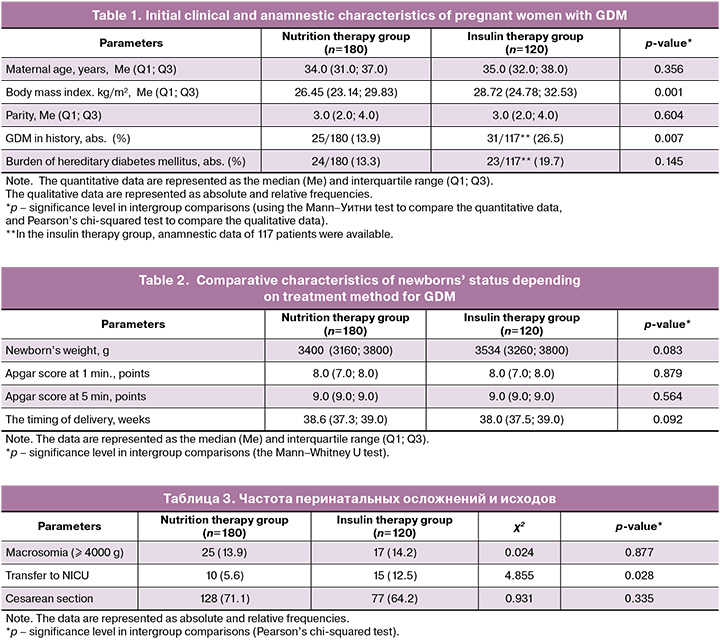
Analysis of medical documentation showed that in the studied cohort diagnostic tests for carbohydrate metabolism disorders were predominantly performed in the third trimester. Hyperglycemia and GDM were diagnosed on average at 32.27±2.67 weeks of gestation. In the insulin therapy group (n=120), treatment initiation was also delayed. The median length of insulin therapy up to childbirth was only 53.00 [28.00; 82.00] days, that indicated that the start of therapy was on average at 32–33 weeks of gestation. Late treatment initiation restricted the possibilities of metabolic correction of already existing diabetic fetopathy.
Anthropometric measurements of newborns
Comparative analysis of birth weight showed a trend toward higher birth weight in the insulin therapy group. However, the differences did not reach statistical significance. The median birth weight of infants born to mothers who were receiving insulin was 3534 (3260; 3800) g, whereas in the nutrition therapy group it was 3400 (3160; 3800) g (p=0.083). There was no statistically significant difference between the groups in the prevalence of macrosomia (birth weight ≥4000 g) (p=0.877). Large for gestational age infants were born to 25/180 (13.9%) women in the nutrition therapy group and 17/120 (14.2%) women in the insulin therapy group.
Newborns’ status and neonatal outcomes
Assessment of the functional state of newborns using the Apgar score found no statistically significant differences between the groups (Table 2).
The Apgar score of 7.66 at 1st minute was in the nutrition therapy group versus 7,65 in the insulin therapy group, p=0.879.
The Apgar score of 8.73 at 5th minute was in the nutrition therapy group versus 8.66 in the insulin therapy group, p=0.564.
However, the most important finding of the study was statistically significant difference in the frequency of severe neonatal complications (Table 3). The infants born to mothers who received insulin therapy required transfer to NICU significantly more often. The frequency of transfer to NICU was 12.5% (15/120), while in the nutrition therapy group it was 5.6% (10/180) (χ2=4.855, p=0.028). This confirms the hypothesis that the patients taking insulin initially had severe metabolic disorders, which could not be fully compensated due to the late start of treatment.
Mode of delivery
High frequency of cesarean section was in both groups, that is typical for patients with GDM. However, the type of diabetes treatment did not significantly influence this indicator. The frequency of cesarean section was 71.1% (128/180) in the nutrition therapy group and 64.2% (77/120) in the insulin therapy group (p=0.335).
Discussion
The findings of this study demonstrate a complex relationship between hyperglycemia correction methods and perinatal outcomes. We came across the clinical paradox – in the group of patients receiving intensive insulin therapy the frequency of neonatal transfer to the NICU was significantly higher (12.5%) versus the nutrition therapy group (5.6%).
Interpretation of the results
At first glance, this phenomenon might indicate insufficient effectiveness of insulin therapy. However, detailed analysis of time parameters allows us to interpret the data in a different way. The median time to detect carbohydrate metabolism disorders in our sample was 33.5 (30.0; 36.0) weeks. This means that the vast majority of patients in the insulin therapy group started treatment in the third trimester, when diabetic fetopathy had already developed.
It is known that maternal hyperglycemia in the second trimester (20–28 weeks) is a critical factor triggering fetal pancreatic beta cell hypertrophy and hyperinsulinemia, that blocks pulmonary surfactant maturation [3, 4]. Prescription of insulin after 32 weeks of gestation helps to keep blood sugar in the normal range in the mother, but is often late to prevent respiratory distress syndrome in the newborn, that explains high frequency of neonatal transfers to the NICU in this group of women.
Comparison with the nutrition therapy group
More favorable outcomes in the nutrition therapy group (lower weight of newborns, less need for intensive care) are apparently due to the fact that this sample included the women who initially had less severe metabolic disorders (GDM compensated by nutrition therapy). The patients who required insulin therapy initially had severe disease phenotype (resistance to non-pharmacological intervention, and severe hyperglycemia). Therefore, high frequency of transfers to the NICU in the insulin therapy group was conditioned by initial severity of the disease, that could not be timely compensated due to late start of therapy at 32–33 weeks of gestation, rather than the negative impact of the medication (confounding by indication).
Clinical significance
The data obtained in our study confirm the necessity to shift the focus from treatment “after-the-fact” to early prediction. If patients in the insulin therapy group had been identified as a high-risk group in the first trimester and had started therapy earlier, the outcomes could have been significantly better [9, 11]. We assume that high incidence of neonatal complications in the insulin therapy group was due to initially severe metabolic profile of these patients, that could not be compensated due to late treatment initiation, rather than negative impact of the medication. To confirm this hypothesis, further prospective research is required that will compare early and late start of insulin therapy.
Limitations of the study
This study had a number of limitations specific for a retrospective research. First, there was a systematic bias associated with confounding by indication. Initially, more severe course of GDM was in patients in the insulin therapy group, that was an independent risk factor for neonatal complications. Second, it was impossible to reliably assess patient compliance (strict adherence to diet and lifestyle modifications) at the outpatient stage of medical care before switching to insulin. Third, the study was limited by assessment of short-term perinatal outcomes without analyzing long-term developmental follow-up of children.
Conclusion
In real clinical practice, insulin therapy for GDM was often initiated at 32–33 weeks of gestation. Significantly high frequency of transfers to NICU was registered among infants born to mothers who received insulin therapy – 15/120 (12.5%) versus those who received nutrition therapy – 10/180 (5.6%) (p=0.028).
The incidence of neonatal complications was significantly higher (transfers to the NICU) in the group of patients who required insulin therapy, that reflected initially more severe GDM, resistant to nutrition management. It can be assumed that late start of pharmacotherapy (in the third trimester) does not allow to eliminate the accumulated metabolic risks for the fetus, that necessitates further research to evaluate the effectiveness of early insulin initiation.
References
- International Diabetes Federation. IDF Diabetes Atlas. 10th ed. Brussels: International Diabetes Federation; 2021. 54 p. Available at: https://diabetesatlas.org/idfawp/resource-files/2021/07/IDF_Atlas_10th_Edition_2021.pdf
- Комилова И.А., Шаймуродова М.У. Гестационный сахарный диабет: проблемы современного скрининга. IQRO INDEXING. 2024; 12(2): 177-80. [Komilova I.A., Shaimurodova M.U. Gestational diabetes mellitus: problems of modern screening. IQRO INDEXING. 2024; 12(2): 177-80 (in Russian)].
- Ye W., Luo C., Huang J., Li C., Liu Z., Liu F. Gestational diabetes mellitus and adverse pregnancy outcomes: systematic review and meta-analysis. BMJ. 2022; 377: e067946. https://dx.doi.org/10.1136/bmj-2021-067946
- Khan A.A., Javed S., Noreen S., Chaudhry M.R., Afridi S. Impact of gestational diabetes on neonatal birth weight and maternal postpartum metabolic changes. Cureus. 2025; 17(6): e86060. https://dx.doi.org/10.7759/cureus.86060
- Tsironikos G.I., Potamianos P., Zakynthinos G.E., Tsolaki V., Tatsioni A., Bargiota A. Effectiveness of lifestyle interventions during pregnancy on preventing gestational diabetes mellitus in high-risk women: a systematic review and meta-analyses of published RCTs. J. Clin. Med. 2023; 12(22): 7038. https://dx.doi.org/10.3390/jcm12227038
- Cheong L., Law L.S., Tan L.Y.L., Amal A.A., Khoo C.M., Eng P.C. Medical nutrition therapy for women with gestational diabetes: current practice and future perspectives. Nutrients. 2025; 17(7): 1210. https://dx.doi.org/10.3390/nu17071210
- American Diabetes Association Professional Practice Committee. 15. Management of diabetes in pregnancy: Standards of care in diabetes-2024. Diabetes Care. 2024; 47(Suppl. 1): S282-S294. https://dx.doi.org/10.2337/dc24-S015
- Radhakrishnan A., Surya B.N., Ethirajan S. Neonatal outcomes of gestational diabetes mellitus (GDM) mothers: a cross-sectional study comparing medical nutritional therapy, metformin, and insulin treatments at a tertiary care centre. Indian J. Obstet. Gynecol. Res. 2024; 11(3): 420-5. https://dx.doi.org/10.18231/j.ijogr.2024.076
- Simmons D., Immanuel J., Hague W.M., Teede H., Nolan C.J., Peek M.J. et al. Perinatal outcomes in early and late gestational diabetes mellitus after treatment at 24 to 28 weeks of gestation: secondary analysis of the TOBOGM Data. Diabetes Care. 2024; 47(12): 414-21. https://dx.doi.org/10.2337/dc23-1667
- World Medical Association. World Medical Association Declaration of Helsinki: Ethical Principles for Medical Research Involving Human Participants. JAMA. 2025; 333(1): 71-4. https://dx.doi.org/10.1001/jama.2024.21972
- Simmons D., Immanuel J., Hague W.M., Teede H., Nolan C.J., Peek M.J. et al. Treatment of gestational diabetes mellitus diagnosed early in pregnancy. N. Engl. J. Med. 2023; 388(23): 2132-44. https://dx.doi.org/10.1056/NEJMoa2214956
Received 24.02.2026
Accepted 26.06.2026
About the Authors
Aliya A. Eszhanova, Teaching Assistant at the Department of Obstetrics and Gynecology No. 2, NAO «Astana Medical University», 010000, Kazakhstan, Astana,Ryskulova str., 8, +77015476982, eszhanova.a@amu.kz, https://orcid.org/0009-0002-6770-390X
Makpal A. Beketova, Master of Science in Medicine, Teaching Assistant at the Department of Obstetrics and Gynecology No. 2, NAO «Astana Medical University»,
010000, Kazakhstan, Astana, Ryskulova str., 8, +7 771 371 0186, makpal.beketova0807@gmail.com, https://orcid.org/0000-0003-3014-0170
Jasur A. Rizaev, Dr. Med. Sci., Professor, Rector, Samarkand State Medical University, 140100, Uzbekistan, Samarkand, Amir Temur str., 18, +998954197899,
dr.jasur@gmail.com, https://orcid.org/0000-0001-5468-9403
Larisa R. Agababyan, PhD, Professor, Head of the Department of Obstetrics and Gynecology with the Course of Neonatology, Faculty of Postgraduate Education,
140100, Uzbekistan, Samarkand, Amir Temur str., 18, +998954197899, larisa_mct@yahoo.com, https://orcid.org/0000-0003-3011-6998
Corresponding author: Aliya A. Eszhanova, a.eszhanova@list.ru
Similar Articles